TSUMURA Research Laboratories, TSUMURA & CO, 3586 Yoshiwara, Ami-machi, Inashiki-gun, Ibaraki 300-1192, Japan.
BMC Complement Altern Med. 2012 Aug 9;12:118. doi: 10.1186/1472-6882-12-118.
TS-1 is an oral anticancer drug containing a 5-fluorouracil derivative (Tegafur) that is widely used in Japan for the treatment of cancer, especially gastrointestinal tumors. Frequently, however, TS-1 therapy has to be discontinued because of leukopenia. If it were possible to predict the development of bone marrow suppression before the white blood cell (WBC) count had actually decreased, treatment could be improved by strict dosage control and/or the prophylactic administration of hematopoietic drugs. Juzentaihoto (JTT), a traditional Japanese medicine (Kampo), has been reported to activate hematopoiesis and reduce the side effects associated with chemotherapy and radiotherapy. Here, we 1) evaluate the efficacy of JTT in alleviating myelosuppression induced by TS-1 therapy in mice, and 2) explore biomarkers that reflect both induction by TS-1 and alleviation by JTT of bone marrow suppression using a proteomics approach.
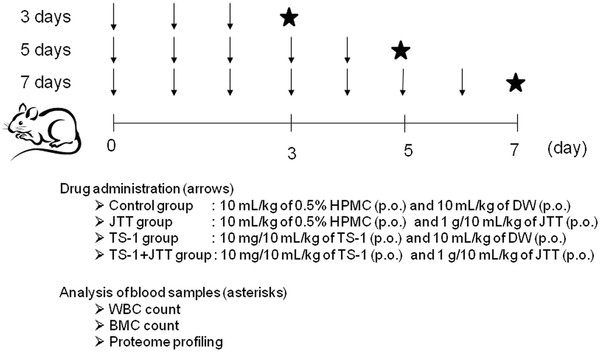
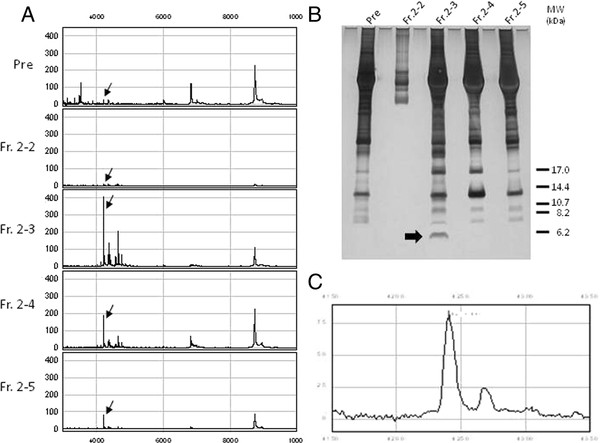
Ten mg/kg of TS-1 was administered to Balb/c mice with or without 1 g/kg of oral JTT for 3, 5 and 7 days. WBC count and ratio of CD34+ bone marrow cells (BMCs) were estimated by flow cytometry. Plasma samples were analyzed using surface-enhanced laser desorption/ionization time-of-flight mass spectrometry (SELDI TOF-MS). A biomarker candidate from SELDI profiling was identified using a combination of cation exchange spin column purification, SDS-PAGE, enzymatic digestion and LC-MS/MS.
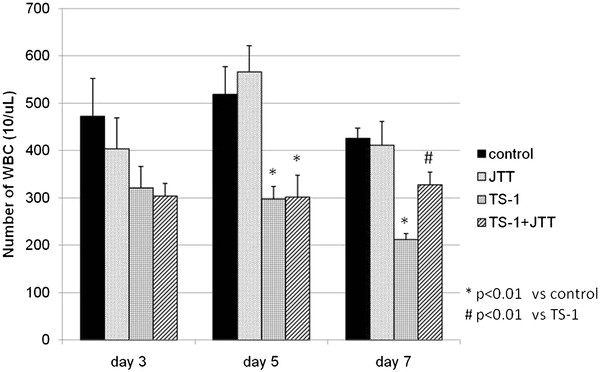
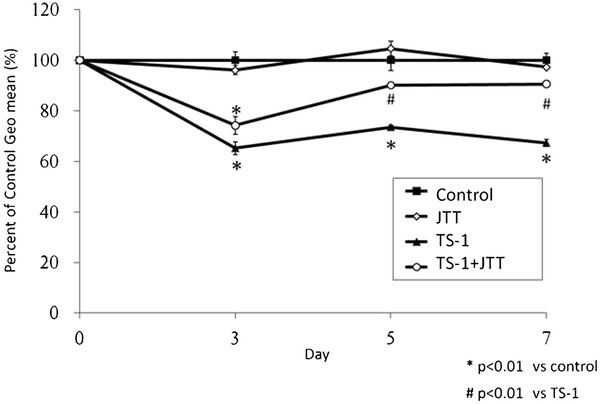
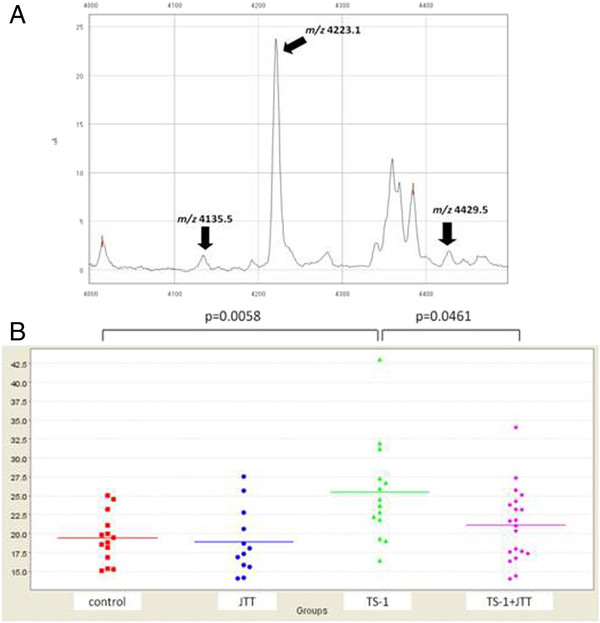
After administration of TS-1, a significant decrease in WBC count and CD34+ BMC ratio were observed at days 5 and 3, respectively. JTT treatment improved WBC count on day 7 and CD34+ BMC ratio on days 5 and 7. SELDI analysis highlighted three protein peaks that had increased on day 3 after treatment with TS-1 but remained unchanged in mice co-treated with JTT. One of the three peaks, m/z 4223.1, was further investigated and identified as a specific C-terminal fragment of albumin.
This study indicates that bone marrow suppression by treatment with TS-1 in mice might be improved by coadministration of JTT. A C-terminal fragment of albumin was identified as a candidate biomarker for predicting TS-1-induced myelosuppression. However, the sensitivity and specificity of the biomarker candidate must be validated in future clinical studies.
替加氟是一种广泛用于日本治疗癌症,特别是胃肠道肿瘤的口服抗癌药物。然而,替加氟治疗经常因白细胞减少而不得不停止。如果能够在白细胞计数实际下降之前预测骨髓抑制的发展,通过严格的剂量控制和/或预防性给予造血药物,就可以改善治疗。一种传统的日本药物(汉方药),即救心汤(JTT),已被报道可激活造血功能并减少与化疗和放疗相关的副作用。在这里,我们 1)评估 JTT 减轻替加氟治疗引起的骨髓抑制的疗效,2)使用蛋白质组学方法,探索反映替加氟诱导和 JTT 缓解骨髓抑制的生物标志物。
替加氟 10mg/kg 联合或不联合口服 JTT(1g/kg),连续 3、5、7 天,给予 Balb/c 小鼠。用流式细胞术估计白细胞计数和 CD34+骨髓细胞(BMC)的比例。用表面增强激光解吸/电离时间飞行质谱(SELDI TOF-MS)分析血浆样品。用阳离子交换柱纯化、SDS-PAGE、酶消化和 LC-MS/MS 相结合的方法,从 SELDI 图谱中鉴定出一个生物标志物候选物。
替加氟给药后,白细胞计数和 CD34+BMC 比例分别于第 5 天和第 3 天显著下降。JTT 治疗可改善第 7 天的白细胞计数和第 5 天和第 7 天的 CD34+BMC 比例。SELDI 分析突出了 3 个蛋白峰,在替加氟治疗后第 3 天增加,但在 JTT 联合治疗的小鼠中没有变化。这 3 个峰中的 1 个,m/z 4223.1,进一步被研究并鉴定为白蛋白的一个特异性 C 末端片段。
本研究表明,替加氟治疗小鼠的骨髓抑制可能通过联合 JTT 得到改善。白蛋白的 C 末端片段被鉴定为预测替加氟诱导的骨髓抑制的候选生物标志物。然而,该生物标志物候选物的灵敏度和特异性必须在未来的临床研究中得到验证。