CIBIO-UP, Centro de Investigação em Biodiversidade e Recursos Genéticos, Campus Agrário de Vairão, Universidade do Porto, Vairão, 4485-661, Portugal.
BMC Genet. 2012 Aug 15;13:72. doi: 10.1186/1471-2156-13-72.
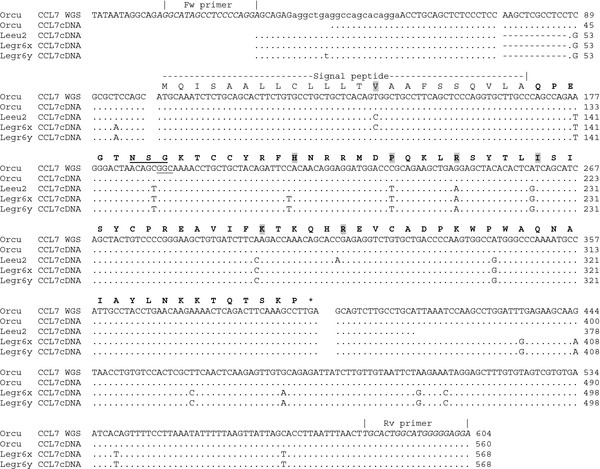
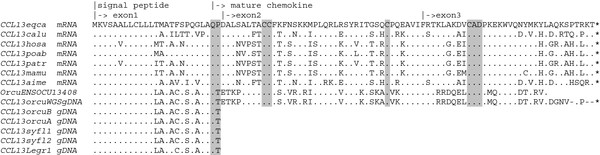
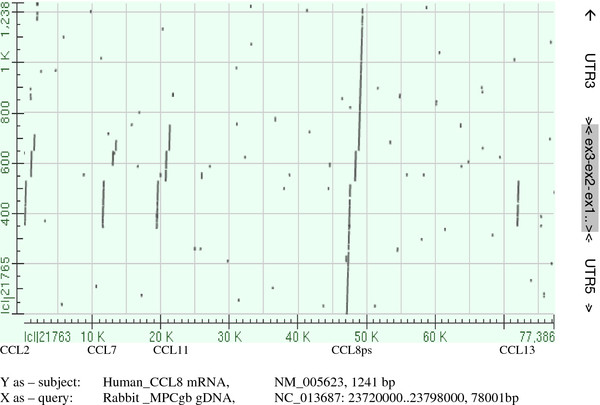
Recent studies in human have highlighted the importance of the monocyte chemotactic proteins (MCP) in leukocyte trafficking and their effects in inflammatory processes, tumor progression, and HIV-1 infection. In European rabbit (Oryctolagus cuniculus) one of the prime MCP targets, the chemokine receptor CCR5 underwent a unique structural alteration. Until now, no homologue of MCP-2/CCL8a, MCP-3/CCL7 or MCP-4/CCL13 genes have been reported for this species. This is interesting, because at least the first two genes are expressed in most, if not all, mammals studied, and appear to be implicated in a variety of important chemokine ligand-receptor interactions. By assessing the Rabbit Whole Genome Sequence (WGS) data we have searched for orthologs of the mammalian genes of the MCP-Eotaxin cluster.
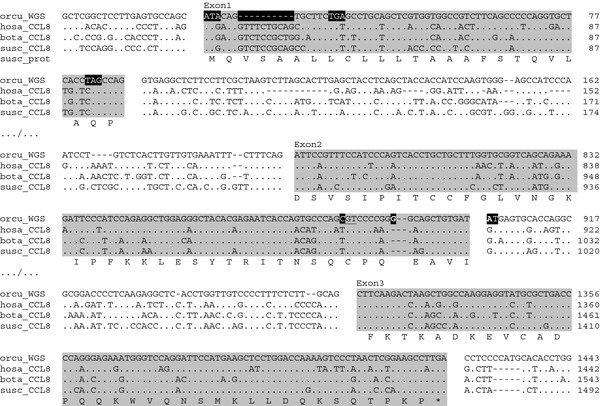
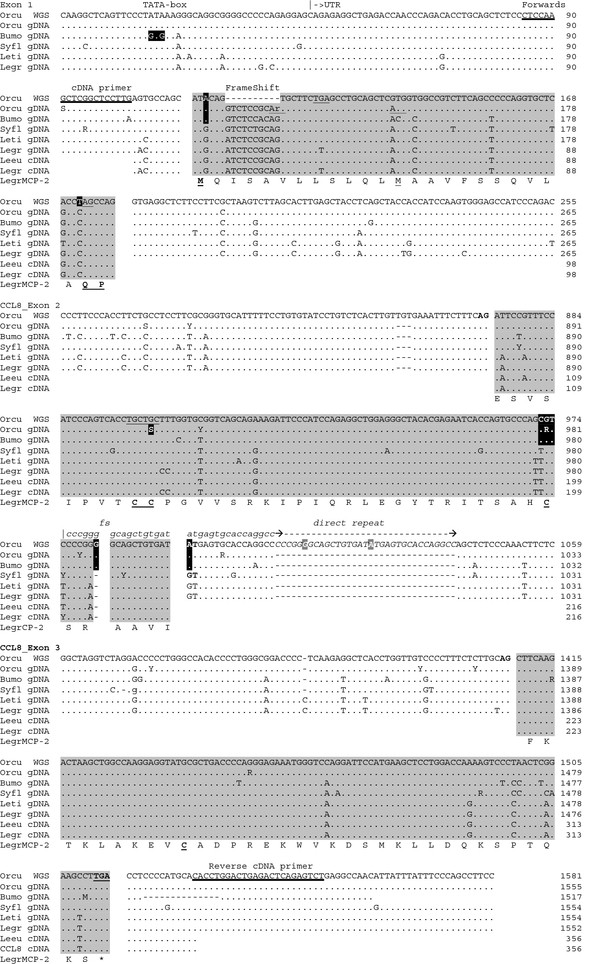
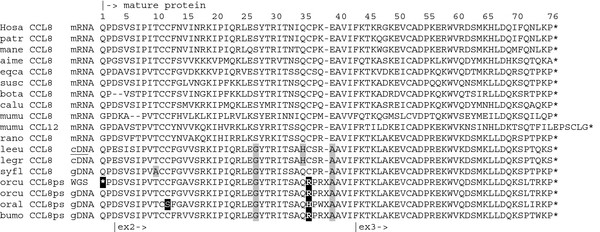
We have localized the orthologs of these chemokine genes in the genome of European rabbit and compared them to those of leporid genera which do (i.e. Oryctolagus and Bunolagus) or do not share the CCR5 alteration with European rabbit (i.e. Lepus and Sylvilagus). Of the Rabbit orthologs of the CCL8, CCL7, and CCL13 genes only the last two were potentially functional, although showing some structural anomalies at the protein level. The ortholog of MCP-2/CCL8 appeared to be pseudogenized by deleterious nucleotide substitutions affecting exon1 and exon2. By analyzing both genomic and cDNA products, these studies were extended to wild specimens of four genera of the Leporidae family: Oryctolagus, Bunolagus, Lepus, and Sylvilagus. It appeared that the anomalies of the MCP-3/CCL7 and MCP-4/CCL13 proteins are shared among the different species of leporids. In contrast, whereas MCP-2/CCL8 was pseudogenized in every studied specimen of the Oryctolagus - Bunolagus lineage, this gene was intact in species of the Lepus - Sylvilagus lineage, and was, at least in Lepus, correctly transcribed.
The biological function of a gene was often revealed in situations of dysfunction or gene loss. Infections with Myxoma virus (MYXV) tend to be fatal in European rabbit (genus Oryctolagus), while being harmless in Hares (genus Lepus) and benign in Cottontail rabbit (genus Sylvilagus), the natural hosts of the virus. This communication should stimulate research on a possible role of MCP-2/CCL8 in poxvirus related pathogenicity.
最近的人体研究强调了单核细胞趋化蛋白(MCP)在白细胞迁移中的重要性及其在炎症过程、肿瘤进展和 HIV-1 感染中的作用。在欧洲兔(Oryctolagus cuniculus)中,趋化因子受体 CCR5 发生了独特的结构改变。到目前为止,这种物种还没有报道过 MCP-2/CCL8a、MCP-3/CCL7 或 MCP-4/CCL13 基因的同源物。这很有趣,因为至少前两个基因在大多数(如果不是全部)研究的哺乳动物中都有表达,并且似乎与各种重要的趋化因子配体-受体相互作用有关。通过评估兔全基因组序列(WGS)数据,我们搜索了 MCP-Eotaxin 簇中哺乳动物基因的同源物。
我们在欧洲兔的基因组中定位了这些趋化因子基因的同源物,并将其与那些与欧洲兔共享 CCR5 改变的兔科属(即 Oryctolagus 和 Bunolagus)或不共享 CCR5 改变的兔科属(即 Lepus 和 Sylvilagus)进行了比较。在兔的 CCL8、CCL7 和 CCL13 基因的同源物中,只有后两种可能具有功能,尽管在蛋白质水平上存在一些结构异常。MCP-2/CCL8 的同源物似乎因影响外显子 1 和外显子 2 的有害核苷酸取代而被致病变异体化。通过分析基因组和 cDNA 产物,这些研究扩展到了兔科的四个属(Oryctolagus、Bunolagus、Lepus 和 Sylvilagus)的野生标本。似乎 MCP-3/CCL7 和 MCP-4/CCL13 蛋白的异常在兔科的不同物种中是共享的。相比之下,虽然 MCP-2/CCL8 在 Oryctolagus-Bunolagus 谱系的每个研究标本中都被致病变异体化,但在 Lepus-Sylvilagus 谱系的物种中,该基因是完整的,至少在 Lepus 中,该基因是正确转录的。
基因的生物学功能通常在功能障碍或基因丢失的情况下显现出来。黏液瘤病毒(MYXV)感染在欧洲兔(Oryctolagus 属)中往往是致命的,而在野兔(Lepus 属)中则是无害的,在棉尾兔(Sylvilagus 属)中则是良性的,病毒的天然宿主。这一发现应该会刺激对 MCP-2/CCL8 在痘病毒相关致病性中的可能作用的研究。