
与细胞分裂素水平有关的正常和干旱条件下大豆中细胞分裂素代谢基因的鉴定和表达分析。
Identification and expression analysis of cytokinin metabolic genes in soybean under normal and drought conditions in relation to cytokinin levels.
机构信息
Signaling Pathway Research Unit, RIKEN Plant Science Center, Yokohama, Kanagawa, Japan.
出版信息
PLoS One. 2012;7(8):e42411. doi: 10.1371/journal.pone.0042411. Epub 2012 Aug 10.
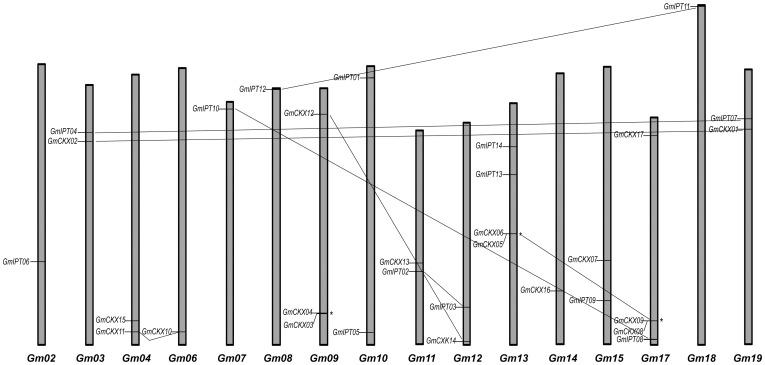
Cytokinins (CKs) mediate cellular responses to drought stress and targeted control of CK metabolism can be used to develop drought-tolerant plants. Aiming to manipulate CK levels to improve drought tolerance of soybean cultivars through genetic engineering of CK metabolic genes, we surveyed the soybean genome and identified 14 CK biosynthetic (isopentenyltransferase, GmIPT) and 17 CK degradative (CK dehydrogenase, GmCKX) genes. Comparative analyses of GmIPTs and GmCKXs with Arabidopsis counterparts revealed their similar architecture. The average numbers of abiotic stress-inducible cis-elements per promoter were 0.4 and 1.2 for GmIPT and GmCKX genes, respectively, suggesting that upregulation of GmCKXs, thereby reduction of CK levels, maybe the major events under abiotic stresses. Indeed, the expression of 12 GmCKX genes was upregulated by dehydration in R2 roots. Overall, the expressions of soybean CK metabolic genes in various tissues at various stages were highly responsive to drought. CK contents in various organs at the reproductive (R2) stage were also determined under well-watered and drought stress conditions. Although tRNA-type GmIPT genes were highly expressed in soybean, cis-zeatin and its derivatives were found at low concentrations. Moreover, reduction of total CK content in R2 leaves under drought was attributable to the decrease in dihydrozeatin levels, suggesting a role of this molecule in regulating soybean's responses to drought stress. Our systematic analysis of the GmIPT and GmCKX families has provided an insight into CK metabolism in soybean under drought stress and a solid foundation for in-depth characterization and future development of improved drought-tolerant soybean cultivars by manipulation of CK levels via biotechnological approach.
细胞分裂素(CKs)介导细胞对干旱胁迫的响应,而靶向控制 CK 代谢可以用于培育耐旱植物。本研究旨在通过 CK 代谢基因的遗传工程来操纵 CK 水平,从而提高大豆品种的耐旱性。为此,我们对大豆基因组进行了调查,鉴定了 14 个 CK 生物合成(异戊烯基转移酶,GmIPT)和 17 个 CK 降解(CK 脱氢酶,GmCKX)基因。与拟南芥同源基因的比较分析表明,GmIPTs 和 GmCKXs 具有相似的结构。每个启动子上非生物胁迫诱导顺式元件的平均数量分别为 GmIPT 和 GmCKX 基因的 0.4 和 1.2,这表明 GmCKXs 的上调,从而降低 CK 水平,可能是非生物胁迫下的主要事件。事实上,在 R2 根中,12 个 GmCKX 基因的表达在脱水时被上调。总的来说,大豆 CK 代谢基因在不同组织和不同阶段对干旱的表达高度敏感。在充分供水和干旱胁迫条件下,还测定了生殖(R2)期各器官的 CK 含量。虽然 tRNA 型 GmIPT 基因在大豆中高度表达,但发现顺式玉米素及其衍生物的浓度较低。此外,R2 叶片中 CK 含量的降低归因于二氢玉米素水平的降低,这表明该分子在调节大豆对干旱胁迫的响应中起作用。我们对 GmIPT 和 GmCKX 家族的系统分析为大豆在干旱胁迫下的 CK 代谢提供了深入了解,并为通过生物技术手段操纵 CK 水平来深入表征和未来培育改良耐旱大豆品种奠定了坚实的基础。




 Zotero 插件