Department of Cell Biology, Yale University School of Medicine, 333 Cedar Street, New Haven, CT 06520, USA.
Science. 2012 Sep 14;337(6100):1340-3. doi: 10.1126/science.1224492. Epub 2012 Aug 16.
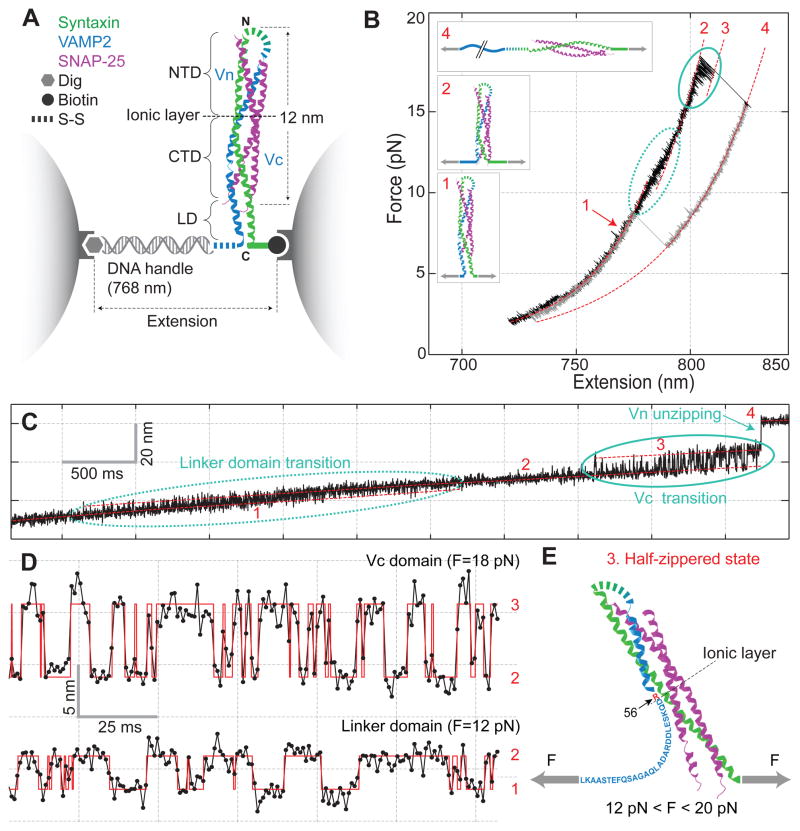
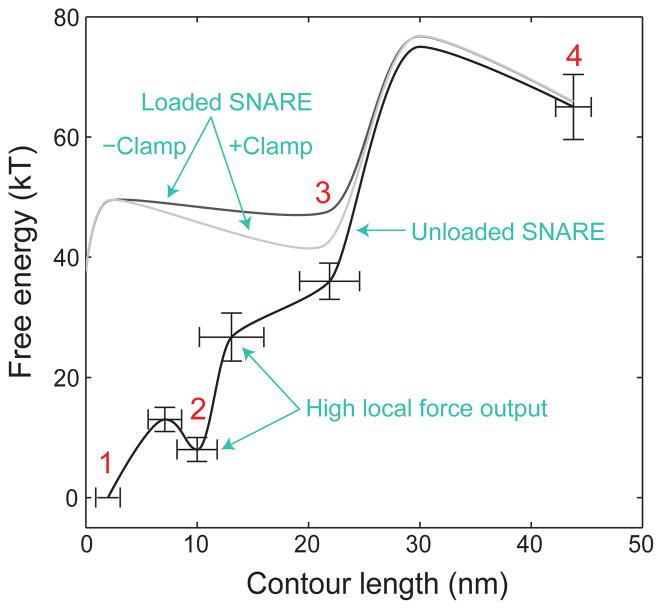
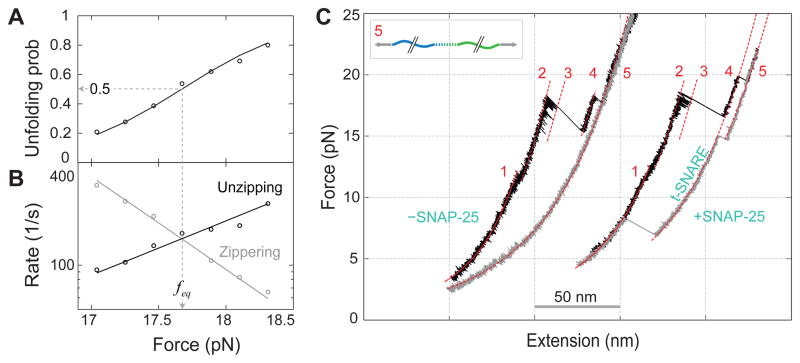
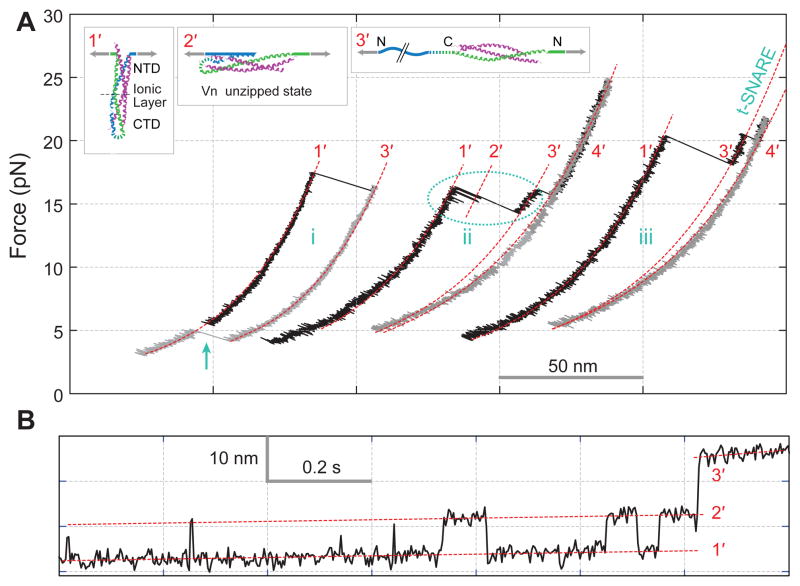
Soluble N-ethylmaleimide-sensitive factor attachment protein receptor (SNARE) proteins drive membrane fusion by assembling into a four-helix bundle in a zippering process. Here, we used optical tweezers to observe in a cell-free reconstitution experiment in real time a long-sought SNARE assembly intermediate in which only the membrane-distal amino-terminal half of the bundle is assembled. Our findings support the zippering hypothesis, but suggest that zippering proceeds through three sequential binary switches, not continuously, in the amino- and carboxyl-terminal halves of the bundle and the linker domain. The half-zippered intermediate was stabilized by externally applied force that mimicked the repulsion between apposed membranes being forced to fuse. This intermediate then rapidly and forcefully zippered, delivering free energy of 36 k(B)T (where k(B) is Boltzmann's constant and T is temperature) to mediate fusion.
可溶性 N-乙基马来酰亚胺敏感因子附着蛋白受体 (SNARE) 蛋白通过组装成拉链过程中的四螺旋束驱动膜融合。在这里,我们使用光学镊子在无细胞重建实验中实时观察到一个长期以来备受关注的 SNARE 组装中间体,其中只有束的膜远端氨基末端的一半被组装。我们的研究结果支持拉链假说,但表明拉链过程不是连续的,而是通过三个连续的二进制开关,在束的氨基和羧基末端以及连接域中进行。半拉链中间体通过模拟被迫融合的对置膜之间的排斥力的外部施加力来稳定。然后,这个中间体迅速而有力地拉链,传递 36 kBT(其中 kBT 是玻尔兹曼常数,T 是温度)的自由能,以介导融合。