Asia Pacific Veterinary Information Services, PO Box 55, Montmorency, VIC, 3094, Australia.
Curr Top Microbiol Immunol. 2013;365:281-98. doi: 10.1007/82_2012_254.
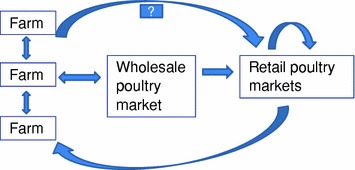
The occurrence of avian influenza A(H5N1) in Hong Kong in 1997 led to the development of a "One-Health" approach to deal with emerging infectious diseases that has been applied to other emergent diseases such as SARS and the pandemic H1N1 2009. Evaluation of poultry marketing and production systems and investigations at the animal-human interface, led to defining the routes of human exposure to avian influenza and factors that allowed virus to multiply and persist. Active and systematic surveillance of apparently healthy as well as diseased poultry and wild birds provided evidence of ongoing virus evolution in the wider region. Epidemiological studies, supplemented with molecular epidemiology, helped to elucidate the role of the poultry marketing system and live poultry markets in the persistence of avian influenza viruses and provided evidence for the impact of interventions designed to interrupt virus transmission. Enhanced bio-security, active surveillance together with targeted and evidence-based interventions in the poultry production, and marketing system together with poultry vaccination has prevented further human H5N1 disease and minimized outbreaks of poultry disease in Hong Kong. Similar strategies have led to the understanding of the emergence of SARS and provided options for preventing the re-emergence of this disease. Surveillance of influenza in swine has provided insights into the emergence of the 2009 pandemic, to the reverse zoonosis of the pandemic virus from humans to swine and to the emergence of novel reassortant viruses within swine. "One Health" strategies are not "cost-free" and require sensitive implementation to optimize food-safety and food security, while safeguarding the economics of animal husbandry and the environment and remaining sensitive to cultural practices.
1997 年香港暴发禽流感 H5N1 疫情后,人们制定了“同一健康”策略来应对新发传染病,这一策略后来也被应用于严重急性呼吸综合征(SARS)和 2009 年甲型 H1N1 流感大流行等其他突发疾病的应对。通过对家禽销售和生产系统的评估,以及对人兽接触界面的调查,确定了人类接触禽流感的途径,以及病毒得以复制和持续存在的因素。对健康家禽和野生鸟类以及病禽的主动、系统监测,为了解该地区病毒的持续演变提供了证据。流行病学研究结合分子流行病学,有助于阐明家禽销售系统和活禽市场在禽流感病毒持续存在中的作用,并为旨在阻断病毒传播的干预措施提供了证据。加强生物安全、对家禽生产和销售系统进行有针对性的、基于证据的主动监测以及家禽疫苗接种,防止了人类感染 H5N1 型禽流感的进一步发生,也使香港的家禽疾病暴发最小化。类似的策略使人们了解了 SARS 的出现,并为预防该病的再次出现提供了选择。对猪流感的监测为了解 2009 年大流行的出现、大流行病毒从人类反向传播到猪以及猪体内新型重组病毒的出现提供了线索。“同一健康”策略并非“无成本”,需要谨慎实施,以优化食品安全和粮食安全,同时保障畜牧业经济和环境,并对文化习俗保持敏感。