Division of Plastic Surgery, Feinberg School of Medicine, Northwestern University, Chicago, Illinois, United States of America.
PLoS One. 2012;7(8):e42897. doi: 10.1371/journal.pone.0042897. Epub 2012 Aug 8.
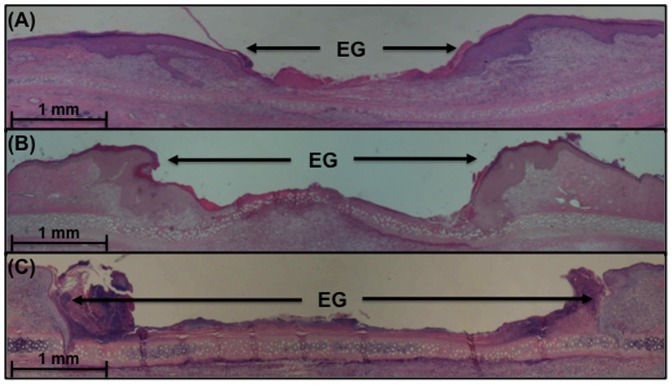
The recent literature suggests that chronic wound biofilms often consist of multiple bacterial species. However, without appropriate in vivo, polybacterial biofilm models, our understanding of these complex infections remains limited. We evaluate and compare the effect of single- and mixed-species biofilm infections on host wound healing dynamics using a quantitative, in vivo, rabbit ear model.
Six-mm dermal punch wounds in New Zealand rabbit ears were inoculated with Staphylococcus aureus strain UAMS-1, Pseudomonas aeruginosa strain PAO1, or both, totaling 10/6 colony-forming units/wound. Bacterial proliferation and maintenance in vivo were done using procedures from our previously published model. Wounds were harvested for histological measurement of wound healing, viable bacterial counts using selective media, or inflammatory cytokine (IL-1β, TNF-α) expression via quantitative reverse-transcription PCR. Biofilm structure was studied using scanning electron microscopy (SEM). For comparison, biofilm deficient mutant UAMS-929 replaced strain UAMS-1 in some mixed-species infections.
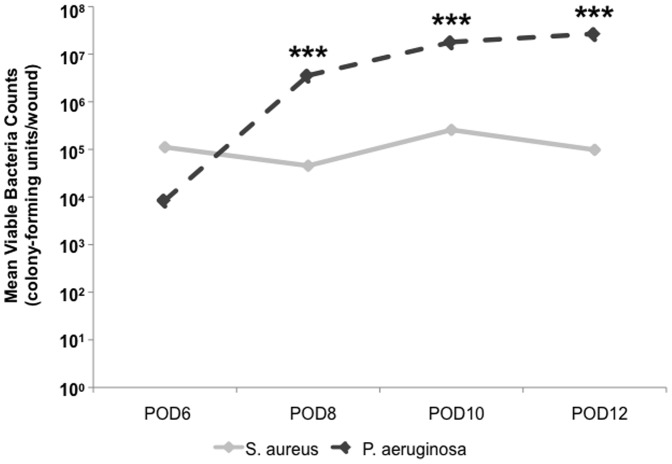
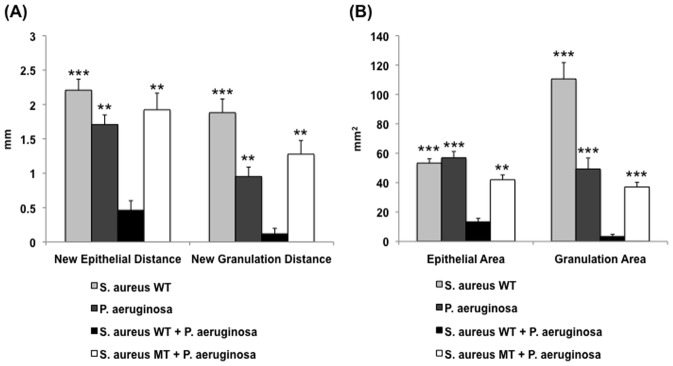
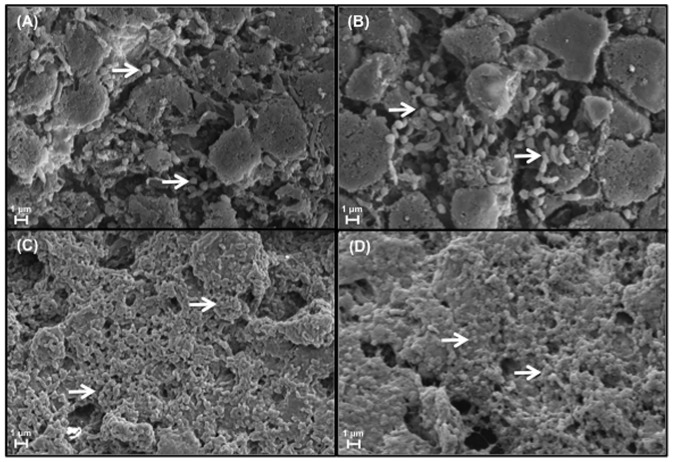
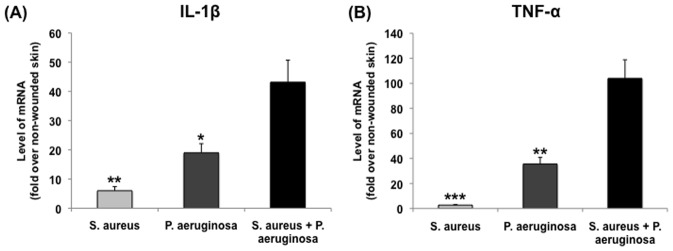
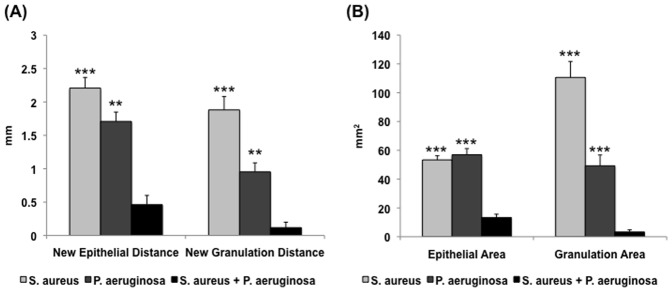
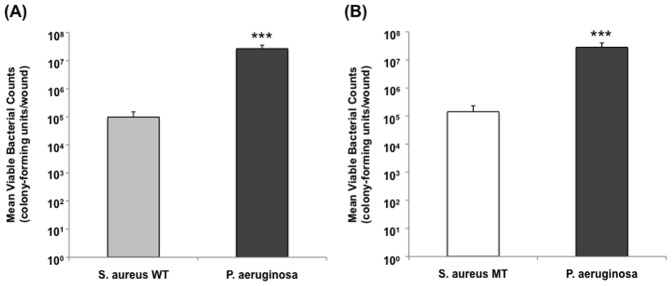
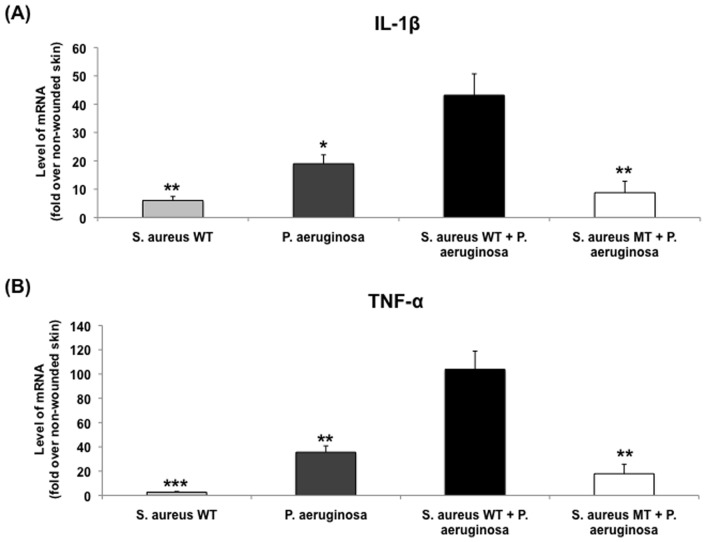
Bacterial counts verified the presence of both strains UAMS-1 and PAO1 in polybacterial wounds. Over time, strain PAO1 became predominant (p<0.001). SEM showed colocalization of both species within an extracellular matrix at multiple time-points. Compared to each monospecies infection, polybacterial biofilms impaired all wound healing parameters (p<0.01), and increased expression of IL-1β and TNF-α (p<0.05). In contrast, mixed-species infections using biofilm-deficient mutant UAMS-929 instead of wild-type strain UAMS-1 showed less wound impairment (p<0.01) with decreased host cytokine expression (p<0.01), despite a bacterial burden and distribution comparable to that of mixed-wild-type wounds.
This study reveals that mixed-species biofilms have a greater impact on wound healing dynamics than their monospecies counterparts. The increased virulence of polybacterial biofilm appears dependent on the combined pathogenicity of each species, verified using a mutant strain. These data suggest that individual bacterial species can interact synergistically within a single biofilm structure.
最近的文献表明,慢性伤口生物膜通常由多种细菌组成。然而,如果没有适当的体内多细菌生物膜模型,我们对这些复杂感染的理解仍然有限。我们使用定量的体内兔耳模型评估和比较了单种和混合种生物膜感染对宿主伤口愈合动态的影响。
新西兰兔耳上的 6mm 皮肤打孔伤接种金黄色葡萄球菌 UAMS-1 株、铜绿假单胞菌 PAO1 株或两者的混合物,每孔 10/6 菌落形成单位。使用我们之前发表的模型中的程序进行体内细菌增殖和维持。收获伤口进行组织学测量伤口愈合、使用选择性培养基进行活菌计数或通过定量逆转录 PCR 进行炎症细胞因子(IL-1β、TNF-α)表达。使用扫描电子显微镜(SEM)研究生物膜结构。为了比较,在一些混合种感染中,生物膜缺陷突变株 UAMS-929 替代了 UAMS-1 株。
细菌计数证实了多细菌伤口中两种 UAMS-1 株和 PAO1 株的存在。随着时间的推移,PAO1 株成为优势菌(p<0.001)。SEM 显示两种细菌在多个时间点在细胞外基质中共定位。与每种单种感染相比,多细菌生物膜会损害所有伤口愈合参数(p<0.01),并增加 IL-1β 和 TNF-α 的表达(p<0.05)。相比之下,使用生物膜缺陷突变株 UAMS-929 而不是野生型 UAMS-1 进行混合种感染时,尽管细菌负荷和分布与混合野生型伤口相当,但伤口损伤较小(p<0.01),宿主细胞因子表达减少(p<0.01)。
本研究表明,与单种生物膜相比,混合种生物膜对伤口愈合动态的影响更大。多细菌生物膜的毒力增加似乎取决于每种细菌的联合致病性,这通过突变株得到了验证。这些数据表明,单个细菌物种可以在单个生物膜结构中协同作用。