Department of Immunology, University of Washington, School of Medicine, Seattle, Washington, United States of America.
PLoS Pathog. 2012;8(8):e1002839. doi: 10.1371/journal.ppat.1002839. Epub 2012 Aug 2.
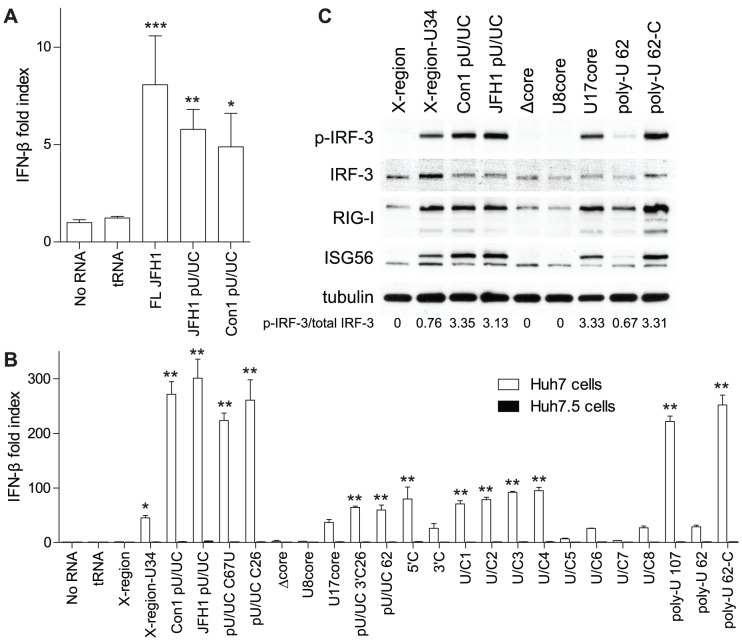
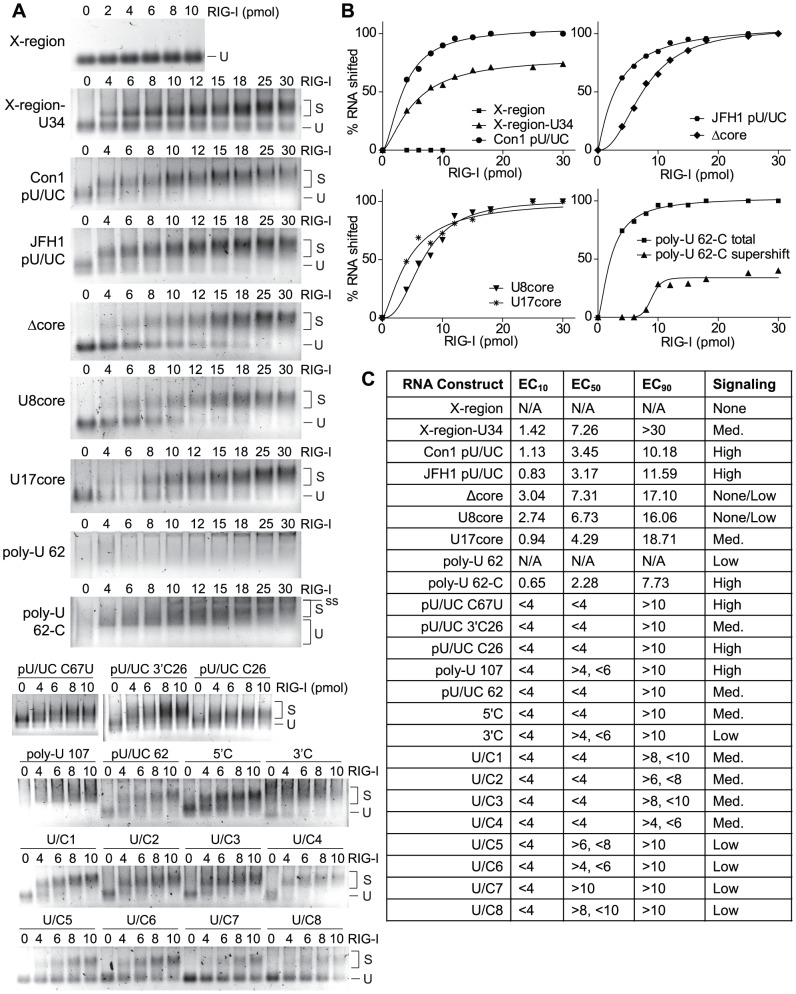
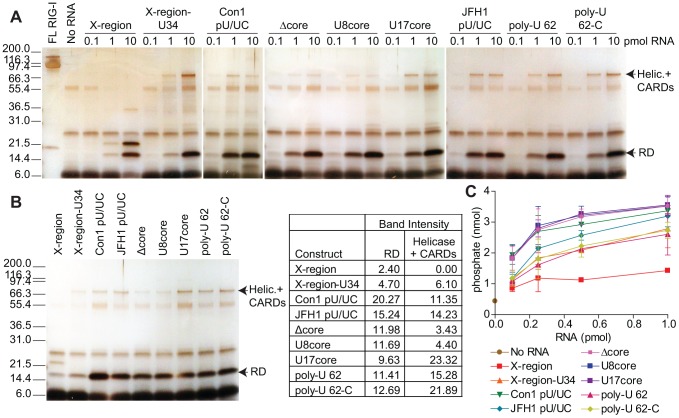
Viral infection of mammalian cells triggers the innate immune response through non-self recognition of pathogen associated molecular patterns (PAMPs) in viral nucleic acid. Accurate PAMP discrimination is essential to avoid self recognition that can generate autoimmunity, and therefore should be facilitated by the presence of multiple motifs in a PAMP that mark it as non-self. Hepatitis C virus (HCV) RNA is recognized as non-self by RIG-I through the presence of a 5'-triphosphate (5'-ppp) on the viral RNA in association with a 3' poly-U/UC tract. Here we define the HCV PAMP and the criteria for RIG-I non-self discrimination of HCV by examining the RNA structure-function attributes that impart PAMP function to the poly-U/UC tract. We found that the 34 nucleotide poly-uridine "core" of this sequence tract was essential for RIG-I activation, and that interspersed ribocytosine nucleotides between poly-U sequences in the RNA were required to achieve optimal RIG-I signal induction. 5'-ppp poly-U/UC RNA variants that stimulated strong RIG-I activation efficiently bound purified RIG-I protein in vitro, and RNA interaction with both the repressor domain and helicase domain of RIG-I was required to activate signaling. When appended to 5'-ppp RNA that lacks PAMP activity, the poly-U/UC U-core sequence conferred non-self recognition of the RNA and innate immune signaling by RIG-I. Importantly, HCV poly-U/UC RNA variants that strongly activated RIG-I signaling triggered potent anti-HCV responses in vitro and hepatic innate immune responses in vivo using a mouse model of PAMP signaling. These studies define a multi-motif PAMP signature of non-self recognition by RIG-I that incorporates a 5'-ppp with poly-uridine sequence composition and length. This HCV PAMP motif drives potent RIG-I signaling to induce the innate immune response to infection. Our studies define a basis of non-self discrimination by RIG-I and offer insights into the antiviral therapeutic potential of targeted RIG-I signaling activation.
哺乳动物细胞的病毒感染通过病毒核酸中病原体相关分子模式(PAMPs)的非自我识别触发先天免疫反应。准确的 PAMP 识别对于避免自身识别至关重要,因为自身识别可能会产生自身免疫,因此应该通过 PAMP 中标记为非自我的多个基序来促进。HCV RNA 通过病毒 RNA 5'-三磷酸(5'-ppp)与 3'多聚 U/UC 链的存在而被 RIG-I 识别为非自我。在这里,我们通过检查赋予多聚 U/UC 链 PAMP 功能的 RNA 结构-功能属性,来定义 HCV 的 HCV PAMP 和 RIG-I 非自我识别 HCV 的标准。我们发现,该序列片段的 34 个核苷酸聚尿嘧啶“核心”对于 RIG-I 激活是必需的,并且 RNA 中多聚 U 序列之间散布的核碱基对于实现最佳 RIG-I 信号诱导也是必需的。强烈刺激 RIG-I 激活的 5'-ppp 多聚 U/UC RNA 变体在体外有效地与纯化的 RIG-I 蛋白结合,并且 RNA 与 RIG-I 的抑制结构域和解旋酶结构域的相互作用对于激活信号是必需的。当附加到缺乏 PAMP 活性的 5'-ppp RNA 上时,聚 U/UC U 核心序列赋予 RNA 和 RIG-I 的先天免疫信号的非自我识别。重要的是,强烈激活 RIG-I 信号的 HCV 多聚 U/UC RNA 变体在体外和使用 PAMP 信号的小鼠模型中触发强烈的抗 HCV 反应和肝先天免疫反应。这些研究定义了 RIG-I 非自我识别的多基序 PAMP 特征,该特征包含 5'-ppp 和聚尿嘧啶序列组成和长度。该 HCV PAMP 基序驱动强烈的 RIG-I 信号以诱导对感染的先天免疫反应。我们的研究定义了 RIG-I 的非自我识别基础,并为靶向 RIG-I 信号激活的抗病毒治疗潜力提供了见解。