University of California, Davis, School of Veterinary Medicine, Department of Molecular Biosciences, Sacramento, CA 95817, USA.
Neurotoxicol Teratol. 2013 Mar-Apr;36:67-81. doi: 10.1016/j.ntt.2012.07.006. Epub 2012 Aug 17.
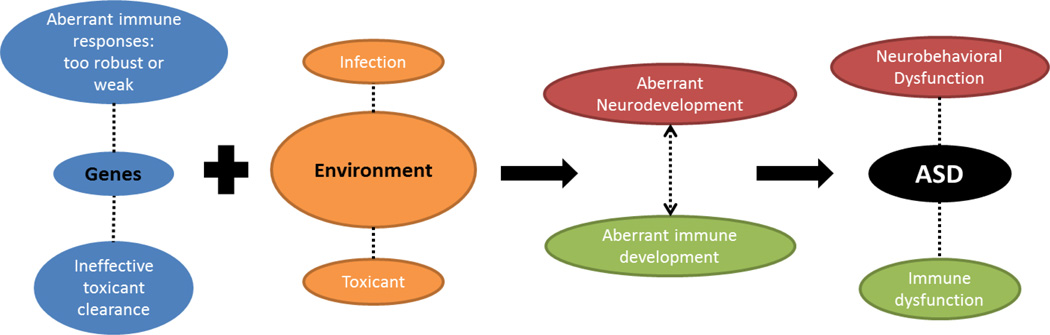
Autism spectrum disorders (ASD) are neurodevelopmental diseases that affect an alarming number of individuals. The etiological basis of ASD is unclear, and evidence suggests it involves both genetic and environmental factors. There are many reports of cytokine imbalances in ASD. These imbalances could have a pathogenic role, or they may be markers of underlying genetic and environmental influences. Cytokines act primarily as mediators of immunological activity but they also have significant interactions with the nervous system. They participate in normal neural development and function, and inappropriate activity can have a variety of neurological implications. It is therefore possible that cytokine dysregulation contributes directly to neural dysfunction in ASD. Further, cytokine profiles change dramatically in the face of infection, disease, and toxic exposures. Imbalances in cytokines may represent an immune response to environmental contributors to ASD. The following review is presented in two main parts. First, we discuss select cytokines implicated in ASD, including IL-1Β, IL-6, IL-4, IFN-γ, and TGF-Β, and focus on their role in the nervous system. Second, we explore several neurotoxic environmental factors that may be involved in the disorders, and focus on their immunological impacts. This review represents an emerging model that recognizes the importance of both genetic and environmental factors in ASD etiology. We propose that the immune system provides critical clues regarding the nature of the gene by environment interactions that underlie ASD pathophysiology.
自闭症谱系障碍(ASD)是一种神经发育疾病,影响着数量惊人的个体。ASD 的病因基础尚不清楚,有证据表明它涉及遗传和环境因素。有许多关于 ASD 中细胞因子失衡的报道。这些失衡可能具有致病性作用,也可能是潜在遗传和环境影响的标志物。细胞因子主要作为免疫活性的介质起作用,但它们与神经系统也有显著的相互作用。它们参与正常的神经发育和功能,不适当的活动可能会对神经系统产生各种影响。因此,细胞因子的失调可能直接导致 ASD 中的神经功能障碍。此外,细胞因子谱在面对感染、疾病和有毒物质暴露时会发生剧烈变化。细胞因子失衡可能代表对 ASD 环境致病因素的免疫反应。以下综述分为两大部分。首先,我们讨论了一些与 ASD 相关的细胞因子,包括 IL-1Β、IL-6、IL-4、IFN-γ 和 TGF-Β,并重点讨论了它们在神经系统中的作用。其次,我们探讨了几种可能与这些疾病有关的神经毒性环境因素,并重点讨论了它们的免疫影响。这篇综述代表了一种新兴的模型,该模型认识到遗传和环境因素在 ASD 病因学中的重要性。我们提出免疫系统为 ASD 病理生理学中潜在的基因-环境相互作用的性质提供了关键线索。