Department of Cellular and Molecular Medicine, University of California, San Diego, La Jolla, CA 92093, USA.
Mol Cell. 2012 Oct 12;48(1):28-38. doi: 10.1016/j.molcel.2012.07.020. Epub 2012 Aug 23.
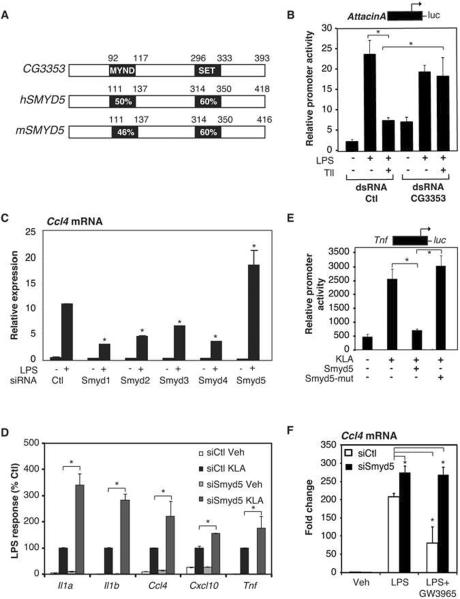
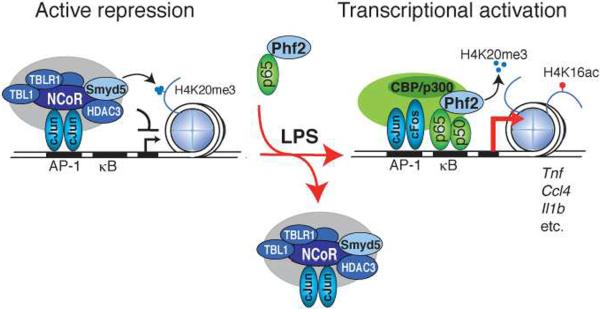
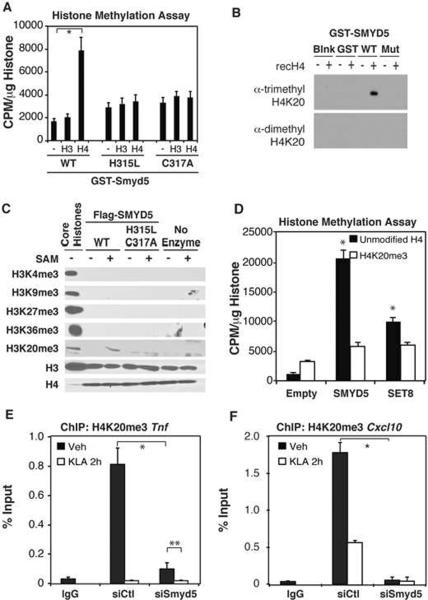
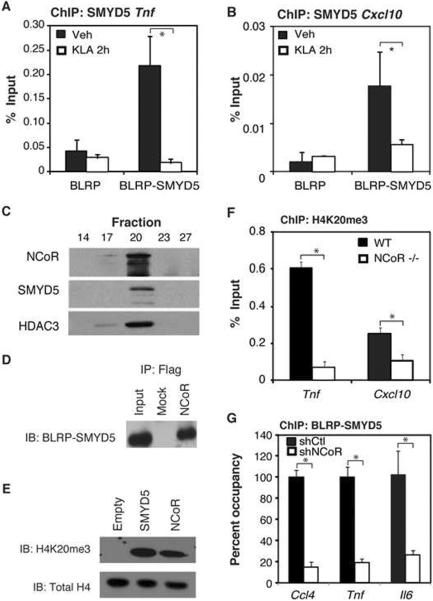
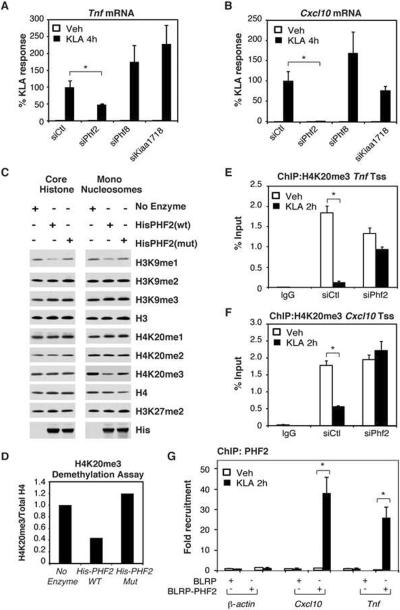
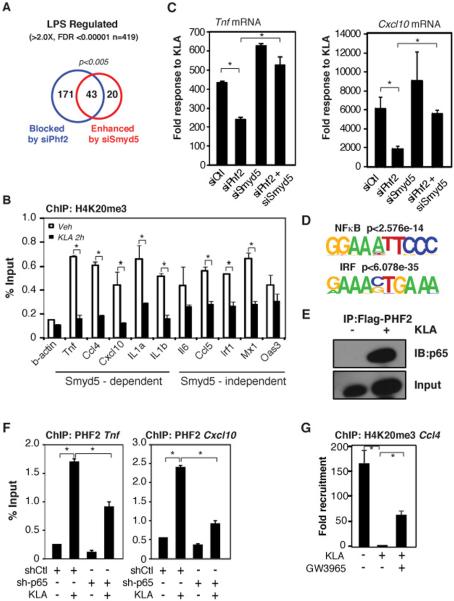
Regulation of genes that initiate and amplify inflammatory programs of gene expression is achieved by signal-dependent exchange of coregulator complexes that function to read, write, and erase specific histone modifications linked to transcriptional activation or repression. Here, we provide evidence for the role of trimethylated histone H4 lysine 20 (H4K20me3) as a repression checkpoint that restricts expression of toll-like receptor 4 (TLR4) target genes in macrophages. H4K20me3 is deposited at the promoters of a subset of these genes by the SMYD5 histone methyltransferase through its association with NCoR corepressor complexes. Signal-dependent erasure of H4K20me3 is required for effective gene activation and is achieved by NF-κB-dependent delivery of the histone demethylase PHF2. Liver X receptors antagonize TLR4-dependent gene activation by maintaining NCoR/SMYD5-mediated repression. These findings reveal a histone H4K20 trimethylation/demethylation strategy that integrates positive and negative signaling inputs that control immunity and homeostasis.
基因表达的炎症程序起始和放大的基因调控是通过信号依赖性的共激活因子复合物的交换来实现的,这些复合物的功能是读取、写入和擦除与转录激活或抑制相关的特定组蛋白修饰。在这里,我们提供了证据表明,三甲基化组蛋白 H4 赖氨酸 20(H4K20me3)作为一个抑制检查点,限制巨噬细胞中 Toll 样受体 4(TLR4)靶基因的表达。SMYD5 组蛋白甲基转移酶通过与 NCoR 共抑制复合物的关联,在这些基因的一部分启动子上沉积 H4K20me3。H4K20me3 的信号依赖性擦除对于有效的基因激活是必需的,并且通过 NF-κB 依赖性递送来实现,该过程涉及组蛋白去甲基酶 PHF2。肝 X 受体通过维持 NCoR/SMYD5 介导的抑制作用,拮抗 TLR4 依赖性基因激活。这些发现揭示了一种组蛋白 H4K20 三甲基化/去甲基化策略,该策略整合了正负信号输入,以控制免疫和动态平衡。