Department of Cellular and Molecular Medicine, University of California San Diego, La Jolla, California, United States of America.
PLoS Genet. 2011 Dec;7(12):e1002401. doi: 10.1371/journal.pgen.1002401. Epub 2011 Dec 8.
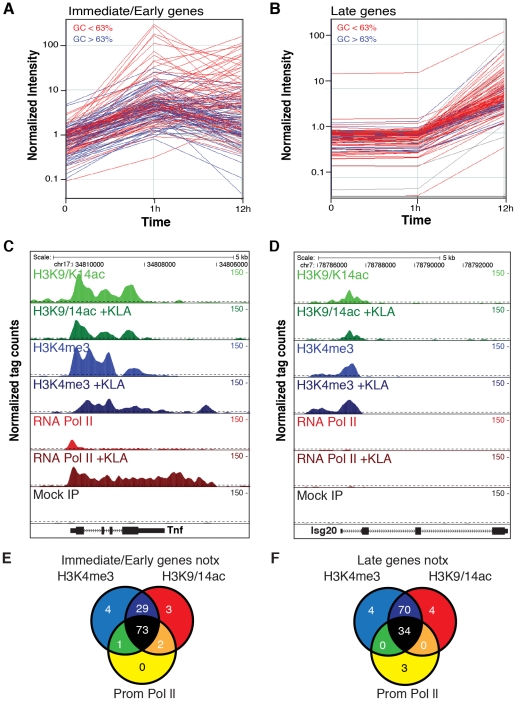
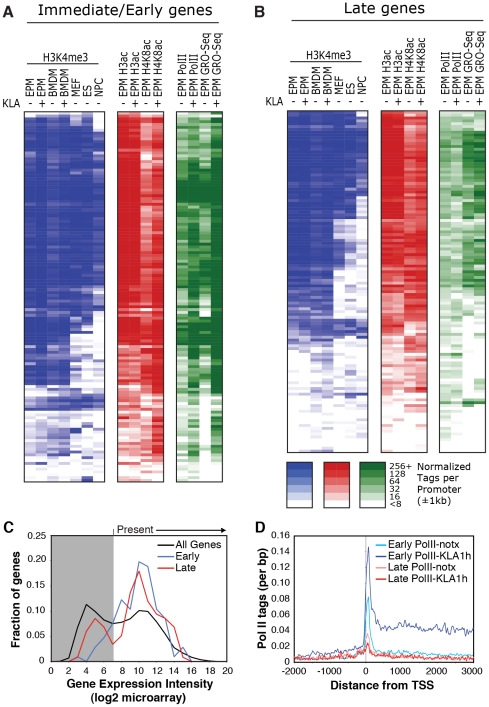
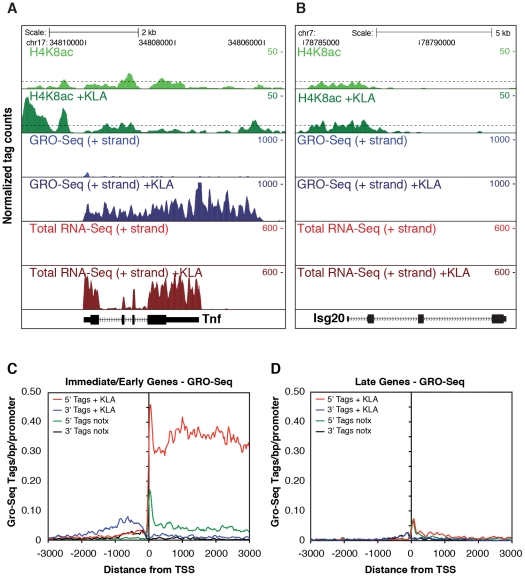
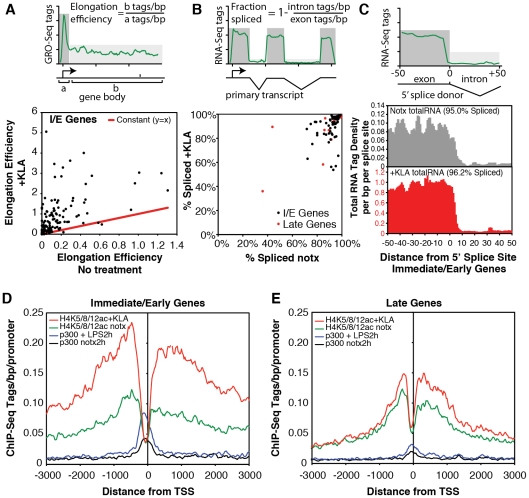
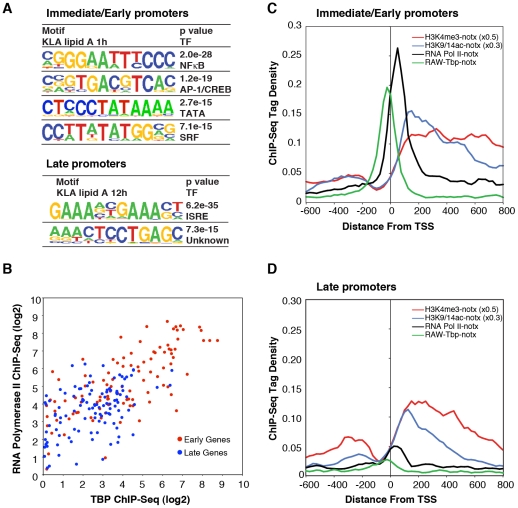
Precise control of the innate immune response is required for resistance to microbial infections and maintenance of normal tissue homeostasis. Because this response involves coordinate regulation of hundreds of genes, it provides a powerful biological system to elucidate the molecular strategies that underlie signal- and time-dependent transitions of gene expression. Comprehensive genome-wide analysis of the epigenetic and transcription status of the TLR4-induced transcriptional program in macrophages suggests that Toll-like receptor 4 (TLR4)-dependent activation of nearly all immediate/early- (I/E) and late-response genes results from a sequential process in which signal-independent factors initially establish basal levels of gene expression that are then amplified by signal-dependent transcription factors. Promoters of I/E genes are distinguished from those of late genes by encoding a distinct set of signal-dependent transcription factor elements, including TATA boxes, which lead to preferential binding of TBP and basal enrichment for RNA polymerase II immediately downstream of transcriptional start sites. Global nuclear run-on (GRO) sequencing and total RNA sequencing further indicates that TLR4 signaling markedly increases the overall rates of both transcriptional initiation and the efficiency of transcriptional elongation of nearly all I/E genes, while RNA splicing is largely unaffected. Collectively, these findings reveal broadly utilized mechanisms underlying temporally distinct patterns of TLR4-dependent gene activation required for homeostasis and effective immune responses.
精确控制先天免疫反应对于抵抗微生物感染和维持正常组织稳态至关重要。由于这种反应涉及数百个基因的协调调节,它为阐明信号和时间依赖性基因表达转换的分子策略提供了一个强大的生物系统。对 TLR4 诱导的巨噬细胞转录程序的表观遗传和转录状态进行全面的全基因组分析表明,Toll 样受体 4(TLR4)依赖性激活几乎所有的早期/早期(I/E)和晚期反应基因都源于一个顺序过程,其中信号非依赖性因子最初建立基因表达的基础水平,然后由信号依赖性转录因子进行扩增。I/E 基因的启动子与晚期基因的启动子不同,因为它们编码了一组独特的信号依赖性转录因子元件,包括 TATA 盒,这些元件导致 TBP 的优先结合和转录起始位点下游的 RNA 聚合酶 II 的基本富集。全基因组核运行(GRO)测序和总 RNA 测序进一步表明,TLR4 信号显著增加了几乎所有 I/E 基因的转录起始和转录延伸效率的总体速率,而 RNA 剪接的影响则很小。总之,这些发现揭示了维持稳态和有效免疫反应所需的 TLR4 依赖性基因激活的时间上不同模式的广泛利用机制。