FB Biowissenschaften, J.W. Goethe-Universität Frankfurt, Siesmayerstr. 70, 60054 Frankfurt am Main, Germany.
Proc Biol Sci. 2012 Oct 22;279(1745):4230-5. doi: 10.1098/rspb.2012.1654. Epub 2012 Aug 29.
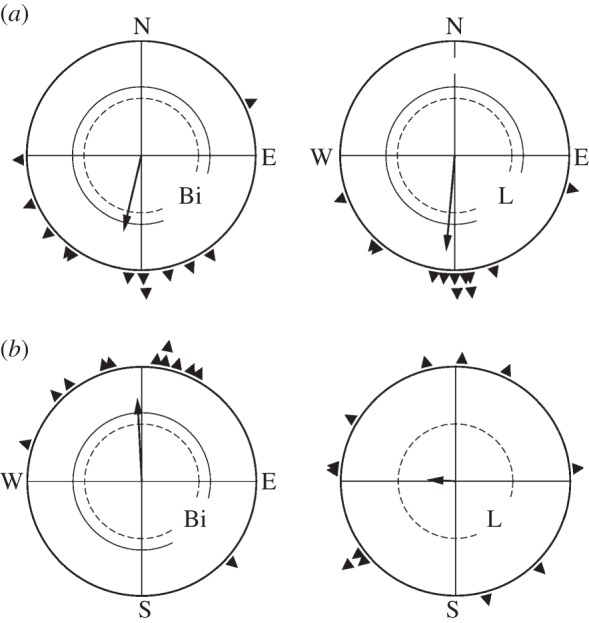
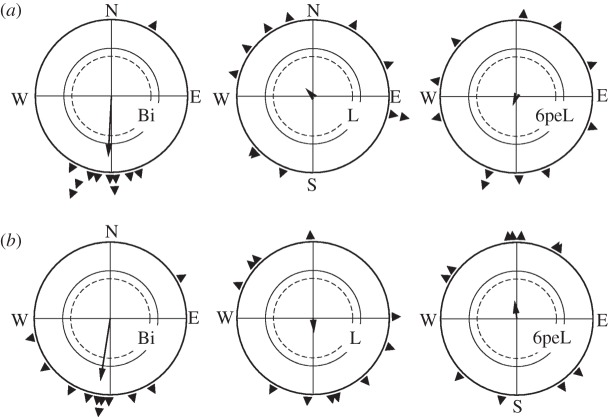
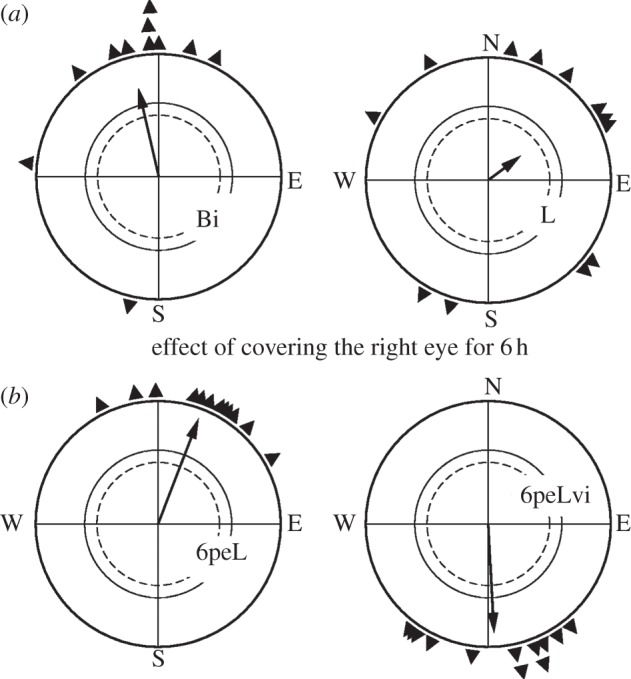
The magnetic compass of a migratory bird, the European robin (Erithacus rubecula), was shown to be lateralized in favour of the right eye/left brain hemisphere. However, this seems to be a property of the avian magnetic compass that is not present from the beginning, but develops only as the birds grow older. During first migration in autumn, juvenile robins can orient by their magnetic compass with their right as well as with their left eye. In the following spring, however, the magnetic compass is already lateralized, but this lateralization is still flexible: it could be removed by covering the right eye for 6 h. During the following autumn migration, the lateralization becomes more strongly fixed, with a 6 h occlusion of the right eye no longer having an effect. This change from a bilateral to a lateralized magnetic compass appears to be a maturation process, the first such case known so far in birds. Because both eyes mediate identical information about the geomagnetic field, brain asymmetry for the magnetic compass could increase efficiency by setting the other hemisphere free for other processes.
候鸟欧洲知更鸟(Erithacus rubecula)的磁罗盘被证明存在偏向右眼/左大脑半球的现象。然而,这种现象似乎并不是鸟类磁罗盘的固有特性,而是随着鸟类的成长逐渐发展而来的。在秋季的首次迁徙中,幼鸟可以通过右眼和左眼来利用其磁罗盘进行定向。然而,次年春季,磁罗盘已经出现了偏向性,但这种偏向性仍然具有灵活性:通过遮盖右眼 6 小时,这种偏向性就可以被消除。在接下来的秋季迁徙中,这种偏向性变得更加固定,遮盖右眼 6 小时已不再产生影响。这种从双侧到单侧磁罗盘的转变似乎是一个成熟过程,这是鸟类中迄今为止首例已知的情况。因为两只眼睛都提供了关于地磁场的相同信息,所以磁罗盘的大脑不对称性可以通过释放另一个半球来提高效率,使其能够处理其他过程。