Adámková Jana, Benediktová Kateřina, Svoboda Jan, Bartoš Luděk, Vynikalová Lucie, Nováková Petra, Hart Vlastimil, Painter Michael S, Burda Hynek
Faculty of Forestry and Wood Sciences, Department of Game Management and Wildlife Biology, Czech University of Life Sciences, Praha, Czech Republic.
Department of Ethology, Institute of Animal Science, Praha, Czech Republic.
PLoS One. 2021 Jan 28;16(1):e0245940. doi: 10.1371/journal.pone.0245940. eCollection 2021.
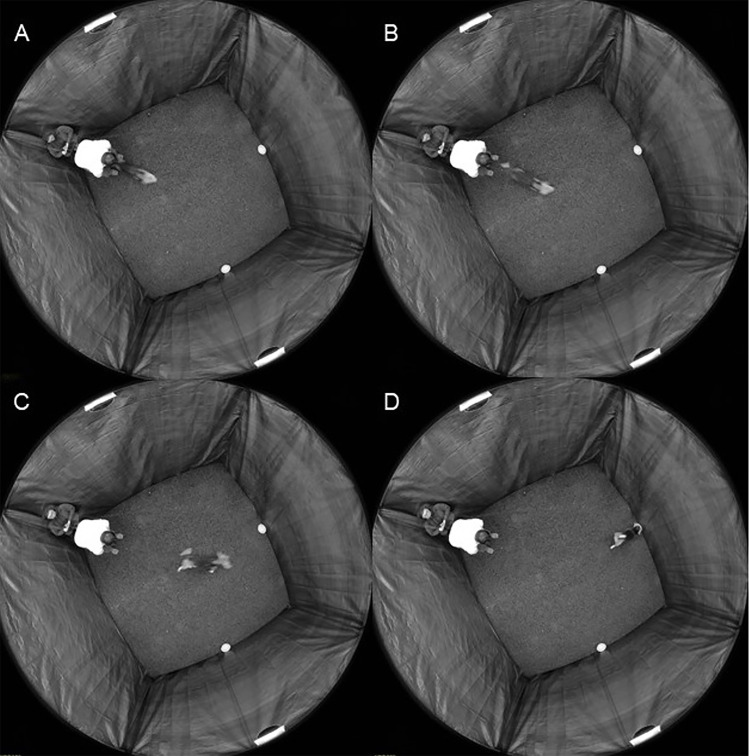
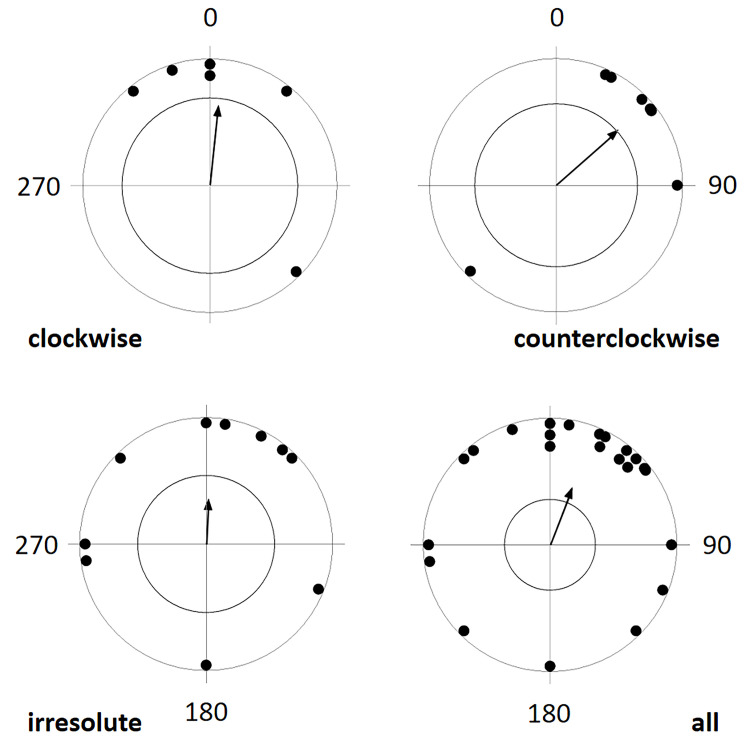
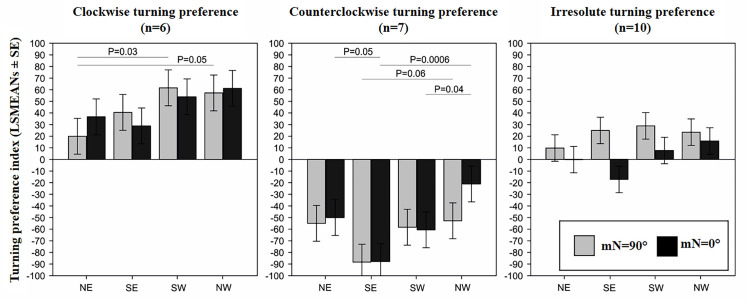
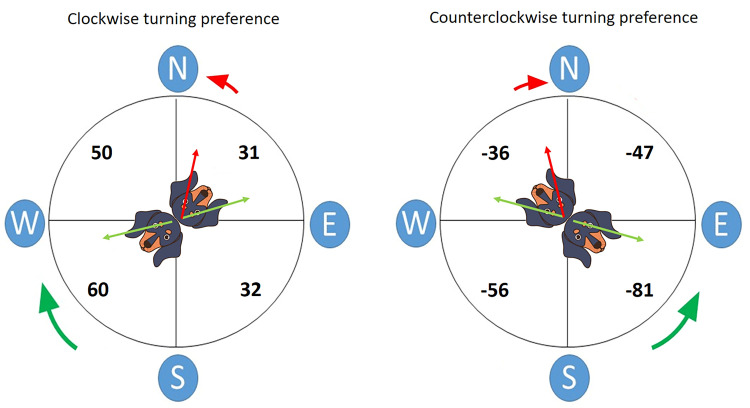
It was shown earlier that dogs, when selecting between two dishes with snacks placed in front of them, left and right, prefer to turn either clockwise or counterclockwise or randomly in either direction. This preference (or non-preference) is individually consistent in all trials but it is biased in favor of north if they choose between dishes positioned north and east or north and west, a phenomenon denoted as "pull of the north". Here, we replicated these experiments indoors, in magnetic coils, under natural magnetic field and under magnetic field shifted 90° clockwise. We demonstrate that "pull of the north" was present also in an environment without any outdoor cues and that the magnetic (and not topographic) north exerted the effect. The detailed analysis shows that the phenomenon involves also "repulsion of the south". The clockwise turning preference in the right-preferring dogs is more pronounced in the S-W combination, while the counterclockwise turning preference in the left-preferring dogs is pronounced in the S-E combination. In this way, south-placed dishes are less frequently chosen than would be expected, while the north-placed dishes are apparently more preferred. Turning preference did not correlate with the motoric paw laterality (Kong test). Given that the choice of a dish is visually guided, we postulate that the turning preference was determined by the dominant eye, so that a dominant right eye resulted in clockwise, and a dominant left eye in counterclockwise turning. Assuming further that magnetoreception in canines is based on the radical-pair mechanism, a "conflict of interests" may be expected, if the dominant eye guides turning away from north, yet the contralateral eye "sees the north", which generally acts attractive, provoking body alignment along the north-south axis.
先前的研究表明,狗在面对放在它们面前左右两侧的两盘零食时,选择向左或向右转的偏好是随机的,或者顺时针或逆时针转动的偏好是个体一致的。但如果它们在位于北方和东方或北方和西方的盘子之间进行选择,这种偏好(或无偏好)会偏向北方,这一现象被称为“北方拉力”。在这里,我们在室内、磁线圈中、自然磁场下以及顺时针偏移90°的磁场下重复了这些实验。我们证明,“北方拉力”在没有任何户外线索的环境中也存在,并且是磁(而非地形)北方产生了这种影响。详细分析表明,该现象还涉及“南方排斥”。在右偏好的狗中,顺时针转动偏好在西南组合中更为明显,而在左偏好的狗中,逆时针转动偏好在东南组合中更为明显。这样一来,放置在南方的盘子被选择的频率低于预期,而放置在北方的盘子显然更受青睐。转动偏好与运动爪的偏侧性(Kong测试)无关。鉴于对盘子的选择是由视觉引导的,我们推测转动偏好是由优势眼决定的,因此优势右眼导致顺时针转动,优势左眼导致逆时针转动。进一步假设犬类的磁感应是基于自由基对机制,如果优势眼引导转向远离北方,但对侧眼“看到北方”,而北方通常具有吸引力,会促使身体沿南北轴对齐,那么可能会出现“利益冲突”。