Institute of Oncology Ljubljana, Ljubljana, Slovenia.
Radiol Oncol. 2011 Mar;45(1):46-52. doi: 10.2478/v10019-010-0054-4. Epub 2010 Dec 31.
Triple negative breast cancer (TNBC) is defined by a lack of expression of both estrogen (ER) and progesteron (PgR) receptors as well as human epidermal growth factor receptor 2 (HER2). Our retrospective analysis addressed prognostic factors for short- and long-term outcomes of patients (pts) with TNBC pts treated in routine clinical practice. PATIENT AND METHODS.: Our retrospective study included 269 TNBC treated at Institute of Oncology Ljubljana between March 2000 and December 2006. The collected data included patients', tumours' and treatments' characteristics. The survival analyses were performed using the Kaplan-Meier method. The Cox proportional hazard model was used in the multivariate analysis.
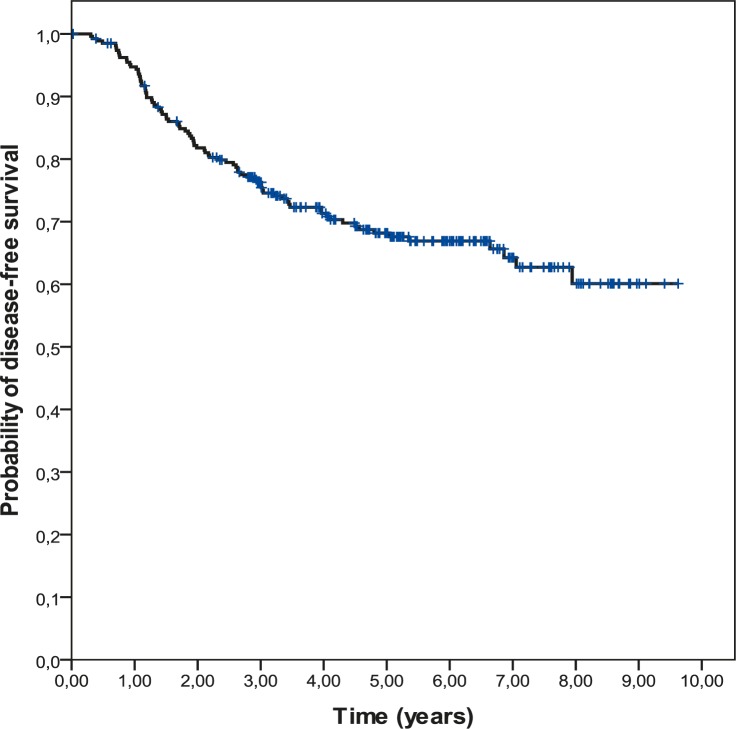
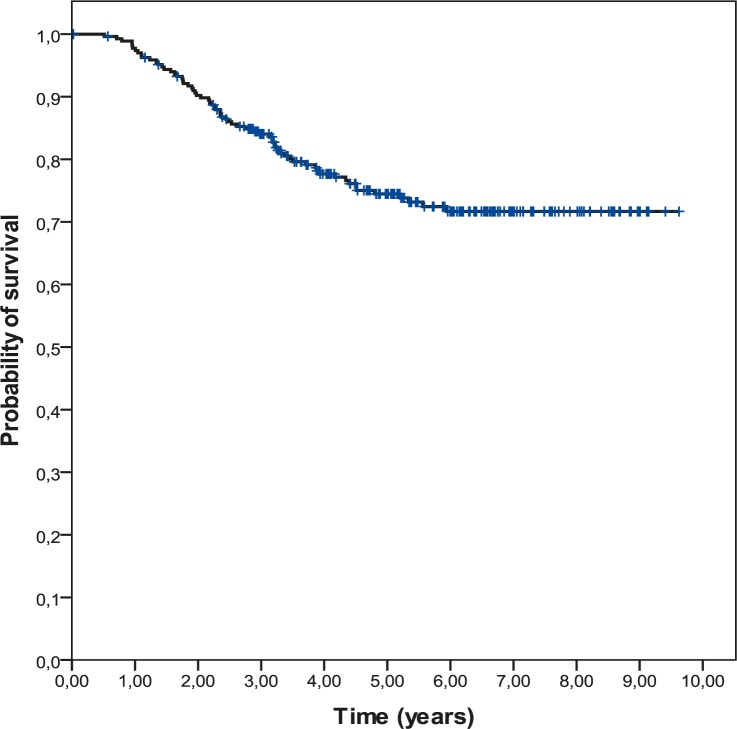
The median age of our patients was 55.3 yrs (23-88.5) and the median follow-up was 5.9 yrs (0.3-9.6). Six (2%) pts experienced local only, 79 (92%) pts distal recurrence and 66 (24%) died. The predominant localisation of the first relapse was in visceral organs (70.4%). The 5-year disease-free survival (DFS) for the entire group was 68.2% and the 5-year overall survival (OS) was 74.5%. We found a pattern of high recurrence rate in the first 3 years following the diagnosis and a clear decline in recurrence rate over the next 3 years. In the univariate analysis age, nodal status, size and lymphovascular invasion (LVI) were found to have a significant impact on DFS as well as on OS. In the multivariate analysis only age (HR=1.79; 95%CI=1.14-2.82; p=0.012) and nodal status (HR=2.71; 95%CI=1.64-4.46; p<0.001) retained their independent prognostic value for DFS and for OS only the nodal status (HR=2.96; 95%CI=1.51-5.82; p=0.002).
In our series of TNBC pts nodal status and age (older than 65 yrs) were found to be independent prognostic factors for DFS, whereas for OS only the nodal status. We found a pattern of a high recurrence rate in the first 3 years following the diagnosis and a decline in the recurrence rate over the next 3 yrs with higher rate of distal versus local recurrence and a predominant localization of distal metastases in visceral organs.
三阴性乳腺癌(TNBC)的定义是缺乏雌激素(ER)和孕激素(PgR)受体以及人表皮生长因子受体 2(HER2)的表达。我们的回顾性分析旨在探讨在常规临床实践中治疗 TNBC 患者的短期和长期结局的预后因素。
我们的回顾性研究包括 2000 年 3 月至 2006 年 12 月在卢布尔雅那肿瘤研究所治疗的 269 例 TNBC 患者。收集的数据包括患者、肿瘤和治疗的特征。使用 Kaplan-Meier 方法进行生存分析。Cox 比例风险模型用于多变量分析。
我们患者的中位年龄为 55.3 岁(23-88.5),中位随访时间为 5.9 年(0.3-9.6)。6 例(2%)患者仅出现局部复发,79 例(92%)患者出现远处复发,66 例(24%)患者死亡。首次复发的主要部位是内脏器官(70.4%)。全组 5 年无病生存率(DFS)为 68.2%,5 年总生存率(OS)为 74.5%。我们发现诊断后前 3 年复发率较高,后 3 年复发率明显下降。单因素分析发现年龄、淋巴结状态、肿瘤大小和脉管侵犯(LVI)对 DFS 和 OS 有显著影响。多因素分析仅发现年龄(HR=1.79;95%CI=1.14-2.82;p=0.012)和淋巴结状态(HR=2.71;95%CI=1.64-4.46;p<0.001)对 DFS 具有独立的预后价值,而仅淋巴结状态(HR=2.96;95%CI=1.51-5.82;p=0.002)对 OS 具有独立的预后价值。
在我们的 TNBC 患者系列中,淋巴结状态和年龄(大于 65 岁)被发现是 DFS 的独立预后因素,而 OS 仅与淋巴结状态有关。我们发现诊断后前 3 年复发率较高,后 3 年复发率下降,远处复发率高于局部复发率,且远处转移主要位于内脏器官。