Fazeli Nima, Hahn Jin-Oh
Department of Mechanical Engineering, University of Alberta, Edmonton AB, Canada.
Front Physiol. 2012 Jul 25;3:298. doi: 10.3389/fphys.2012.00298. eCollection 2012.
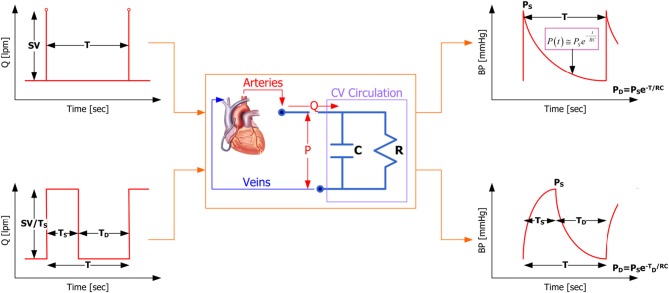
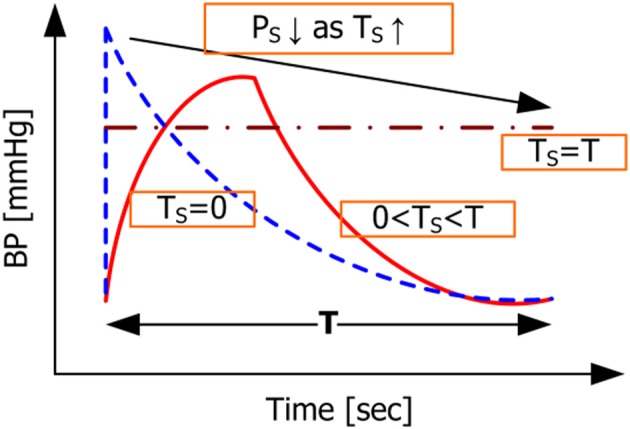
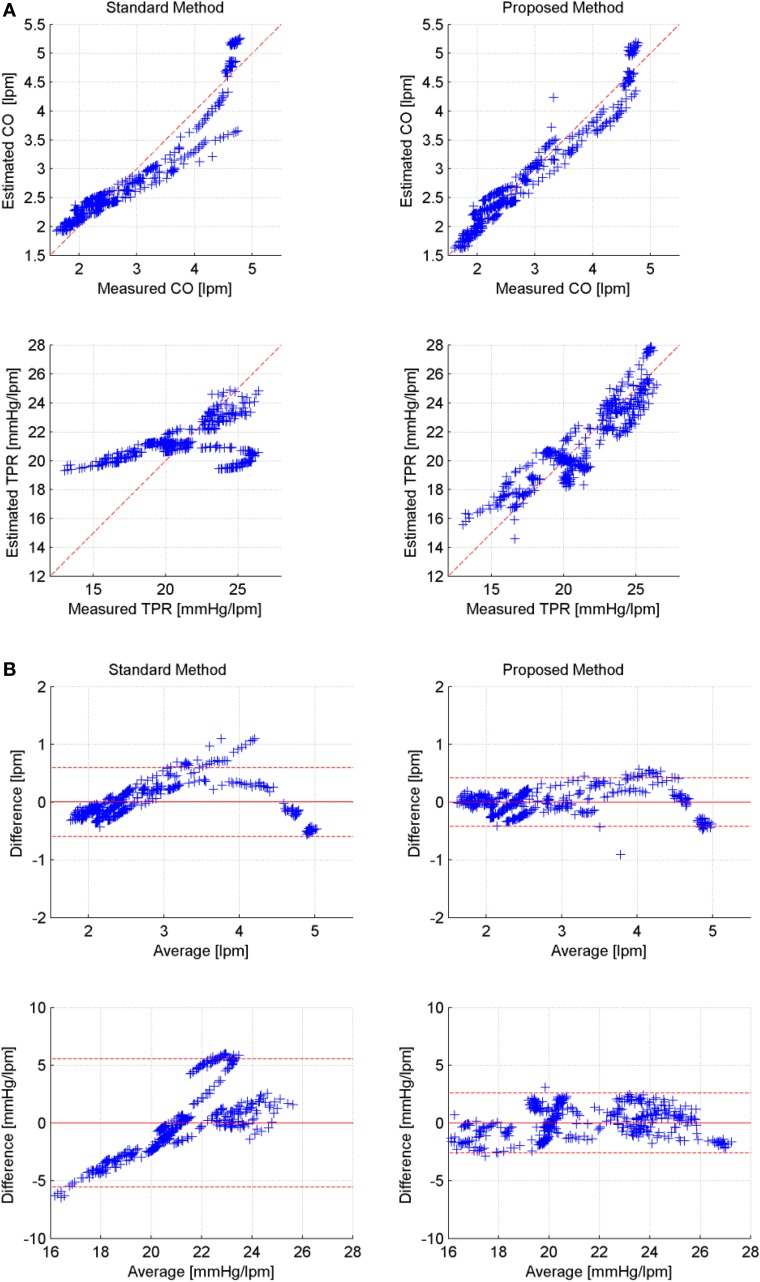
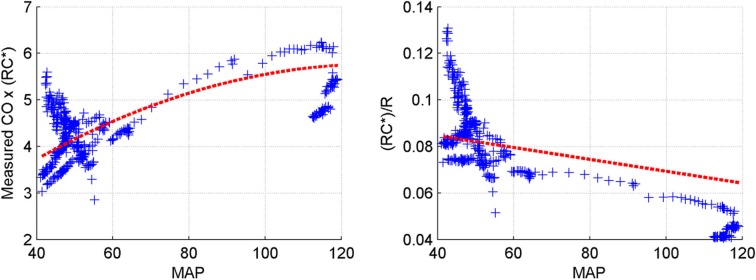
This paper presents a model-based approach to estimation of cardiac output (CO) and total peripheral resistance (TPR). In the proposed approach, the response of cardiovascular system (CVS), described by the windkessel model, is tuned to the measurements of systolic, diastolic and mean arterial blood pressures (BP) so as to yield optimal individual- and time-specific system time constant that is used to estimate CO and TPR. Unique aspects of the proposed approach are that it approximates the aortic flow as a train of square waves and that it also assumes pressure-dependent arterial compliance, as opposed to the traditional windkessel model in which aortic flow is approximated as a train of impulses and constant arterial compliance is assumed. It was shown that the proposed model encompasses the standard windkessel model as a limiting case, and that it also yields more realistic BP waveform response than the standard windkessel model. The proposed approach has potential to outperform its standard counterpart by treating systolic, diastolic, and mean BP as independent features in estimating CO and TPR, rather than solely resorting to pulse pressure as in the case of the standard windkessel model. Experimental results from in-vivo data collected from a number of animal subjects supports the viability of the proposed approach in that it could achieve approximately 29% and 24% reduction in CO and TPR errors when compared with its standard counterpart.
本文提出了一种基于模型的方法来估计心输出量(CO)和总外周阻力(TPR)。在所提出的方法中,由风箱模型描述的心血管系统(CVS)的响应被调整以适应收缩压、舒张压和平均动脉血压(BP)的测量值,从而得出用于估计CO和TPR的最优个体特异性和时间特异性系统时间常数。所提出方法的独特之处在于,它将主动脉血流近似为一系列方波,并且还假设动脉顺应性与压力有关,这与传统风箱模型不同,传统风箱模型将主动脉血流近似为一系列脉冲,并假设动脉顺应性恒定。结果表明,所提出的模型包含标准风箱模型作为一种极限情况,并且它还能产生比标准风箱模型更符合实际的血压波形响应。所提出的方法有潜力优于其标准对应方法,因为在估计CO和TPR时,它将收缩压、舒张压和平均血压视为独立特征,而不是像标准风箱模型那样仅依赖脉压。从多个动物受试者收集的体内数据的实验结果支持了所提出方法的可行性,因为与标准对应方法相比,它在CO和TPR误差方面可分别降低约29%和24%。