Leibniz-Institut für Pflanzengenetik und Kulturpflanzenforschung (IPK), Gatersleben, D-06466, Germany.
BMC Plant Biol. 2012 Aug 30;12:154. doi: 10.1186/1471-2229-12-154.
The majority of nitrogen accumulating in cereal grains originates from proteins remobilised from vegetative organs. However, interactions between grain filling and remobilisation are poorly understood. We used transcriptome large-scale pyrosequencing of flag leaves, glumes and developing grains to identify cysteine peptidase and N transporter genes playing a role in remobilisation and accumulation of nitrogen in barley.
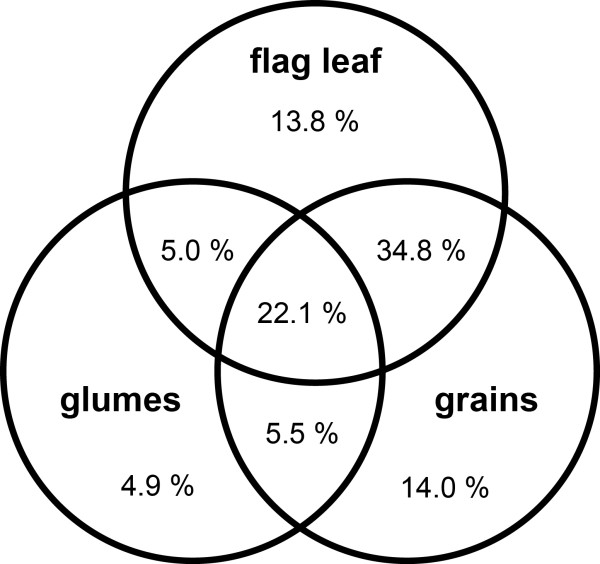
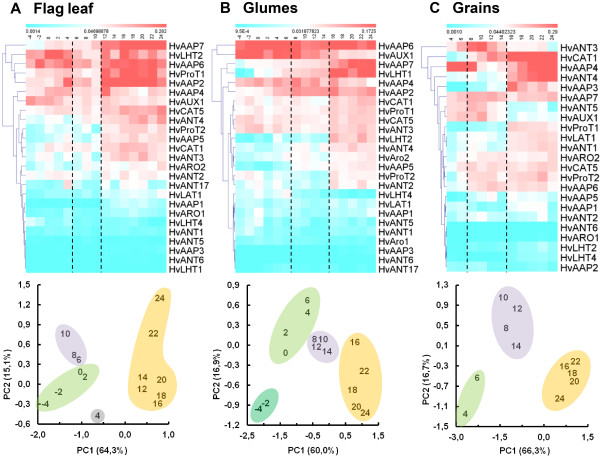
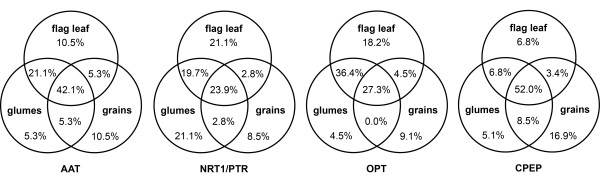
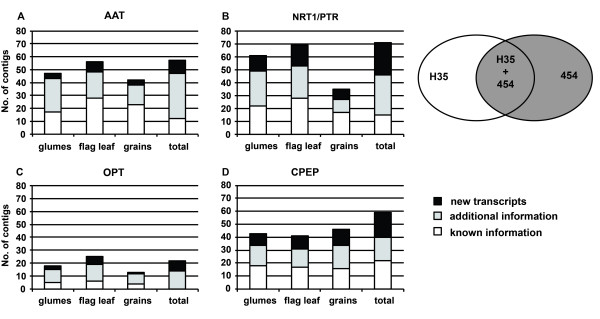
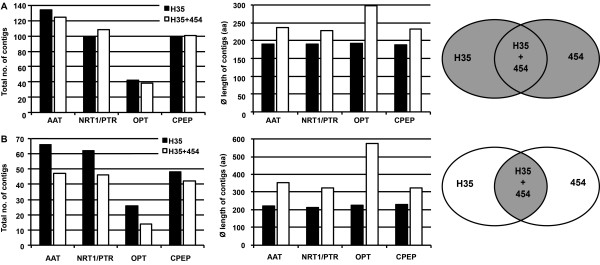
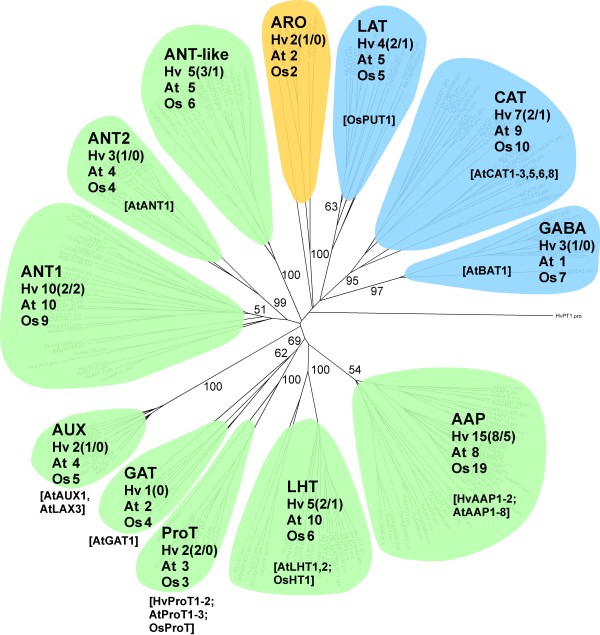
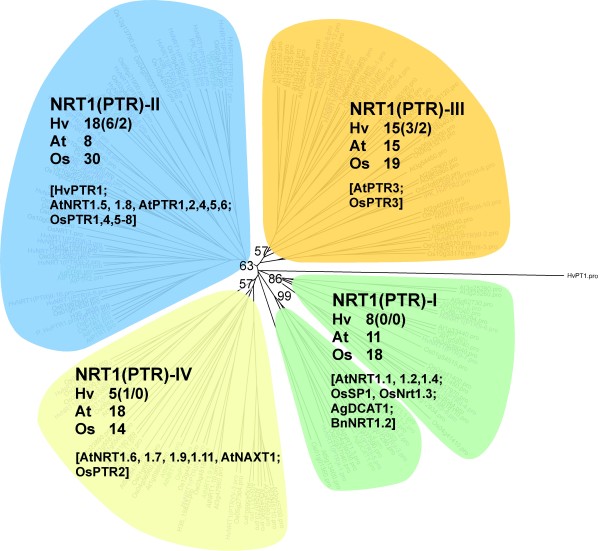
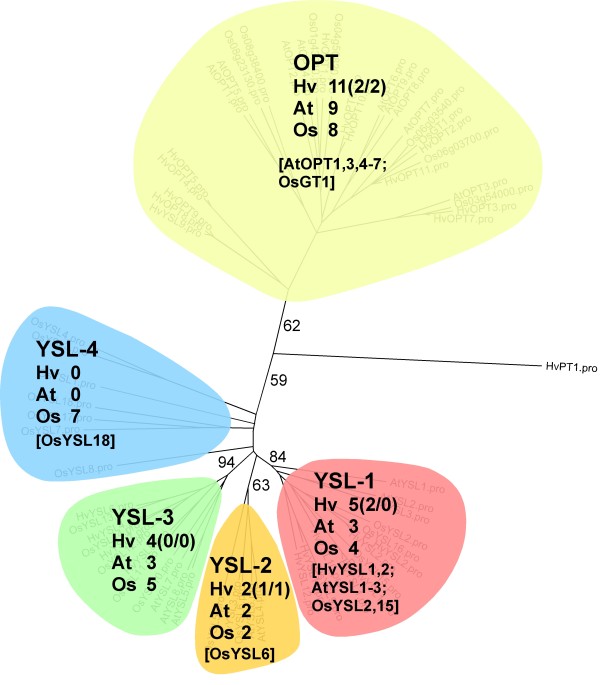
Combination of already known and newly derived sequence information reduced redundancy, increased contig length and identified new members of cysteine peptidase and N transporter gene families. The dataset for N transporter genes was aligned with N transporter amino acid sequences of rice and Arabidopsis derived from Aramemnon database. 57 AAT, 45 NRT1/PTR and 22 OPT unigenes identified by this approach cluster to defined subgroups in the respective phylogenetic trees, among them 25 AAT, 8 NRT1/PTR and 5 OPT full-length sequences. Besides, 59 unigenes encoding cysteine peptidases were identified and subdivided into different families of the papain cysteine peptidase clade. Expression profiling of full-length AAT genes highlighted amino acid permeases as the group showing highest transcriptional activity. HvAAP2 and HvAAP6 are highly expressed in vegetative organs whereas HvAAP3 is grain-specific. Sequence similarities cluster HvAAP2 and the putative transporter HvAAP6 together with Arabidopsis transporters, which are involved in long-distance transfer of amino acids. HvAAP3 is closely related to AtAAP1 and AtAAP8 playing a role in supplying N to developing seeds. An important role in amino acid re-translocation can be considered for HvLHT1 and HvLHT2 which are specifically expressed in glumes and flag leaves, respectively. PCA and K-means clustering of AAT transcript data revealed coordinate developmental stages in flag leaves, glumes and grains. Phloem-specific metabolic compounds are proposed that might signal high grain demands for N to distantly located plant organs.
The approach identified cysteine peptidases and specific N transporters of the AAT family as obviously relevant for grain filling and thus, grain yield and quality in barley. Up to now, information is based only on transcript data. To make it relevant for application, the role of identified candidates in sink-source communication has to be analysed in more detail.
谷物中积累的氮素大部分来源于从营养器官中再转移的蛋白质。然而,籽粒灌浆与再转移之间的相互作用还不太清楚。我们使用大规模的转录组 pyrosequencing 技术对旗叶、颖片和发育中的籽粒进行分析,以鉴定在大麦中氮素再转移和积累过程中起作用的半胱氨酸蛋白酶和氮转运体基因。
组合已知和新衍生的序列信息减少了冗余,增加了 contig 长度,并鉴定了半胱氨酸蛋白酶和氮转运体基因家族的新成员。氮转运体基因数据集与从 Aramemnon 数据库中获得的水稻和拟南芥的氮转运体氨基酸序列进行了比对。通过这种方法鉴定的 57 个 AAT、45 个 NRT1/PTR 和 22 个 OPT 基因簇在各自的系统发育树中聚类到特定的亚群中,其中包括 25 个 AAT、8 个 NRT1/PTR 和 5 个 OPT 全长序列。此外,还鉴定了 59 个编码半胱氨酸蛋白酶的基因,并分为木瓜蛋白酶半胱氨酸蛋白酶族的不同家族。全长 AAT 基因的表达谱分析突出了氨基酸渗透酶作为转录活性最高的一组。HvAAP2 和 HvAAP6 在营养器官中高度表达,而 HvAAP3 则是籽粒特异性的。序列相似性将 HvAAP2 和假定的转运蛋白 HvAAP6 与参与氨基酸远距离转运的拟南芥转运蛋白聚类在一起。HvAAP3 与 AtAAP1 和 AtAAP8 密切相关,它们在向发育中的种子供应氮方面发挥作用。HvLHT1 和 HvLHT2 在颖片和旗叶中特异性表达,可能在氨基酸再转移中发挥重要作用。AAT 转录数据的 PCA 和 K-means 聚类揭示了旗叶、颖片和籽粒发育阶段的协调性。提出了韧皮部特异性代谢化合物的概念,这些化合物可能向远距离的植物器官发出高籽粒对氮的需求信号。
该方法鉴定了半胱氨酸蛋白酶和 AAT 家族的特定氮转运体,显然与大麦籽粒灌浆有关,因此与籽粒产量和品质有关。到目前为止,信息仅基于转录数据。为了使其具有应用价值,还必须更详细地分析鉴定候选物在源库通讯中的作用。