University Paris Diderot, Sorbonne Paris Cité, Paris, France.
PLoS One. 2012;7(8):e37095. doi: 10.1371/journal.pone.0037095. Epub 2012 Aug 24.
Resistance of pandemic A(H1N1)2009 (H1N1pdm09) virus to neuraminidase inhibitors (NAIs) has remained limited. A new mutation I223R in the neuraminidase (NA) of H1N1pdm09 virus has been reported along with H275Y in immunocompromised patients. The aim of this study was to determine the impact of I223R on oseltamivir and zanamivir susceptibility.
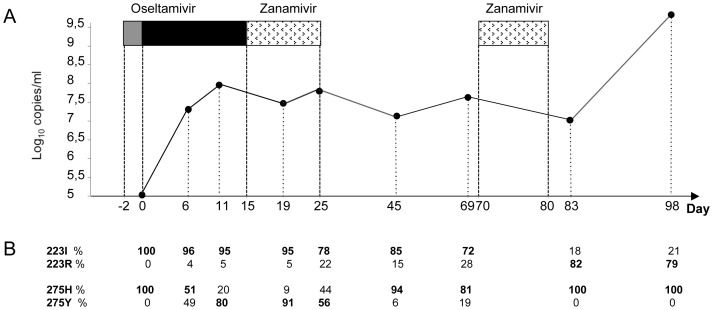
The NA enzymatic characteristics and susceptibility to NAIs of viruses harbouring the mutations I223R and H275Y alone or in combination were analyzed on viruses produced by reverse genetics and on clinical isolates collected from an immunocompromised patient with sustained influenza H1N1pdm09 virus shedding and treated by oseltamivir (days 0-15) and zanamivir (days 15-25 and 70-80).
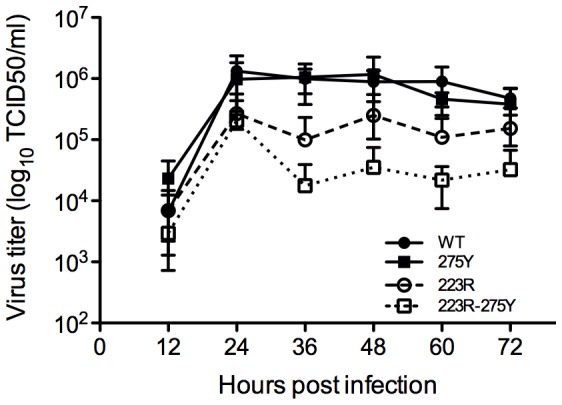
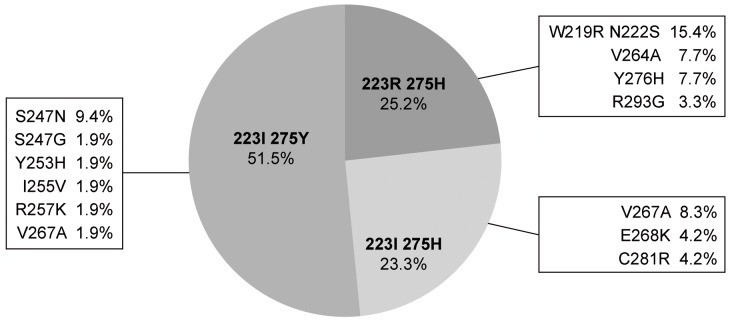
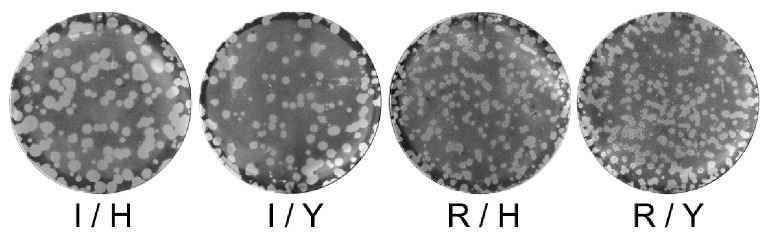
Compared with the wild type, the NA of recombinant viruses and clinical isolates with H275Y or I223R mutations had about two-fold reduced affinity for the substrate. The H275Y and I223R isolates showed decreased susceptibility to oseltamivir (246-fold) and oseltamivir and zanamivir (8.9- and 4.9-fold), respectively. Reverse genetics assays confirmed these results and further showed that the double mutation H275Y and I223R conferred enhanced levels of resistance to oseltamivir and zanamivir (6195- and 15.2-fold). In the patient, six days after initiation of oseltamivir therapy, the mutation H275Y conferring oseltamivir resistance and the I223R mutation were detected in the NA. Mutations were detected concomitantly from day 6-69 but molecular cloning did not show any variant harbouring both mutations. Despite cessation of NAI treatment, the mutation I223R persisted along with additional mutations in the NA and the hemagglutinin.
Reduced susceptibility to both oseltamivir and zanamivir was conferred by the I223R mutation which potentiated resistance to both NAIs when associated with the H275Y mutation in the NA. Concomitant emergence of the I223R and H275Y mutations under oseltamivir treatment underlines the importance of close monitoring of treated patients especially those immunocompromised.
大流行 A(H1N1)2009(H1N1pdm09)病毒对神经氨酸酶抑制剂(NAIs)的耐药性仍然有限。已报道 H1N1pdm09 病毒的神经氨酸酶(NA)中存在新的突变 I223R,以及免疫功能低下患者中的 H275Y。本研究的目的是确定 I223R 对奥司他韦和扎那米韦敏感性的影响。
通过反向遗传学产生的病毒和从免疫功能低下患者中持续流感 H1N1pdm09 病毒脱落并接受奥司他韦(第 0-15 天)和扎那米韦(第 15-25 天和 70-80 天)治疗的临床分离株,分析单独或组合携带突变 I223R 和 H275Y 的病毒的 NA 酶特性和对 NAI 的敏感性。
与野生型相比,具有 H275Y 或 I223R 突变的重组病毒和临床分离株的 NA 对底物的亲和力降低约两倍。H275Y 和 I223R 分离株对奥司他韦(246 倍)和奥司他韦和扎那米韦(8.9-和 4.9 倍)的敏感性降低。反向遗传学检测证实了这些结果,并进一步表明双突变 H275Y 和 I223R 赋予对奥司他韦和扎那米韦的增强耐药性(6195-和 15.2 倍)。在患者中,奥司他韦治疗开始后六天,在 NA 中检测到赋予奥司他韦耐药性的 H275Y 突变和 I223R 突变。从第 6-69 天检测到突变,但分子克隆未显示任何同时携带两种突变的变体。尽管停止了 NAI 治疗,但 I223R 突变仍与 NA 和血凝素中的其他突变一起持续存在。
I223R 突变赋予对奥司他韦和扎那米韦的敏感性降低,当与 NA 中的 H275Y 突变同时存在时,增强了对两种 NAI 的耐药性。在奥司他韦治疗下同时出现 I223R 和 H275Y 突变,强调了密切监测接受治疗的患者,尤其是免疫功能低下患者的重要性。