Department of Hospital Management and Health Policy, West China Hospital, Sichuan University, Chengdu, People's Republic of China.
PLoS One. 2012;7(8):e43081. doi: 10.1371/journal.pone.0043081. Epub 2012 Aug 21.
Few research studies have addressed the long-term effects caused by catastrophes, and no study has ever explored the life quality, physical diseases, and psychological impairment of earthquake survivors at the same time. This study seeks to reveal survivors' quality of life, physical diseases, and mental health.
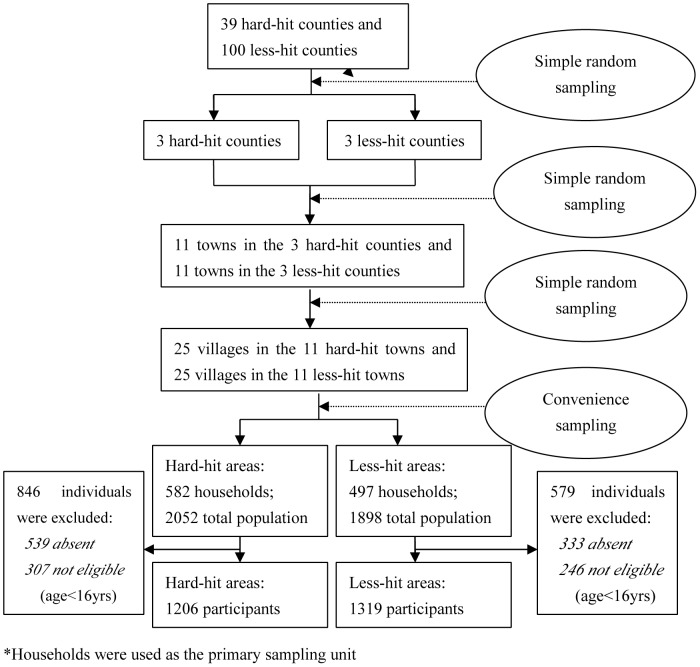
A cross-sectional survey was conducted through multi-stage sampling approach three years after the Wenchuan earthquake.
A total of 2525 subjects were interviewed. Symptoms of PTSD were reported by 8.8% of the respondents from the seriously affected areas and 0.5%, the less hit areas. Prevalence of chronic diseases was 39.2% and 22.1% respectively, and two-week prevalence rate, 24.9% and 12.7% respectively. In the multivariate analysis, two-week prevalence, displacement, no regular income, receiving mental health support after the disaster, family members died or missing, injured due to the quake, and person who witnessed someone being killed or injured were independently associated with higher prevalence for symptoms of PTSD. Most subscales of SF-12 negatively correlated with age, chronic diseases, two-week prevalence, injured due to the disaster, home or property loss, and score of the 3-year PTSD symptoms, but positively correlated with higher education and higher household income.
The rates of physical diseases and symptoms of PTSD were relatively high, and the quality of life was poor among victims in the hard-hit areas 3 years after the earthquake. Physical impairment correlated with symptom of PTSD, and both were negatively associated with quality of life.
很少有研究探讨灾难带来的长期影响,也没有研究同时探究地震幸存者的生活质量、身体疾病和心理障碍。本研究旨在揭示幸存者的生活质量、身体疾病和心理健康状况。
采用多阶段抽样方法,在汶川地震三年后进行了横断面调查。
共访谈了 2525 名受访者。重灾区和轻灾区分别有 8.8%和 0.5%的受访者出现创伤后应激障碍症状。慢性疾病的患病率分别为 39.2%和 22.1%,两周患病率分别为 24.9%和 12.7%。多变量分析显示,两周患病率、流离失所、没有固定收入、灾后接受心理健康支持、家庭成员死亡或失踪、因地震受伤以及目睹他人死亡或受伤与创伤后应激障碍症状的更高患病率独立相关。SF-12 的大多数子量表与年龄、慢性疾病、两周患病率、因灾害受伤、家庭或财产损失以及 3 年 PTSD 症状评分呈负相关,但与较高的教育程度和较高的家庭收入呈正相关。
震后 3 年,重灾区受害者的身体疾病和创伤后应激障碍症状发生率相对较高,生活质量较差。身体损伤与 PTSD 症状相关,两者均与生活质量呈负相关。