MRC Centre for Drug Safety Science, Department of Molecular and Clinical Pharmacology, University of Liverpool, Liverpool, United Kingdom.
PLoS One. 2012;7(8):e43809. doi: 10.1371/journal.pone.0043809. Epub 2012 Aug 24.
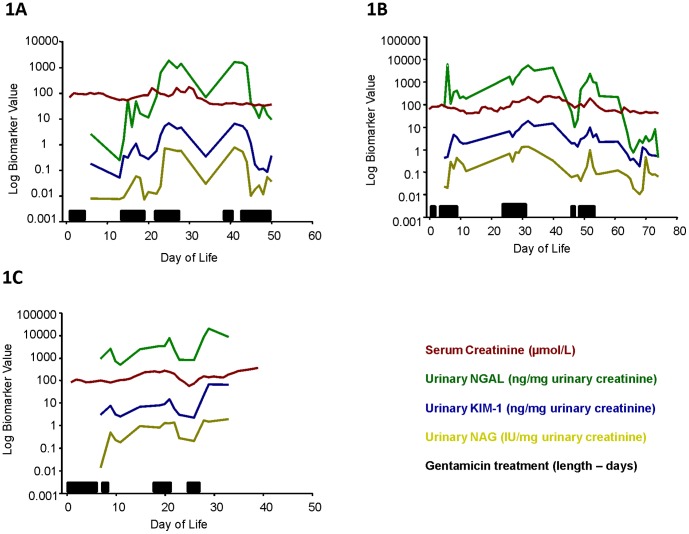
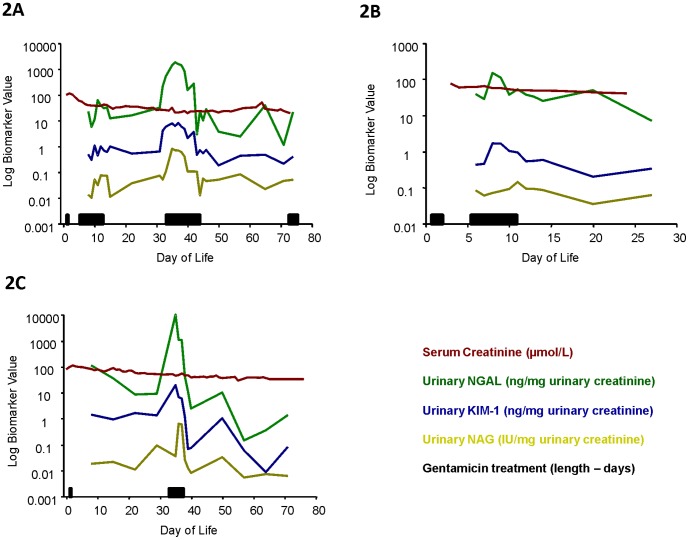
Premature infants are frequently exposed to aminoglycoside antibiotics. Novel urinary biomarkers may provide a non-invasive means for the early identification of aminoglycoside-related proximal tubule renal toxicity, to enable adjustment of treatment and identification of infants at risk of long-term renal impairment. In this proof-of-concept study, urine samples were collected from 41 premature neonates (≤ 32 weeks gestation) at least once per week, and daily during courses of gentamicin, and for 3 days afterwards. Significant increases were observed in the three urinary biomarkers measured (Kidney Injury Molecule-1 (KIM-1), Neutrophil Gelatinase-associated Lipocalin (NGAL), and N-acetyl-β-D-glucosaminidase (NAG)) during treatment with multiple courses of gentamicin. When adjusted for potential confounders, the treatment effect of gentamicin remained significant only for KIM-1 (mean difference from not treated, 1.35 ng/mg urinary creatinine; 95% CI 0.05-2.65). Our study shows that (a) it is possible to collect serial urine samples from premature neonates, and that (b) proximal tubule specific urinary biomarkers can act as indicators of aminoglycoside-associated nephrotoxicity in this age group. Further studies to investigate the clinical utility of novel urinary biomarkers in comparison to serum creatinine need to be undertaken.
早产儿经常接触氨基糖苷类抗生素。新型尿生物标志物可能为早期识别氨基糖苷类相关的近端肾小管肾毒性提供一种非侵入性手段,以便调整治疗方案,并识别有长期肾损伤风险的婴儿。在这项概念验证研究中,收集了 41 名早产儿(≤32 周妊娠)的尿液样本,每周至少收集一次,在使用庆大霉素期间每天收集,之后连续 3 天收集。在多次使用庆大霉素治疗期间,所测量的三种尿生物标志物(肾损伤分子-1(KIM-1)、中性粒细胞明胶酶相关脂质运载蛋白(NGAL)和 N-乙酰-β-D-氨基葡萄糖苷酶(NAG))均观察到显著增加。在调整了潜在混杂因素后,庆大霉素的治疗效果仅对 KIM-1 具有显著意义(与未治疗相比的平均差异为 1.35ng/mg 尿肌酐;95%CI 0.05-2.65)。我们的研究表明:(a)可以从早产儿中收集连续的尿液样本;(b)近端肾小管特异性尿生物标志物可以作为该年龄组中氨基糖苷类相关肾毒性的指标。需要进一步研究新型尿生物标志物与血清肌酐相比的临床实用性。