Golshani Kiarash, Ferrel Andrew, Lessne Mark, Shah Pratish, Chowdhary Abhineet, Choulakian Armen, Alexander Michael J, Smith Tony P, Enterline David S, Zomorodi Ali R, Britz Gavin W
Department of Neurological Surgery, Loma Linda University Medical Center, Loma Linda, USA.
Surg Neurol Int. 2012;3:84. doi: 10.4103/2152-7806.99174. Epub 2012 Jul 28.
The purpose of this study is to retrospectively review our experience with stent-assisted embolization of patients with an acutely ruptured cerebral aneurysm.
Medical records and imaging were reviewed for 36 patients who underwent stent-assisted embolization of a ruptured cerebral aneurysm.
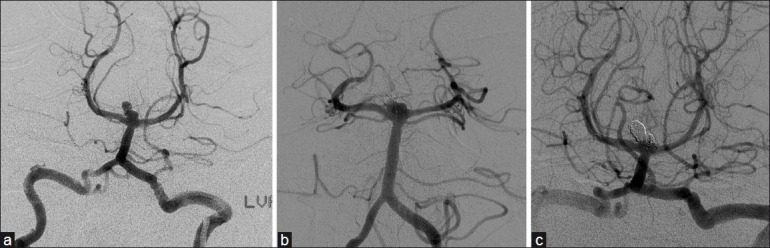
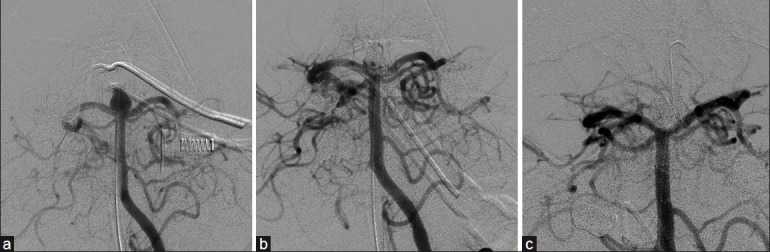
Seventeen patients (47%) received a preprocedural loading dose of clopidogrel and five patients (14%) received an intraprocedural dose of clopidogrel. The remaining 14 patients (36%) were treated with antiplatelet therapy following the procedure. Six (17%) stent related intraprocedural thromboembolic complications were encountered; four of these resolved (one partial, three complete) following treatment with abciximab and/or heparin during the procedure. Five of the six thromboembolic events occurred in patients who were not pretreated with clopidogrel (P = 0.043). Two patients in this series (6%) had a permanent thrombotic complication resulting in mild hemiparesis in one patient, and hemianopsia in the second. No procedure related hemorrhagic complications occurred in any patient. One patient had a spontaneous parenchymal hemorrhage contralateral to the treated aneurysm discovered 10 days after treatment. Twenty-eight patients (78%) had a Glasgow Outcome Score of 4 or better at discharge. Seven of 21 patients (33%) with angiographic follow-up required further treatment of the coiled aneurysm.
Stent-assisted coil embolization is an option for treatment of ruptured wide neck ruptured aneurysms and for salvage treatment during unassisted embolization of ruptured aneurysms but complications and retreatment rates are higher than for routine clipping or coiling of cerebral aneurysms. Pretreatment with clopidogrel appears effective in reducing thrombotic complications without significant increasing risk of hemorrhagic complications.
本研究的目的是回顾性分析我们对急性破裂脑动脉瘤患者进行支架辅助栓塞治疗的经验。
回顾了36例接受破裂脑动脉瘤支架辅助栓塞治疗患者的病历和影像学资料。
17例患者(47%)在术前接受了氯吡格雷负荷剂量治疗,5例患者(14%)在术中接受了氯吡格雷剂量治疗。其余14例患者(36%)在术后接受抗血小板治疗。术中发生6例(17%)与支架相关的血栓栓塞并发症;其中4例在术中使用阿昔单抗和/或肝素治疗后得到缓解(1例部分缓解,3例完全缓解)。6例血栓栓塞事件中有5例发生在未接受氯吡格雷预处理的患者中(P = 0.043)。本系列中有2例患者(6%)发生永久性血栓形成并发症,其中1例导致轻度偏瘫,另1例导致偏盲。所有患者均未发生与手术相关的出血并发症。1例患者在治疗后10天发现治疗侧动脉瘤对侧发生自发性脑实质出血。28例患者(78%)出院时格拉斯哥预后评分达到4分或更高。21例接受血管造影随访的患者中有7例(33%)需要对栓塞后的动脉瘤进行进一步治疗。
支架辅助弹簧圈栓塞是治疗破裂宽颈动脉瘤以及在破裂动脉瘤单纯栓塞治疗中进行挽救性治疗的一种选择,但并发症和再治疗率高于脑动脉瘤的常规夹闭或单纯弹簧圈栓塞。氯吡格雷预处理似乎能有效降低血栓形成并发症,而不会显著增加出血并发症的风险。