R&D Center, UNITIKA Ltd, 23 Kozakura, Uji-shi, Kyoto 611-0021, Japan.
Lipids Health Dis. 2012 Aug 31;11:108. doi: 10.1186/1476-511X-11-108.
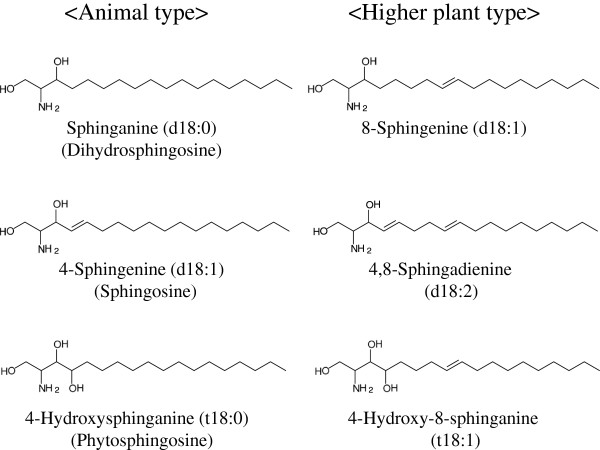
Ingestion of glucosylceramide improves transepidermal water loss (TEWL) from the skin, but the underlying mechanism by which a small amount of dietary glucosylceramide can vastly improve skin conditions remains unclear. In a previous report, glucosylceramides were shown to be digested to sphingoids, which were shown to be absorbed through the intestinal epithelium. Based on these observations, we hypothesized that sphingoids are the key molecules facilitating endogenous ceramide production. In this study, we assessed the effect of 4,8-sphingadienine (d18:2) and 4-hydroxy-8-sphingenine (t18:1), derived from konjac glucosylceramide, on stimulating ceramide production.
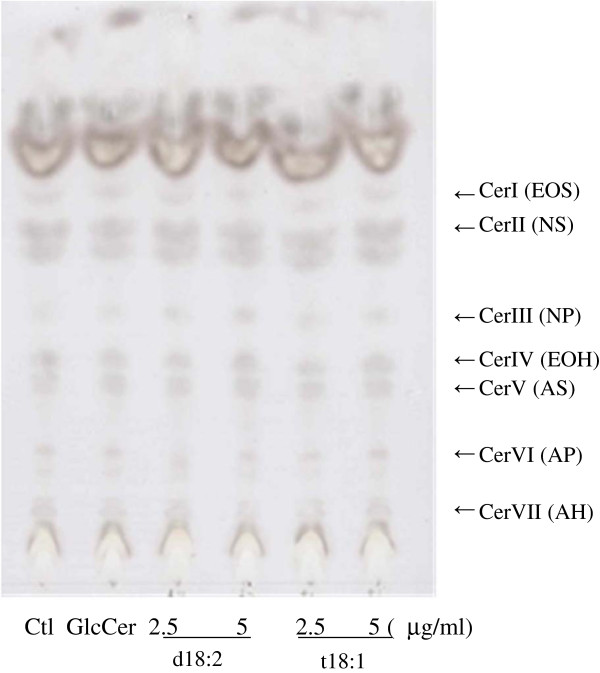
Konjac glucosylceramide acidolysis was performed using hydrochloric acid; the resulting d18:2 and t18:1 were fractionated by column chromatography. Real-time quantitative RT-PCR was performed to assess the effect of d18:2 and t18:1 on gene expression in normal human epidermal keratinocytes, while their effect on the nuclear receptor, peroxisome proliferator-activated receptor (PPAR)γ, was measured using a receptor-cofactor assay system. The effect of d18:2 and t18:1 on stimulating ceramide production was evaluated using HPTLC analysis in a 3-dimensional human skin model.
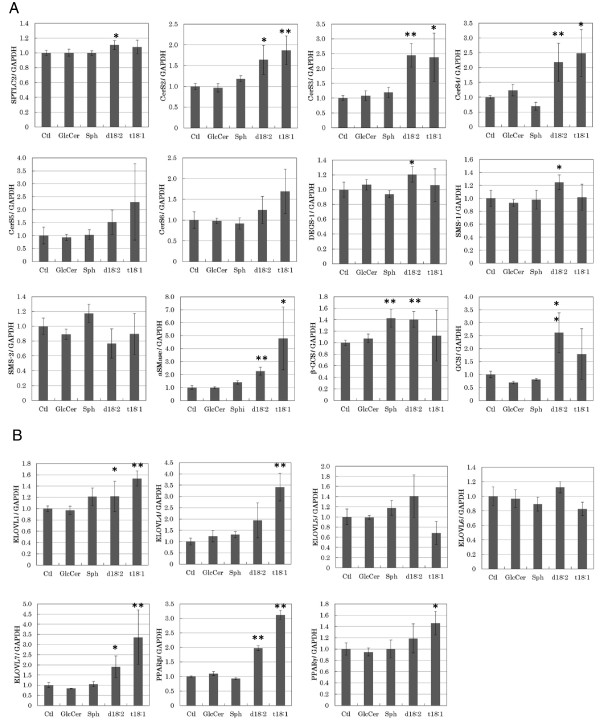
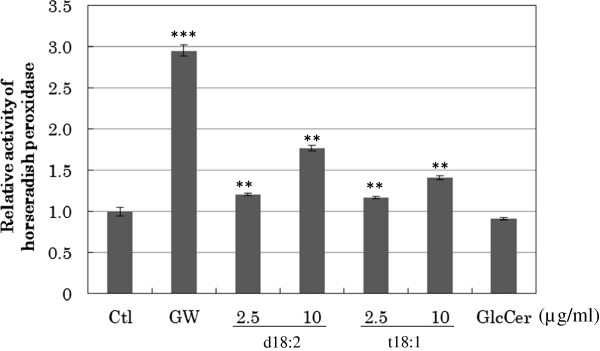
We noted the upregulation of genes related to de novo ceramide synthesis as well as of those encoding the elongases of very long-chain fatty acids by d18:2 and t18:1, but not by glucosylceramide and 4-sphingenine. Both these sphingoids also facilitated the expression of PPARβ/δ and PPARγ; moreover, they also demonstrated ligand activity for PPARγ. These results indicated that d18:2 and t18:1 promote the differentiation of keratinocytes. Analysis of the lipids within the 3-dimensional human skin model indicated that treatment with d18:2 and t18:1 not only upregulated gene expression but also increased ceramide production.
The sphingoids d18:2 and t18:1 activated genes related to de novo ceramide synthesis and increased ceramide production, whereas glucosylceramide and 4-sphingenine could not. These results suggest that the effect of dietary glucosylceramides on the skin is mediated by d18:2 and t18:1.
摄入葡糖基神经酰胺可改善皮肤的经表皮水分流失(TEWL),但少量饮食葡糖基神经酰胺可极大改善皮肤状况的潜在机制尚不清楚。在之前的报告中,葡糖基神经酰胺被消化为神经鞘氨醇,神经鞘氨醇被证明可通过肠上皮吸收。基于这些观察结果,我们假设神经鞘氨醇是促进内源性神经酰胺产生的关键分子。在这项研究中,我们评估了源自魔芋葡糖基神经酰胺的 4,8-神经鞘氨二烯(d18:2)和 4-羟基-8-神经鞘氨醇(t18:1)对刺激神经酰胺产生的影响。
使用盐酸对魔芋葡糖基神经酰胺进行酸解;通过柱层析对所得的 d18:2 和 t18:1 进行分离。通过实时定量 RT-PCR 评估 d18:2 和 t18:1 对正常人表皮角质形成细胞基因表达的影响,同时使用受体辅因子测定系统测量其对过氧化物酶体增殖物激活受体(PPAR)γ的影响。通过在 3D 人体皮肤模型中使用 HPTLC 分析评估 d18:2 和 t18:1 刺激神经酰胺产生的效果。
我们注意到 d18:2 和 t18:1 上调了与从头合成神经酰胺相关的基因以及编码超长链脂肪酸延长酶的基因,但葡糖基神经酰胺和 4-神经鞘氨醇没有。这两种神经鞘氨醇还促进了 PPARβ/δ 和 PPARγ的表达;此外,它们还表现出对 PPARγ的配体活性。这些结果表明 d18:2 和 t18:1 促进角质形成细胞分化。对 3D 人体皮肤模型中的脂质分析表明,用 d18:2 和 t18:1 处理不仅上调了基因表达,还增加了神经酰胺的产生。
神经鞘氨醇 d18:2 和 t18:1 激活了与从头合成神经酰胺相关的基因并增加了神经酰胺的产生,而葡糖基神经酰胺和 4-神经鞘氨醇则不能。这些结果表明饮食葡糖基神经酰胺对皮肤的影响是由 d18:2 和 t18:1 介导的。