Sanford-Burnham Medical Research Institute, Del E. Webb Neuroscience, Aging and Stem Cell Research Center, Program of Development and Aging, La Jolla, CA 92037, USA.
Trends Endocrinol Metab. 2012 Dec;23(12):637-44. doi: 10.1016/j.tem.2012.07.007. Epub 2012 Aug 30.
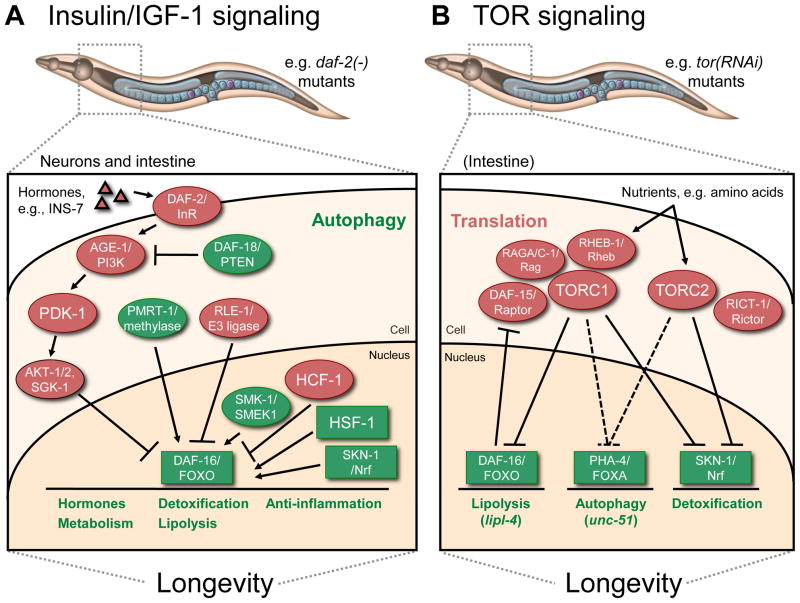
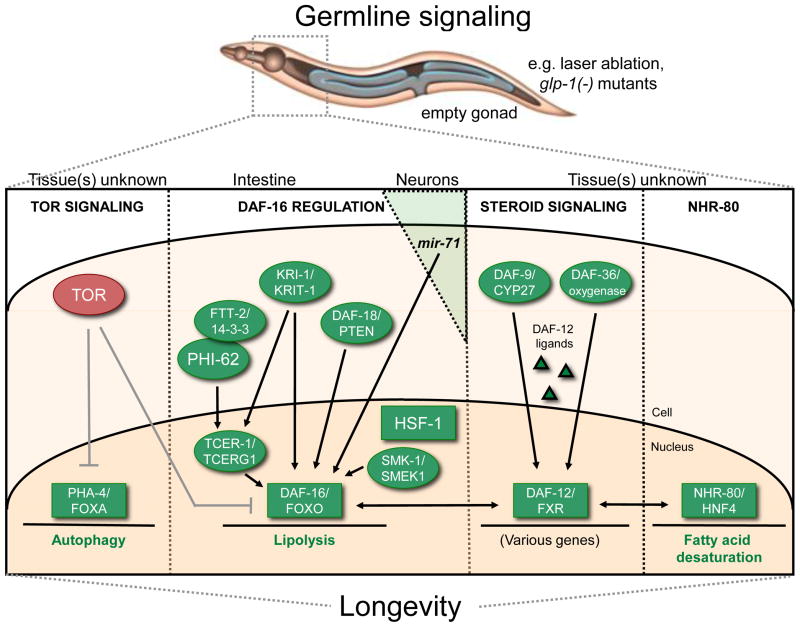
Recent research using model organisms such as the nematode Caenorhabditis elegans has highlighted a crucial role for several conserved signaling pathways in longevity determination. Here, we review three major endocrine- and nutrient-sensing signaling pathways with influence on lifespan, the insulin/insulin-like growth factor (IGF), target of rapamycin (TOR), and germline signaling pathways. Although these pathways engage distinct sets of transcription factors, the three pathways appear to modulate aging in C. elegans through partially overlapping effector mechanisms, including lipid metabolism and autophagy. This review highlights the latest advances in our understanding of how the insulin/IGF-1, TOR, and germline signaling pathways utilize different transcription factors to modulate aging in C. elegans with special emphasis on the role of lipid metabolism and autophagy.
最近利用线虫秀丽隐杆线虫等模式生物的研究强调了几种保守的信号通路在寿命决定中的关键作用。在这里,我们综述了三个主要的内分泌和营养感应信号通路,它们对寿命有影响,即胰岛素/胰岛素样生长因子 (IGF)、雷帕霉素靶蛋白 (TOR) 和生殖细胞信号通路。尽管这些通路涉及不同的转录因子,但这三种途径似乎通过部分重叠的效应机制来调节秀丽隐杆线虫的衰老,包括脂质代谢和自噬。本综述强调了我们对胰岛素/IGF-1、TOR 和生殖细胞信号通路如何利用不同的转录因子来调节秀丽隐杆线虫衰老的理解的最新进展,特别强调了脂质代谢和自噬的作用。