Sanou Anselme Simeon, Diallo Abdoulaye Hama, Holding Penny, Nankabirwa Victoria, Engebretsen Ingunn Marie S, Ndeezi Grace, Tumwine James K, Meda Nicolas, Tylleskär Thorkild, Kashala-Abotnes Esperance
1Centre for International Health (CIH), Department of Global Public Health and Primary Health Care, Faculty of Medicine, University of Bergen, Bergen, Norway.
Department of Public Health, Centre MURAZ Research Institute, Ministry of Health, Bobo-Dioulasso, Burkina Faso.
Child Adolesc Psychiatry Ment Health. 2018 Jun 7;12:30. doi: 10.1186/s13034-018-0236-1. eCollection 2018.
In Burkina Faso, stunting affects children and is a public health problem. We studied the association between stunting and child's neuro-psychological outcomes at 6-8 years of age in rural Burkina Faso using the Kaufman Assessment Battery for Children, 2nd edition (KABC-II), the Children's Category Test 1 (CCT-1) and the Test of Variable of Attention (TOVA).
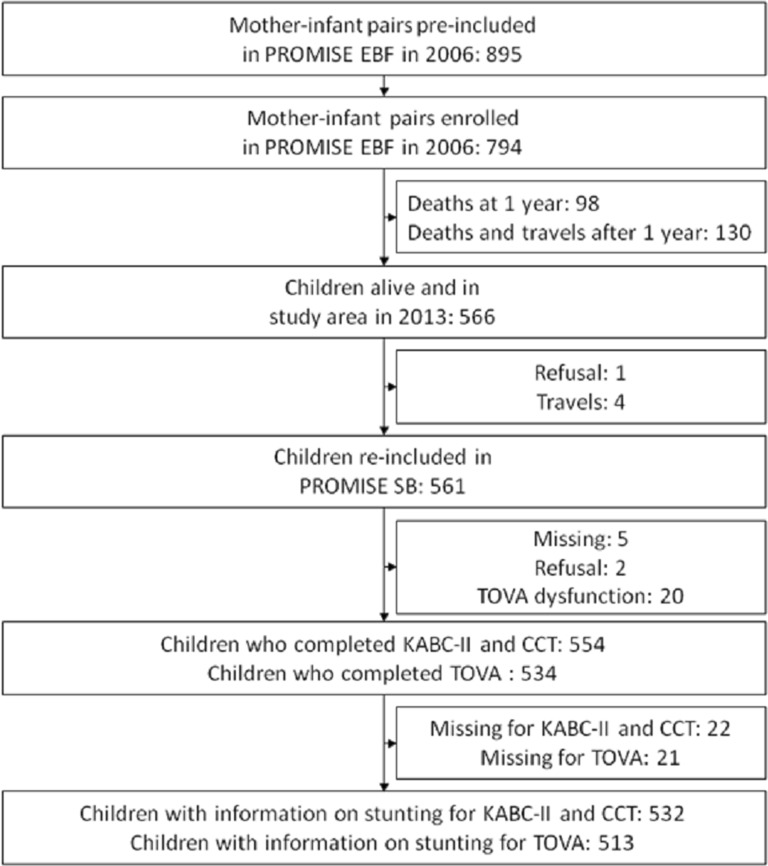
We re-enrolled children of a previously community-based Exclusive breastfeeding trial in Burkina Faso. We assessed a total of 532 children aged 6-8 years using KABC-II for memory (Atlantis and Number Recall subtests), spatial abilities (Conceptual Thinking, Face Recognition and Triangle subtests), reasoning (Block Counting subtest), general cognition and CCT-1 for cognitive flexibility. A total 513 children were assessed using the TOVA to measure attention and inhibition. We calculated the Cohen's d to examine the effect size and conducted a linear regression to examine the association.
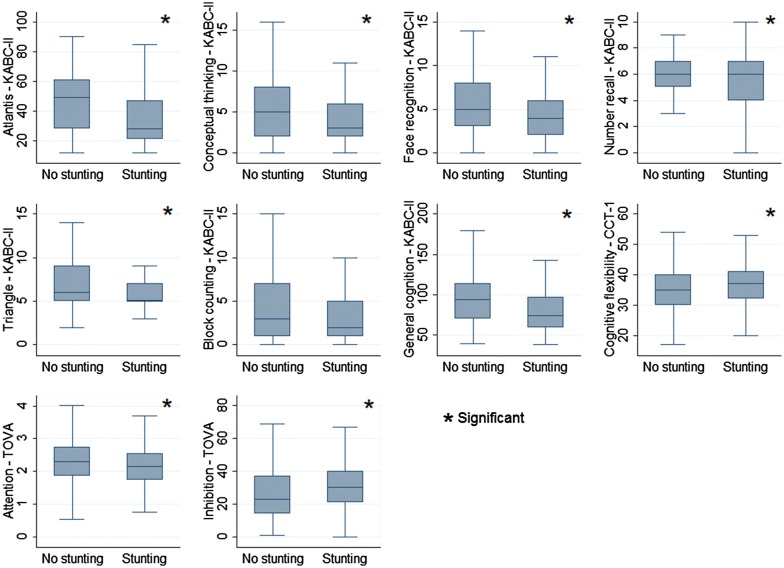
The proportion of stunting was 15.6% (83/532). Stunted children performed significantly poorer for memory (Atlantis and Number Recall), spatial abilities (Conceptual Thinking, Face Recognition and Triangle), general cognition and attention with a small effect size compared to non-stunted children. Children who were exposed scored significantly higher errors for cognitive flexibility and inhibition with a small effect size compared to unexposed children. At standardized and unstandardized multivariable regression analysis, stunted children performed significantly poorer for Atlantis (p = 0.001), Number Recall (p = 0.02), Conceptual Thinking (p = 0.01), Triangle (p = 0.001), general cognition (p ≤ 0.0001) and attention (p = 0.04) compared to non-stunted children. Children who were exposed scored significantly higher errors for cognitive flexibility (p = 0.02) and for inhibition (p = 0.02) compared to unexposed children. We adjusted all the results for age, schooling, sex, playing, father education, mother employment and promotion of previous exclusive breastfeeding.
Stunting is associated with poorer neuro-psychological outcomes among children in rural Burkina Faso. Initiatives related to prevention need to be established and advice on nutrition need to be provided.
在布基纳法索,发育迟缓影响儿童,是一个公共卫生问题。我们使用考夫曼儿童评估量表第二版(KABC-II)、儿童类别测验1(CCT-1)和注意力变量测试(TOVA),研究了布基纳法索农村地区6至8岁儿童发育迟缓与神经心理结果之间的关联。
我们重新招募了布基纳法索一项先前基于社区的纯母乳喂养试验中的儿童。我们使用KABC-II评估了532名6至8岁儿童的记忆力(亚特兰蒂斯和数字回忆子测验)、空间能力(概念思维、面部识别和三角形子测验)、推理能力(积木计数子测验)、一般认知能力,以及使用CCT-1评估认知灵活性。总共513名儿童使用TOVA进行注意力和抑制能力测量。我们计算了科恩d值以检验效应大小,并进行线性回归以检验关联性。
发育迟缓的比例为15.6%(83/532)。与非发育迟缓儿童相比,发育迟缓儿童在记忆力(亚特兰蒂斯和数字回忆)、空间能力(概念思维、面部识别和三角形)、一般认知和注意力方面表现明显较差,效应大小较小。与未暴露儿童相比,暴露儿童在认知灵活性和抑制方面的错误得分明显更高,效应大小较小。在标准化和非标准化多变量回归分析中,与非发育迟缓儿童相比,发育迟缓儿童在亚特兰蒂斯(p = 0.001)、数字回忆(p = 0.02)、概念思维(p = 0.01)、三角形(p = 0.001)、一般认知(p ≤ 0.0001)和注意力(p = 0.04)方面表现明显较差。与未暴露儿童相比,暴露儿童在认知灵活性(p = 0.02)和抑制(p = 0.02)方面的错误得分明显更高。我们对所有结果进行了年龄、上学情况、性别、玩耍情况、父亲教育程度、母亲就业情况以及先前纯母乳喂养推广情况的调整。
在布基纳法索农村地区,发育迟缓与儿童较差的神经心理结果相关。需要制定与预防相关的举措,并提供营养方面的建议。