Division of Immunology, Department of Pathology, University of Cambridge, Cambridge CB2 1QP, United Kingdom.
Genome Res. 2012 Oct;22(10):1845-54. doi: 10.1101/gr.137976.112. Epub 2012 Sep 4.
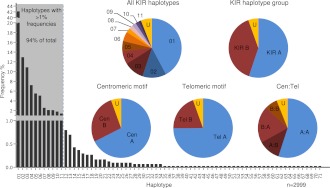
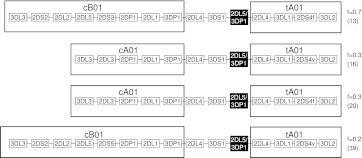
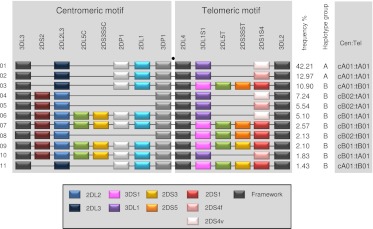
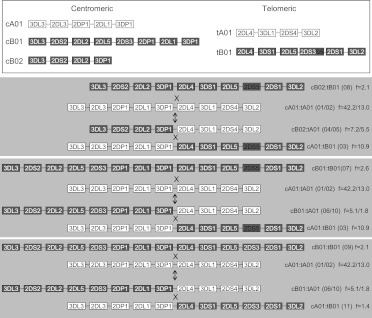
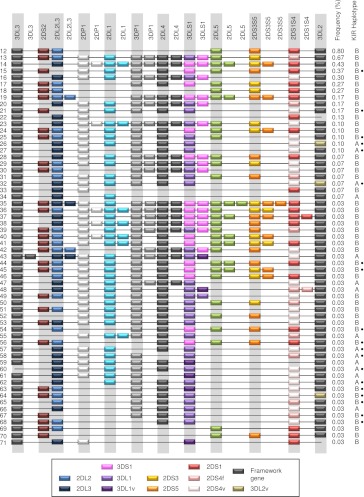
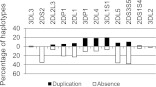
The KIR complex appears to be evolving rapidly in humans, and more than 50 different haplotypes have been described, ranging from four to 14 KIR loci. Previously it has been suggested that most KIR haplotypes consist of framework genes, present in all individuals, which bracket a variable number of other genes. We used a new technique to type 793 families from the United Kingdom and United States for both the presence/absence of all individual KIR genes as well as copy number and found that KIR haplotypes are even more complex. It is striking that all KIR loci are subject to copy number variation (CNV), including the so-called framework genes, but CNV is much more frequent in KIR B haplotypes than KIR A haplotypes. These two basic KIR haplotype groups, A and B, appear to be following different evolutionary trajectories. Despite the great diversity, there are 11 common haplotypes, derived by reciprocal recombination near KIR2DL4, which collectively account for 94% of KIR haplotypes determined in Caucasian samples. These haplotypes could be derived from combinations of just three centromeic and two telomeric motifs, simplifying disease analysis for these haplotypes. The remaining 6% of haplotypes displayed novel examples of expansion and contraction of numbers of loci. Conventional KIR typing misses much of this additional complexity, with important implications for studying the genetics of disease association with KIR that can now be explored by CNV analysis.
KIR 复合体在人类中似乎进化迅速,已经描述了超过 50 种不同的单倍型,范围从 4 到 14 个 KIR 基因座。此前曾有人提出,大多数 KIR 单倍型由所有个体中存在的框架基因组成,这些框架基因框定了数量不定的其他基因。我们使用一种新的技术对来自英国和美国的 793 个家庭进行了基因分型,既包括所有个体 KIR 基因的存在/缺失情况,也包括拷贝数,结果发现 KIR 单倍型甚至更加复杂。引人注目的是,所有 KIR 基因座都受到拷贝数变异(CNV)的影响,包括所谓的框架基因,但 KIR B 单倍型中的 CNV 比 KIR A 单倍型更为频繁。这两种基本的 KIR 单倍型组 A 和 B 似乎遵循不同的进化轨迹。尽管存在巨大的多样性,但有 11 种常见的单倍型,它们通过 KIR2DL4 附近的相互重组产生,这 11 种单倍型共同占确定的高加索人群样本中 KIR 单倍型的 94%。这些单倍型可能源自三个着丝粒和两个端粒基序的组合,使这些单倍型的疾病分析变得简单。其余 6%的单倍型显示出基因座数量扩张和收缩的新例子。传统的 KIR 基因分型错过了许多这种额外的复杂性,这对通过 CNV 分析研究 KIR 与疾病关联的遗传学具有重要意义。