Department of Infectious Diseases, Institute for Viral Hepatitis, Key Laboratory of Molecular Biology for Infectious Diseases, Ministry of Education, Second Affiliated Hospital of Chongqing Medical University, Chongqing, 400010, China.
Virol J. 2012 Sep 6;9:186. doi: 10.1186/1743-422X-9-186.
Clinical and laboratory studies have indicated that coinfection with hepatitis B virus (HBV) and hepatitis C virus (HCV) can suppress one another, eliciting a dominant disease phenotype. To assess whether HBV can influence the antiviral effect of treatment on HCV, we performed a meta-analysis to comparatively analyze the response to interferon plus ribavirin treatment in patients with HBV/HCV coinfection and HCV mono-infection.
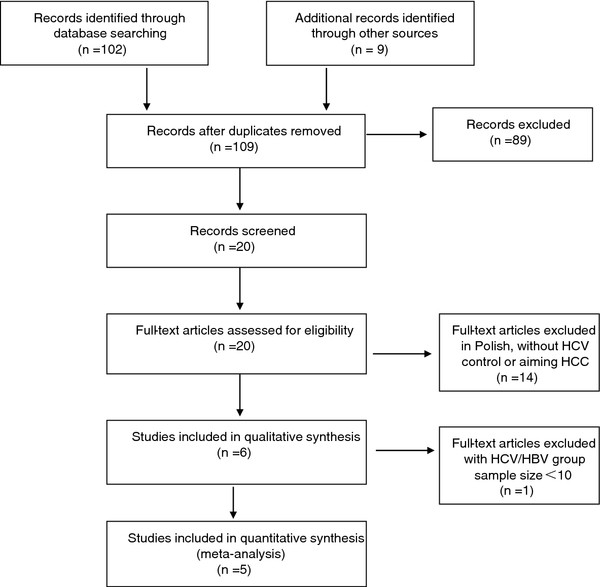
Published studies in the English-language medical literature that involved cohorts of HBV/HCV coinfection and HCV mono-infection were obtained by searching Medline, Cochrane and Embase databases. Studies that compared the efficacy of treatment with interferon plus ribavirin in HBV/HCV coinfection and HCV mono-infection were assessed. End-of-treatment virological response (ETVR), sustained virological response (SVR), HCV relapse rate, and alanine aminotransferase (ALT) normalization rate were compared between HBV/HCV coinfection and HCV mono-infection patients.
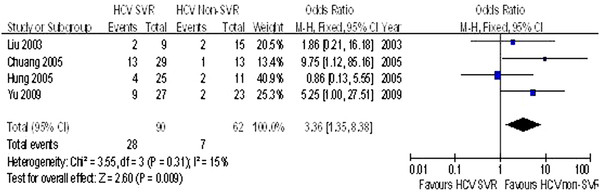
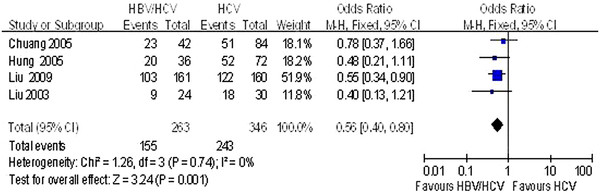
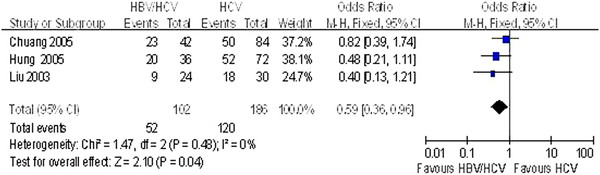
Five trials involving 705 patients were analyzed. At the end of follow-up serum ALT normalization rates in patients with HCV mono-infection were significantly higher than in patients with HBV/HCV coinfection (odds ratio (OR) = 0.56, 95% confidence interval (CI): 0.40-0.80, P = 0.001). The ETVR and SVR achieved in HBV/HCV coinfection patients were comparable to those in HCV mono-infection patients (OR = 1.03, 95% CI: 0.37-2.82, P = 0.96 and OR = 0.87, 95% CI: 0.62-1.21, P = 0.38, respectively). The rate of relapse for HCV or HCV genotype 1 was not significantly different between HBV/HCV coinfection patients and HCV mono-infection patients (OR = 1.55, 95% CI: 0.98-2.47, P = 0.06; HCV genotype 1: OR = 2.4, 95% CI: 1.17-4.91, P = 0.19).
Treatment with interferon and ribavirin achieves similar ETVR and SVR in HBV/HCV coinfection and HCV mono-infection. HBV/HCV coinfection patients had distinctively lower end of follow-up serum ALT normalization.
临床和实验室研究表明,乙型肝炎病毒(HBV)和丙型肝炎病毒(HCV)的合并感染会相互抑制,从而引发优势疾病表型。为了评估 HBV 是否会影响 HCV 治疗的抗病毒效果,我们进行了一项荟萃分析,以比较 HBV/HCV 合并感染和 HCV 单感染患者对干扰素联合利巴韦林治疗的反应。
通过检索 Medline、Cochrane 和 Embase 数据库,获得了 HBV/HCV 合并感染和 HCV 单感染的英文医学文献中的已发表研究。评估了比较 HBV/HCV 合并感染和 HCV 单感染患者干扰素联合利巴韦林治疗疗效的研究。比较了 HBV/HCV 合并感染和 HCV 单感染患者的治疗结束时病毒学应答(ETVR)、持续病毒学应答(SVR)、HCV 复发率和丙氨酸氨基转移酶(ALT)正常化率。
分析了 5 项涉及 705 例患者的试验。在随访结束时,HCV 单感染患者的血清 ALT 正常化率明显高于 HBV/HCV 合并感染患者(比值比(OR)=0.56,95%置信区间(CI):0.40-0.80,P=0.001)。HBV/HCV 合并感染患者的 ETVR 和 SVR 与 HCV 单感染患者相当(OR=1.03,95%CI:0.37-2.82,P=0.96 和 OR=0.87,95%CI:0.62-1.21,P=0.38,分别)。HBV/HCV 合并感染患者和 HCV 单感染患者的 HCV 或 HCV 基因型 1 复发率无显著差异(OR=1.55,95%CI:0.98-2.47,P=0.06;HCV 基因型 1:OR=2.4,95%CI:1.17-4.91,P=0.01)。
干扰素联合利巴韦林治疗在 HBV/HCV 合并感染和 HCV 单感染中均能达到相似的 ETVR 和 SVR。HBV/HCV 合并感染患者的随访结束时血清 ALT 正常化率明显较低。