Veterinary Epidemiology and Public Health Group, Department of Veterinary Clinical Sciences, Royal Veterinary College, Hatfield, United Kingdom.
PLoS Negl Trop Dis. 2012;6(8):e1808. doi: 10.1371/journal.pntd.0001808. Epub 2012 Aug 28.
Rift Valley fever (RVF) is a zoonotic arbovirosis for which the primary hosts are domestic livestock (cattle, sheep and goats). RVF was first described in South Africa in 1950-1951. Mechanisms for short and long distance transmission have been hypothesised, but there is little supporting evidence. Here we describe RVF occurrence and spatial distribution in South Africa in 2008-11, and investigate the presence of a contagious process in order to generate hypotheses on the different mechanisms of transmission.
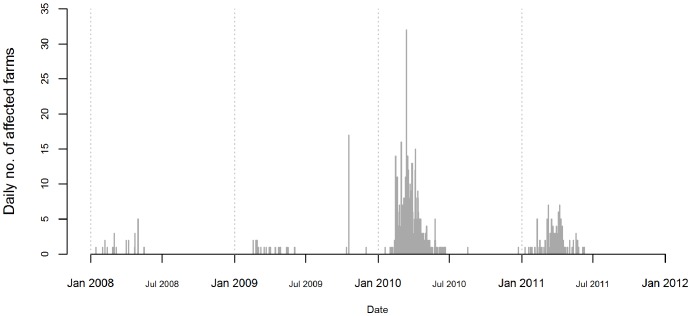
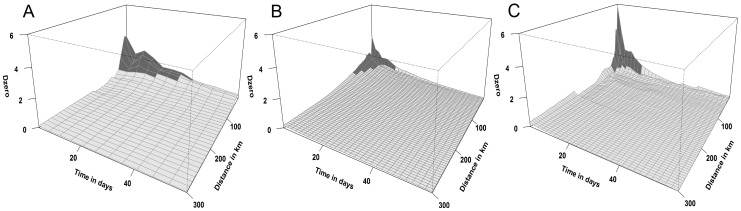
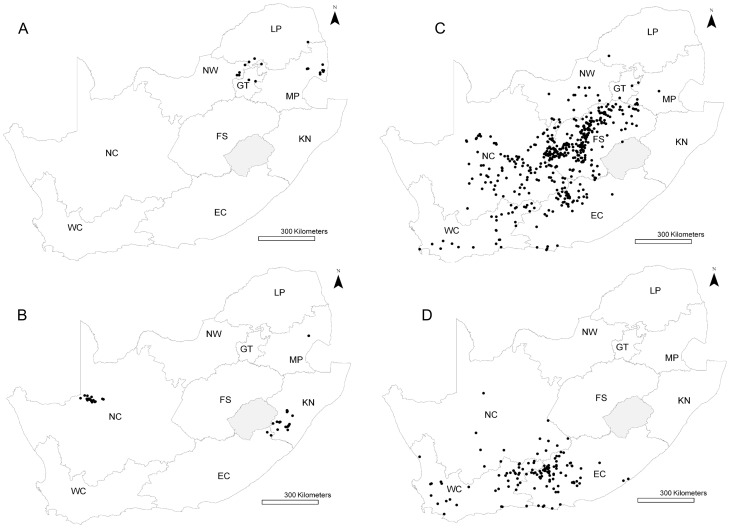
METHODOLOGY/PRINCIPAL FINDINGS: A total of 658 cases were extracted from World Animal Health Information Database. Descriptive statistics, epidemic curves and maps were produced. The space-time K-function was used to test for evidence of space-time interaction. Five RVF outbreak waves (one in 2008, two in 2009, one in 2010 and one in 2011) of varying duration, location and size were reported. About 70% of cases (n = 471) occurred in 2010, when the epidemic was almost country-wide. No strong evidence of space-time interaction was found for 2008 or the second wave in 2009. In the first wave of 2009, a significant space-time interaction was detected for up to one month and over 40 km. In 2010 and 2011 a significant intense, short and localised space-time interaction (up to 3 days and 15 km) was detected, followed by one of lower intensity (up to 2 weeks and 35 to 90 km).
CONCLUSIONS/SIGNIFICANCE: The description of the spatiotemporal patterns of RVF in South Africa between 2008 and 2011 supports the hypothesis that during an epidemic, disease spread may be supported by factors other than active vector dispersal. Limitations of under-reporting and space-time K-function properties are discussed. Further spatial analyses and data are required to explain factors and mechanisms driving RVF spread.
裂谷热(RVF)是一种人畜共患的虫媒病毒病,主要宿主是家畜(牛、羊和山羊)。1950-1951 年在南非首次描述了 RVF。已经假设了短距离和长距离传播的机制,但支持证据很少。在这里,我们描述了 2008-11 年南非的 RVF 发生情况和空间分布,并研究了传染性过程的存在,以便提出关于不同传播机制的假设。
方法/主要发现:从世界动物卫生信息数据库中提取了 658 例。制作了描述性统计数据、流行曲线和地图。时空 K 函数用于检验时空相互作用的证据。报告了五波(2008 年一波、2009 年两波、2010 年一波和 2011 年一波)不同持续时间、地点和规模的 RVF 暴发。大约 70%的病例(n=471)发生在 2010 年,当时疫情几乎遍及全国。2008 年或 2009 年第二次波没有发现强烈的时空相互作用证据。在 2009 年的第一次波中,在长达一个月和 40 公里以上的范围内检测到显著的时空相互作用。2010 年和 2011 年,检测到显著强烈、短暂和局部的时空相互作用(长达 3 天和 15 公里),随后是强度较低的一次(长达 2 周和 35 至 90 公里)。
结论/意义:2008 年至 2011 年期间南非裂谷热时空模式的描述支持这样的假设,即在流行期间,疾病的传播可能不仅仅是由主动媒介传播支持的。讨论了漏报和时空 K 函数特性的局限性。需要进一步的空间分析和数据来解释驱动 RVF 传播的因素和机制。