Center for Health Equity Research and Promotion, VA Pittsburgh Healthcare System, Pittsburgh, PA, USA.
Am J Transplant. 2012 Dec;12(12):3387-97. doi: 10.1111/j.1600-6143.2012.04243.x. Epub 2012 Sep 7.
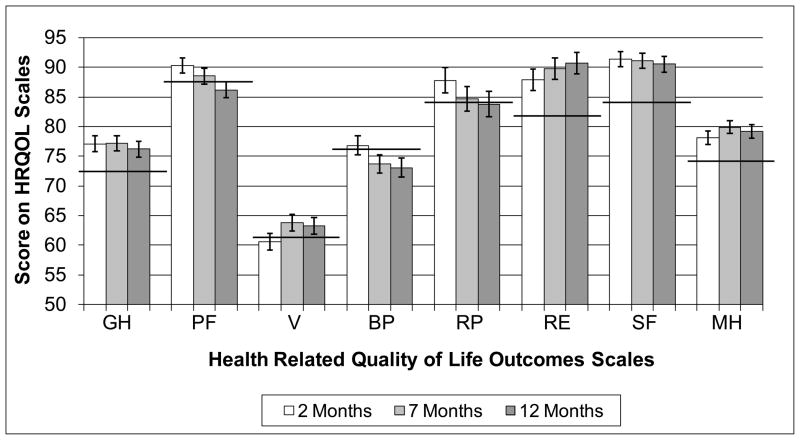
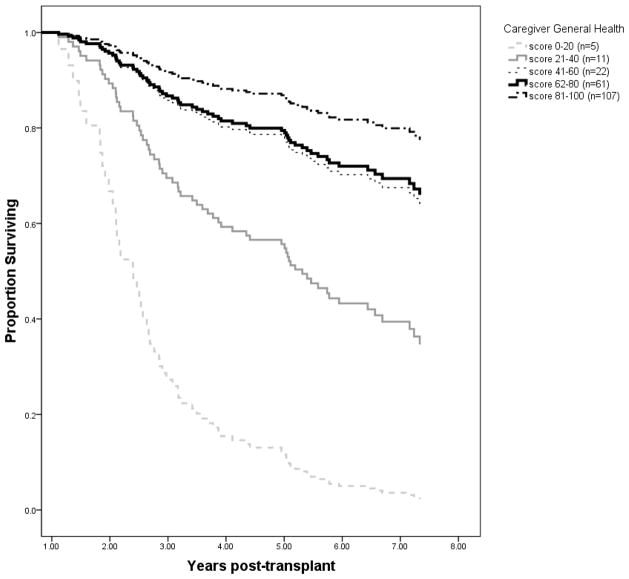
Cardiothoracic transplant programs generally require that transplant recipients have family caregivers to assist them posttransplant. The burden of caregiving on the family members remains poorly understood. If caregivers' well-being is compromised by caregiving, it may bode poorly for transplant recipients' own health in the long-term posttransplant. We examined caregiver health-related quality of life (HRQOL) during the first year after their family member's transplant, its predictors and its relationship to subsequent patient survival. Adult (aged 18+) caregivers of 242 cardiothoracic transplant recipients (lung = 134; heart = 108) completed assessments of demographics, psychosocial characteristics and caregiver burden at 2 months posttransplant, and HRQOL at 2, 7 and 12 months posttransplant. Recipients' survival time was obtained from medical records. Caregiver HRQOL was generally high across the first-year posttransplant in emotional and social functioning; caregiver physical functioning significantly worsened. There were no differences by type of recipient transplant. Greater caregiver burden predicted poorer caregiver HRQOL in several physical domains at 12 months posttransplant. Transplant recipients whose caregivers had lower perceived general health at 12 months posttransplant showed poorer survival rates during the subsequent 7 years of follow up. Transplant teams should identify those caregivers at risk for poorer general health posttransplant to maximize positive outcomes for the entire family.
心肺移植项目通常要求移植受者有家庭照顾者在移植后协助他们。照顾者的负担仍然知之甚少。如果照顾者的健康因照顾而受到损害,这可能对移植受者在移植后的长期健康状况产生不利影响。我们研究了在其家庭成员接受移植后的第一年中照顾者的健康相关生活质量(HRQOL),其预测因素及其与随后患者生存的关系。242 名心肺移植受者(肺 = 134;心脏 = 108)的成年(年龄 18 岁以上)照顾者在移植后 2 个月完成了人口统计学,心理社会特征和照顾者负担的评估,并在移植后 2、7 和 12 个月进行了 HRQOL 评估。从病历中获得了受者的生存时间。在移植后的第一年中,照顾者的 HRQOL 在情感和社会功能方面通常较高;照顾者的身体功能明显恶化。受者移植类型之间没有差异。在 12 个月时,更多的照顾者负担预示着几个身体领域的照顾者 HRQOL 较差。在移植后的 12 个月时,认为自己一般健康状况较差的照顾者的受者在随后的 7 年随访期间显示出较差的生存率。移植团队应识别出那些在移植后有较差一般健康状况风险的照顾者,以最大限度地提高整个家庭的积极结果。