Department of Psychiatry, University of Pennsylvania, USA.
Psychotherapy (Chic). 2012 Sep;49(3):303-16. doi: 10.1037/a0027694.
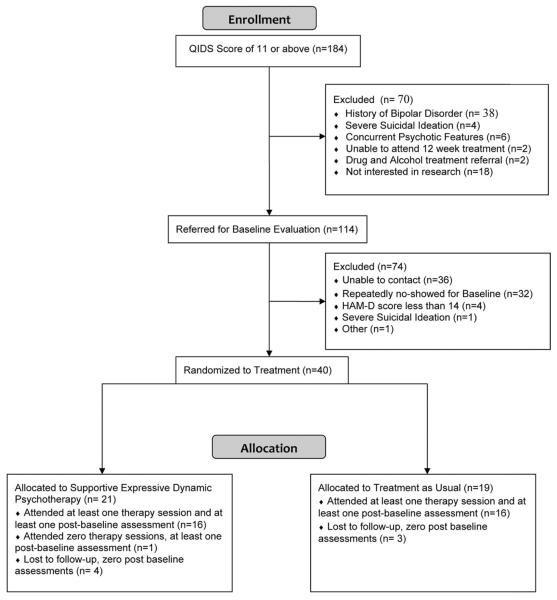
The goal of the current article is to present the results of a randomized pilot investigation of a brief dynamic psychotherapy compared with treatment-as-usual (TAU) in the treatment of moderate-to-severe depression in the community mental health system. Forty patients seeking services for moderate-to-severe depression in the community mental health system were randomized to 12 weeks of psychotherapy, with either a community therapist trained in brief dynamic psychotherapy or a TAU therapist. Results indicated that blind judges could discriminate the dynamic sessions from the TAU sessions on adherence to dynamic interventions. The results indicate moderate-to-large effect sizes in favor of the dynamic psychotherapy over the TAU therapy in the treatment of depression. The Behavior and Symptom Identification Scale-24 showed that 50% of patients treated with dynamic therapy moved into a normative range compared with only 29% of patients treated with TAU.
本文旨在呈现一项随机试点研究的结果,该研究比较了在社区心理健康系统中治疗中度至重度抑郁症时,简短动力心理治疗与常规治疗(TAU)的效果。40 名在社区心理健康系统中寻求中度至重度抑郁症治疗的患者被随机分配接受为期 12 周的心理治疗,治疗师分别为接受过简短动力心理治疗培训的社区治疗师或接受 TAU 治疗的治疗师。结果表明,盲法评判可以区分动力干预治疗与 TAU 治疗的动力治疗。结果表明,在治疗抑郁症方面,动力心理治疗比 TAU 疗法具有中等至较大的效果。行为和症状识别量表-24 显示,接受动力治疗的患者中有 50%进入了正常范围,而接受 TAU 治疗的患者中只有 29%。