Centre for Immunity, Infection and Evolution, University of Edinburgh, Ashworth Laboratories, Kings Buildings, West Mains Road, Edinburgh EH9 3JT, UK.
Philos Trans R Soc Lond B Biol Sci. 2012 Oct 19;367(1604):2864-71. doi: 10.1098/rstb.2011.0354.
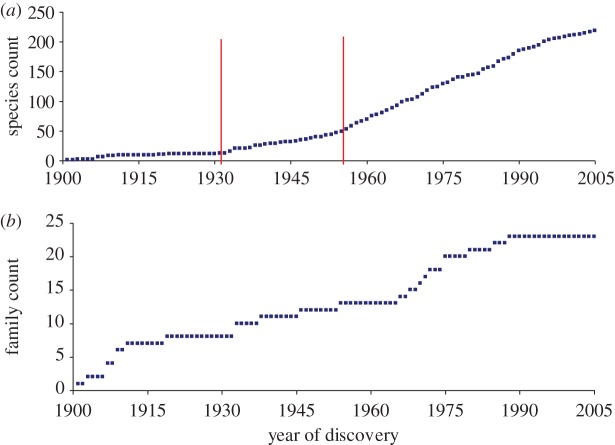
There are 219 virus species that are known to be able to infect humans. The first of these to be discovered was yellow fever virus in 1901, and three to four new species are still being found every year. Extrapolation of the discovery curve suggests that there is still a substantial pool of undiscovered human virus species, although an apparent slow-down in the rate of discovery of species from different families may indicate bounds to the potential range of diversity. More than two-thirds of human viruses can also infect non-human hosts, mainly mammals, and sometimes birds. Many specialist human viruses also have mammalian or avian origins. Indeed, a substantial proportion of mammalian viruses may be capable of crossing the species barrier into humans, although only around half of these are capable of being transmitted by humans and around half again of transmitting well enough to cause major outbreaks. A few possible predictors of species jumps can be identified, including the use of phylogenetically conserved cell receptors. It seems almost inevitable that new human viruses will continue to emerge, mainly from other mammals and birds, for the foreseeable future. For this reason, an effective global surveillance system for novel viruses is needed.
已知有 219 种病毒能够感染人类。其中第一种被发现的是 1901 年的黄热病病毒,每年仍有三到四种新的病毒被发现。根据发现曲线的推断,仍有大量未被发现的人类病毒存在,尽管不同科的病毒种发现率明显放缓可能表明潜在多样性的范围有限。超过三分之二的人类病毒也可以感染非人类宿主,主要是哺乳动物,有时还有鸟类。许多专门感染人类的病毒也有哺乳动物或鸟类的起源。事实上,相当一部分哺乳动物病毒可能有能力跨越物种屏障进入人类,但其中只有一半左右能够在人类中传播,还有一半左右能够传播得足够好而引起大规模爆发。可以确定一些物种跳跃的可能预测因素,包括使用系统发生上保守的细胞受体。在可预见的未来,新的人类病毒将继续出现,主要来自其他哺乳动物和鸟类,这似乎几乎是不可避免的。出于这个原因,需要建立一个有效的全球新型病毒监测系统。