Donders Institute for Brain, Cognition and Behaviour, Radboud University Nijmegen Nijmegen, Netherlands.
Front Integr Neurosci. 2012 Aug 28;6:66. doi: 10.3389/fnint.2012.00066. eCollection 2012.
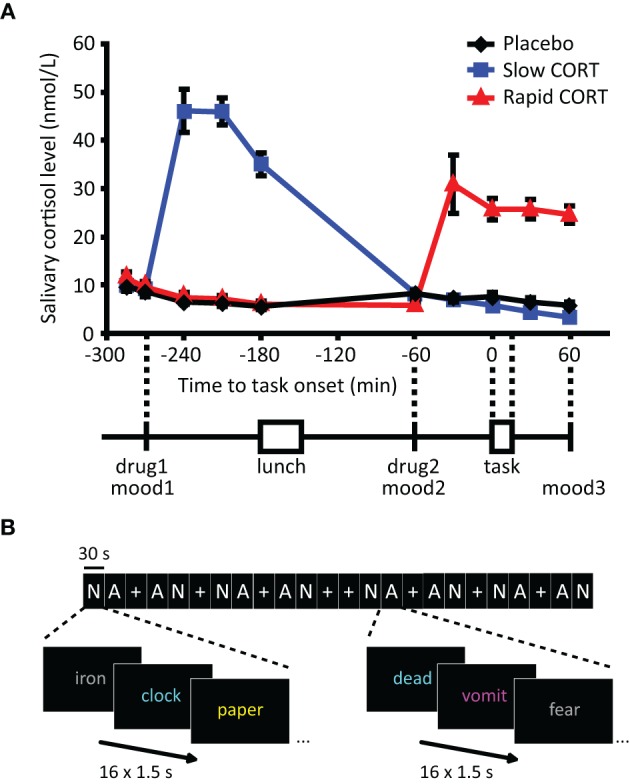
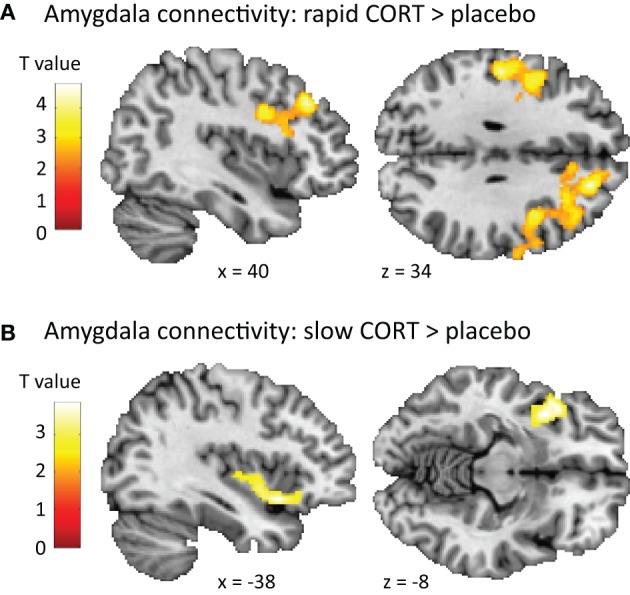
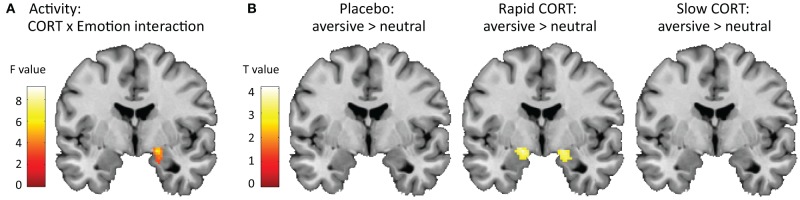
Acute stress is known to induce a state of hypervigilance, allowing optimal detection of threats. Although one may benefit from sensitive sensory processing, it comes at the cost of unselective attention and increased distraction by irrelevant information. Corticosteroids, released in response to stress, have been shown to profoundly influence brain function in a time-dependent manner, causing rapid non-genomic and slow genomic effects. Here, we investigated how these time-dependent effects influence the neural mechanisms underlying selective attention and the inhibition of emotional distracters in humans. Implementing a randomized, double-blind, placebo-controlled design, 65 young healthy men received 10 mg hydrocortisone either 60 min (rapid effects) or 270 min (slow effects), or placebo prior to an emotional distraction task, consisting of color-naming of either neutral or aversive words. Overall, participants responded slower to aversive compared to neutral words, indicating emotional interference with selective attention. Importantly, the rapid effects of corticosteroids increased emotional interference, which was associated with reduced amygdala inhibition to aversive words. Moreover, they induced enhanced amygdala connectivity with frontoparietal brain regions, which may reflect increased influence of the amygdala on an executive network. The slow effects of corticosteroids acted on the neural correlates of sustained attention. They decreased overall activity in the cuneus, possibly indicating reduced bottom-up attentional processing, and disrupted amygdala connectivity to the insula, potentially reducing emotional interference. Altogether, these data suggest a time-specific corticosteroid modulation of attentive processing. Whereas high circulating corticosteroid levels acutely increase emotional interference, possibly facilitating the detection of threats, a history of elevation might promote sustained attention and thereby contribute to stress-recovery of cognitive function.
急性应激会导致警觉状态,从而能够最佳地发现威胁。虽然人们可能会受益于敏感的感官处理,但这是以不选择性注意和对无关信息的分心增加为代价的。皮质类固醇在应激反应中释放,已被证明以时间依赖的方式深刻影响大脑功能,导致快速的非基因组和缓慢的基因组效应。在这里,我们研究了这些时变效应如何影响选择性注意和抑制人类情绪干扰的神经机制。采用随机、双盲、安慰剂对照设计,65 名年轻健康男性在进行情绪分心任务(中性或厌恶词的颜色命名)之前,分别接受 60 分钟(快速效应)或 270 分钟(缓慢效应)的 10mg 氢可的松或安慰剂。总的来说,与中性词相比,参与者对厌恶词的反应较慢,表明情绪干扰了选择性注意。重要的是,皮质类固醇的快速作用增加了情绪干扰,这与对厌恶词的杏仁核抑制减少有关。此外,它们诱导了杏仁核与额顶叶大脑区域之间的连接增强,这可能反映了杏仁核对执行网络的影响增加。皮质类固醇的缓慢作用作用于持续注意力的神经相关物。它们降低了楔前叶的整体活动,可能表明注意力的下传处理减少,并且破坏了杏仁核与岛叶的连接,可能减少了情绪干扰。总之,这些数据表明,皮质类固醇对注意力处理具有特定的时间调节作用。虽然循环皮质醇水平的升高会急性增加情绪干扰,可能有助于发现威胁,但升高的历史可能会促进持续注意力,从而有助于恢复认知功能的压力恢复。