Jones Kevin T, Berryhill Marian E
Memory and Brain Laboratory, Department of Psychology, University of Nevada Reno, NV, USA.
Front Psychiatry. 2012 Sep 10;3:81. doi: 10.3389/fpsyt.2012.00081. eCollection 2012.
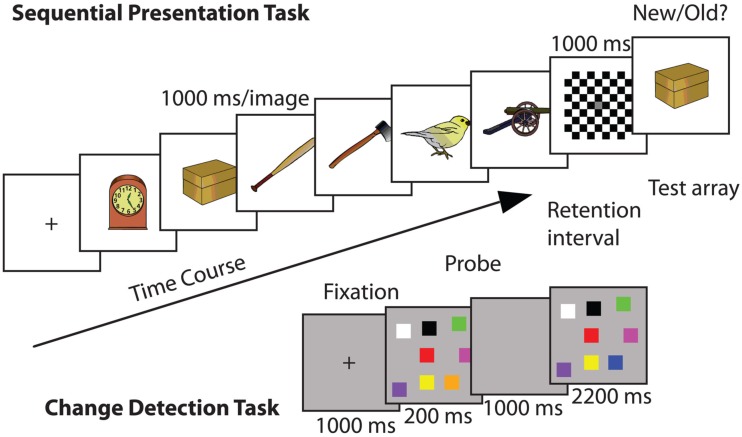
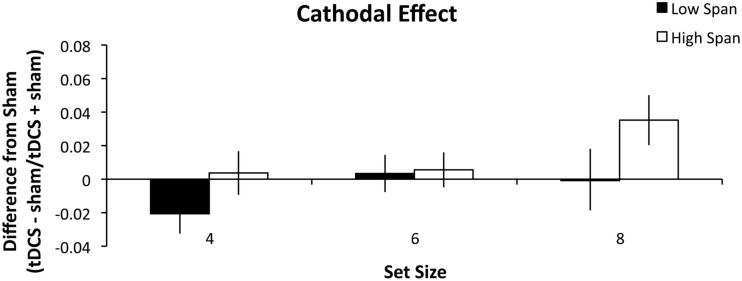
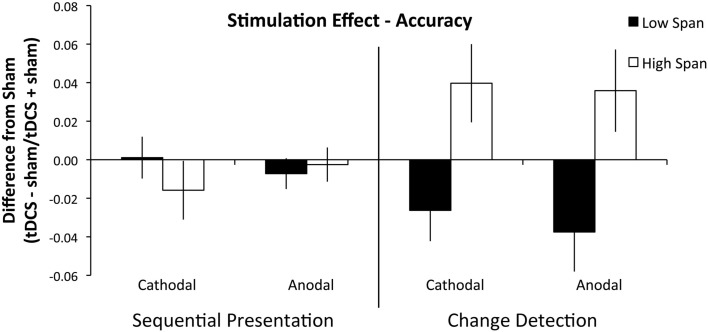
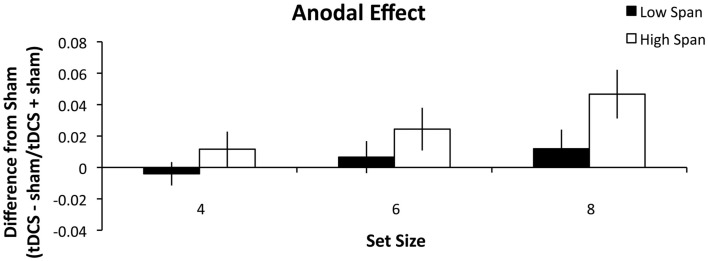
The nature of parietal contributions to working memory (WM) remain poorly understood but of considerable interest. We previously reported that posterior parietal damage selectively impaired WM probed by recognition (Berryhill and Olson, 2008a). Recent studies provided support using a neuromodulatory technique, transcranial direct current stimulation (tDCS) applied to the right parietal cortex (P4). These studies confirmed parietal involvement in WM because parietal tDCS altered WM performance: anodal current tDCS improved performance in a change detection task, and cathodal current tDCS impaired performance on a sequential presentation task. Here, we tested whether these complementary results were due to different degrees of parietal involvement as a function of WM task demands, WM task difficulty, and/or participants' WM capacity. In Experiment 1, we applied cathodal and anodal tDCS to the right parietal cortex and tested participants on both previously used WM tasks. We observed an interaction between tDCS (anodal, cathodal), WM task difficulty, and participants' WM capacity. When the WM task was difficult, parietal stimulation (anodal or cathodal) improved WM performance selectively in participants with high WM capacity. In the low WM capacity group, parietal stimulation (anodal or cathodal) impaired WM performance. These nearly equal and opposite effects were only observed when the WM task was challenging, as in the change detection task. Experiment 2 probed the interplay of WM task difficulty and WM capacity in a parametric manner by varying set size in the WM change detection task. Here, the effect of parietal stimulation (anodal or cathodal) on the high WM capacity group followed a linear function as WM task difficulty increased with set size. The low WM capacity participants were largely unaffected by tDCS. These findings provide evidence that parietal involvement in WM performance depends on both WM capacity and WM task demands. We discuss these findings in terms of alternative WM strategies employed by low and high WM capacity individuals. We speculate that low WM capacity individuals do not recruit the posterior parietal lobe for WM tasks as efficiently as high WM capacity individuals. Consequently, tDCS provides greater benefit to individuals with high WM capacity.
顶叶对工作记忆(WM)的贡献性质仍知之甚少,但却备受关注。我们之前报道过,顶叶后部损伤会选择性地损害通过识别来探测的工作记忆(Berryhill和Olson,2008a)。最近的研究使用一种神经调节技术——经颅直流电刺激(tDCS)作用于右侧顶叶皮层(P4),提供了相关支持。这些研究证实了顶叶参与工作记忆,因为顶叶tDCS改变了工作记忆表现:阳极电流tDCS提高了变化检测任务中的表现,而阴极电流tDCS损害了序列呈现任务中的表现。在这里,我们测试了这些互补的结果是否是由于顶叶参与程度的不同,这取决于工作记忆任务需求、工作记忆任务难度和/或参与者的工作记忆容量。在实验1中,我们将阴极和阳极tDCS应用于右侧顶叶皮层,并让参与者在之前使用过的两个工作记忆任务上进行测试。我们观察到tDCS(阳极、阴极)、工作记忆任务难度和参与者工作记忆容量之间存在相互作用。当工作记忆任务困难时,顶叶刺激(阳极或阴极)在高工作记忆容量的参与者中选择性地提高了工作记忆表现。在低工作记忆容量组中,顶叶刺激(阳极或阴极)损害了工作记忆表现。这些几乎相等且相反的效应仅在工作记忆任务具有挑战性时才观察到,如在变化检测任务中。实验2通过在工作记忆变化检测任务中改变集合大小,以参数方式探究了工作记忆任务难度和工作记忆容量之间的相互作用。在这里,随着集合大小增加,工作记忆任务难度增加,顶叶刺激(阳极或阴极)对高工作记忆容量组的影响呈线性函数。低工作记忆容量的参与者在很大程度上不受tDCS影响。这些发现提供了证据,表明顶叶对工作记忆表现的参与取决于工作记忆容量和工作记忆任务需求。我们根据低和高工作记忆容量个体采用的不同工作记忆策略来讨论这些发现。我们推测,低工作记忆容量个体在工作记忆任务中招募顶叶后部的效率不如高工作记忆容量个体。因此,tDCS对高工作记忆容量个体的益处更大。