Goharian Vahid, Tabatabaee Sayyed Abbas, Mozafarhashemi Sayyed, Mohajery Gholamreza, Ramezani Mohammad Arash, Shabani Fatemeh, Motevalliemami Zahra
General Thoracic Surgeon, Department of Surgery, School of Medicine, Isfahan University of Medical Sciences, Isfahan, Iran.
J Res Med Sci. 2011 Sep;16(9):1210-6.
The efficacy of subpleural analgesia to reduce postoperative pain intensity in patients after lateral thoracotomy is controversial. In this study, we demonstrated the efficacy of two types of subpleural analgesia.
This prospective, controlled, randomized, double-blind trial was performed in Department of Thoracic Surgery of Alzahra Hospital associated with Isfahan University of Medical Sciences from June 2009 until August 2010. After posterolateral thoracotomy and admission to the ICU, patients were randomly assigned into two groups of subpleural patient-controlled analgesia (SPCA) (0.02 cc/kg/h of 0.5% bupivacaine) and subpleural intermittent analgesia (SIA) (0.1cc/kg/6h of 0.5% bupivacaine). The data regarding age, sex, visual analog scale (VAS) (at 8, 16 and 24 hours after initiation of analgesia), morphine consumption, systemic adverse effects, length of ICU and hospital stay, complications, public health service (PHS) criteria, and cost was recorded. Data was analyzed by Mann-Whitney U-test, repeated measured test, chi-square test and the Fisher's exact test. A p < 0.05 was considered significant.
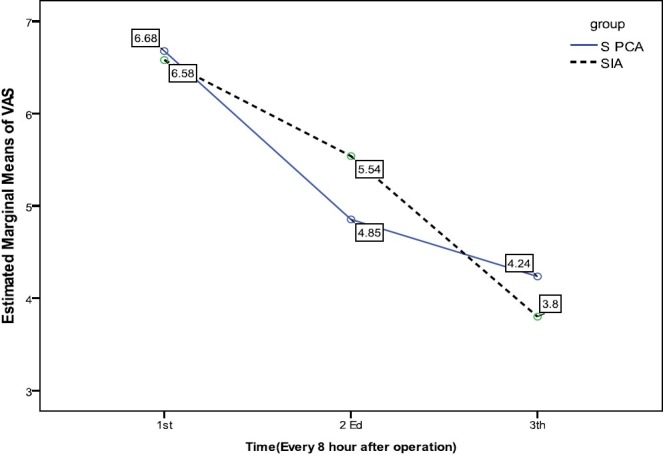
The study population consisted of 90 patients. There were no significant differences in sex, age, weight, intraoperative analgesics, duration of one-lung ventilation, and adverse effects between the SPCA and SIA groups. Although pain scores were significantly reduced at 16 hours after the first subpleural instillation of bupivacaine 0.5% with patient-controlled analgesia, comparison between mean pain scores in the two groups at 8 and 24 hours after the first subpleural instillation of bupivacaine 0.5% revealed no significant difference. In addition, no significant difference was found in VAS scores at the three evaluated times (p < 0.05).
Optimal use of SPCA bupivacaine for postoperative pain treatment is more effective in pain reduction than SIA bupivacaine. The consumption rate of opioid and bupivacaine was also decreased in SPCA group.
胸膜下镇痛减轻开胸术后患者疼痛强度的疗效存在争议。在本研究中,我们证明了两种胸膜下镇痛方法的疗效。
本前瞻性、对照、随机、双盲试验于2009年6月至2010年8月在与伊斯法罕医科大学相关的阿尔扎赫拉医院胸外科进行。后外侧开胸术后入住重症监护病房(ICU)后,患者被随机分为两组,即胸膜下患者自控镇痛(SPCA)组(0.5%布比卡因0.02 cc/kg/h)和胸膜下间断镇痛(SIA)组(0.5%布比卡因0.1cc/kg/6h)。记录有关年龄、性别、视觉模拟评分(VAS)(镇痛开始后8、16和24小时)、吗啡用量、全身不良反应、ICU住院时间和住院时间、并发症、公共卫生服务(PHS)标准以及费用的数据。数据采用曼-惠特尼U检验、重复测量检验、卡方检验和费舍尔精确检验进行分析。p<0.05被认为具有统计学意义。
研究人群包括90例患者。SPCA组和SIA组在性别、年龄、体重、术中镇痛药、单肺通气时间和不良反应方面无显著差异。虽然在首次胸膜下注入0.5%布比卡因并采用患者自控镇痛后16小时疼痛评分显著降低,但在首次胸膜下注入0.5%布比卡因后8小时和24小时两组平均疼痛评分比较无显著差异。此外,在三个评估时间点的VAS评分也未发现显著差异(p<0.05)。
术后疼痛治疗中,SPCA布比卡因的最佳使用在减轻疼痛方面比SIA布比卡因更有效。SPCA组阿片类药物和布比卡因的消耗率也有所降低。