School of Biotechnology and Biomolecular Sciences, University of New South Wales, Sydney 2052, Australia.
G3 (Bethesda). 2012 Sep;2(9):1057-65. doi: 10.1534/g3.112.003103. Epub 2012 Sep 1.
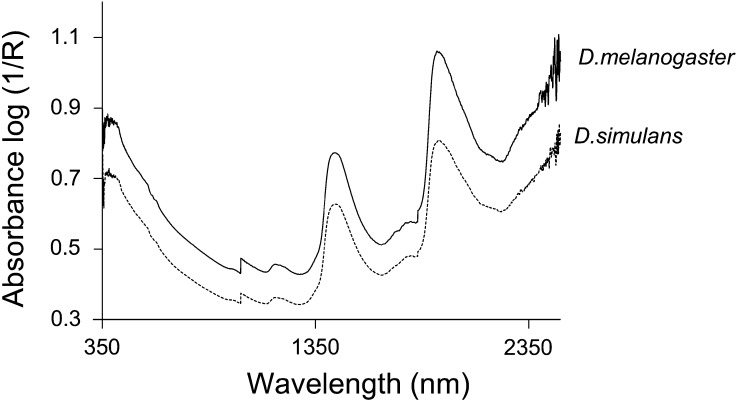
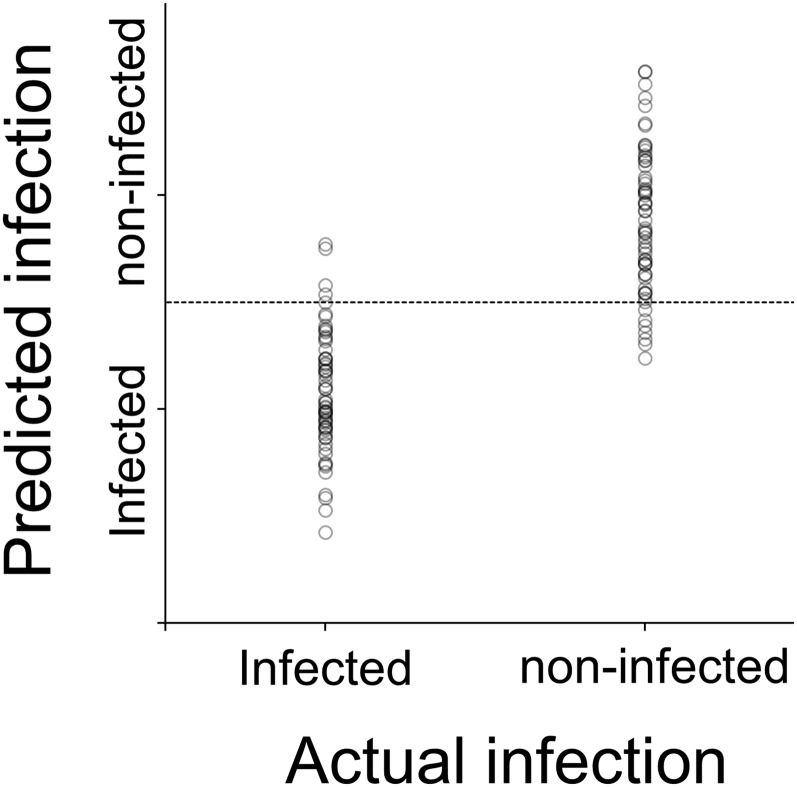
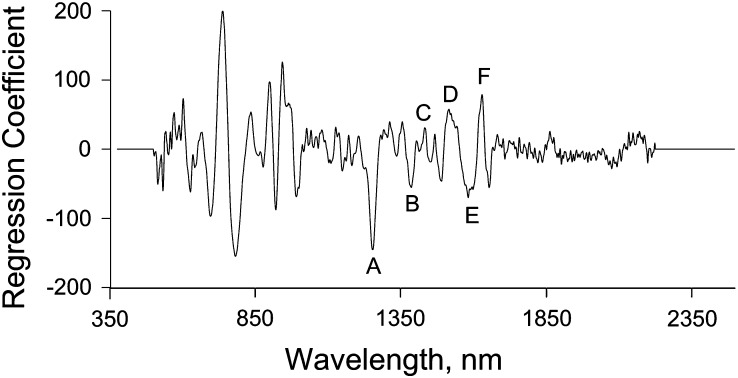
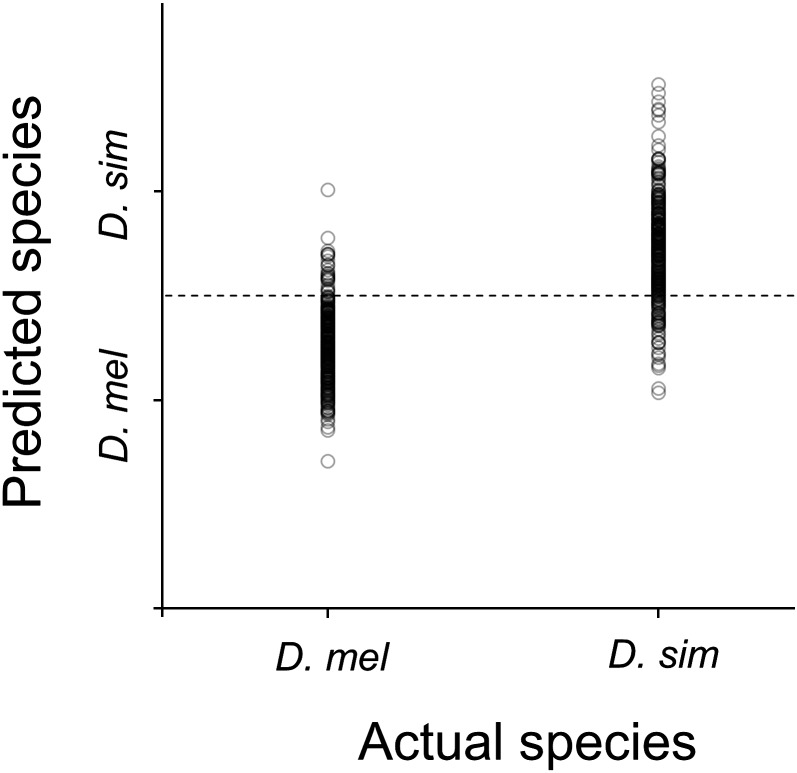
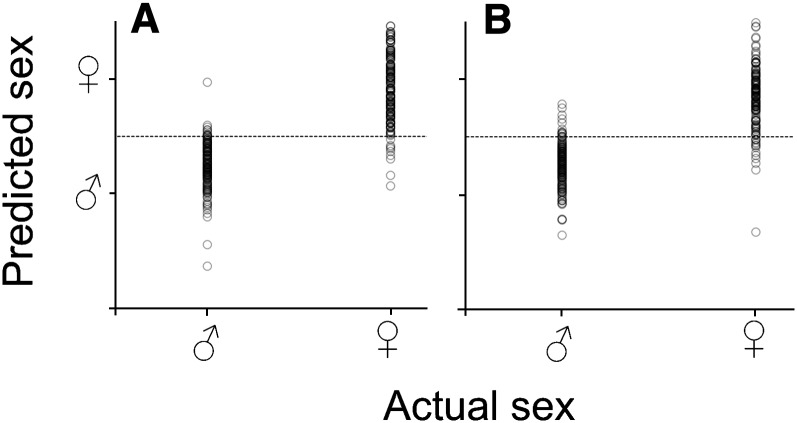
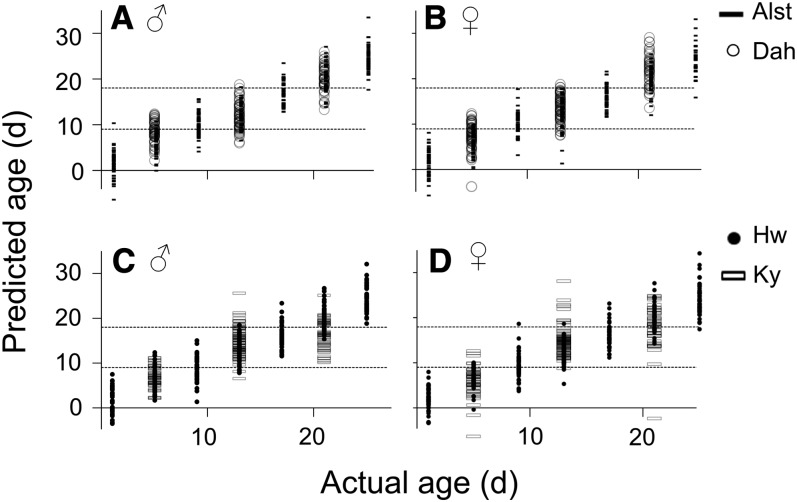
The aim of the study was to determine the accuracy of near-infrared spectroscopy (NIRS) in determining species, gender, age, and the presence of the common endosymbiont Wolbachia in laboratory-reared Drosophila. NIRS measures the absorption of light by organic molecules. Initially, a calibration model was developed for each study. An independent set with flies not involved in initial cross-validation was then used to validate the accuracy of each calibration model. Flies from the independent sets were correctly classified into Drosophila melanogaster and Drosophila simulans with 94% and 82% accuracy, respectively, whereas flies were successfully classified by gender with accuracy greater than 90%. In the age grading test, correlation plots of the actual and predicted age for males and females of D. melanogaster and D. simulans were shown to be overlapping between the adjacent age groups. It is, however, possible to predict the age of flies as less than 9 days of age with 62-88% accuracy and flies that are equal to or older than 9 days of age with 91-98% accuracy. Finally, we used NIRS to detect the presence of Wolbachia in flies. Flies from the independent sets were successfully identified as infected or not infected with Wolbachia with approximately 90% accuracy. These results suggest that NIRS has the potential to quantify the species, gender, and presence of Wolbachia in fly populations. However, additional optimization of the protocol may be necessary before the technique can reliably estimate fly age.
本研究旨在确定近红外光谱(NIRS)在确定实验室饲养的果蝇的物种、性别、年龄和常见共生菌沃尔巴克氏体(Wolbachia)存在方面的准确性。NIRS 测量有机分子对光的吸收。最初,为每个研究开发了一个校准模型。然后,使用未参与初始交叉验证的独立数据集来验证每个校准模型的准确性。独立数据集的果蝇被正确分类为黑腹果蝇和拟暗果蝇,准确率分别为 94%和 82%,而性别分类的准确率大于 90%。在年龄分级测试中,显示黑腹果蝇和拟暗果蝇的雌雄个体的实际年龄和预测年龄的相关图在相邻年龄组之间重叠。然而,可以以 62-88%的准确率预测少于 9 天龄的果蝇的年龄,以 91-98%的准确率预测等于或大于 9 天龄的果蝇的年龄。最后,我们使用 NIRS 来检测果蝇中沃尔巴克氏体的存在。独立数据集的果蝇被成功地识别为感染或未感染沃尔巴克氏体,准确率约为 90%。这些结果表明,NIRS 有可能量化果蝇种群的物种、性别和沃尔巴克氏体的存在。然而,在该技术能够可靠地估计果蝇年龄之前,可能需要对该方案进行额外的优化。