Department of Bioengineering, Rice University, Houston, TX, USA.
BMC Evol Biol. 2012 Sep 14;12:181. doi: 10.1186/1471-2148-12-181.
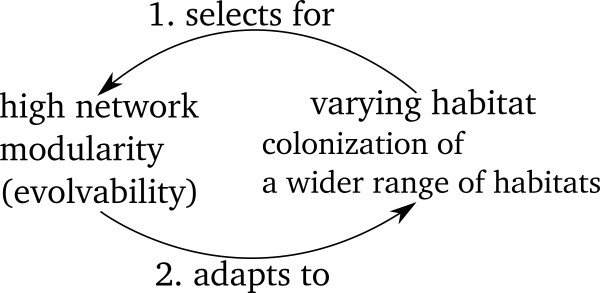
It has been reported that the modularity of metabolic networks of bacteria is closely related to the variability of their living habitats. However, given the dependency of the modularity score on the community structure, it remains unknown whether organisms achieve certain modularity via similar or different community structures.
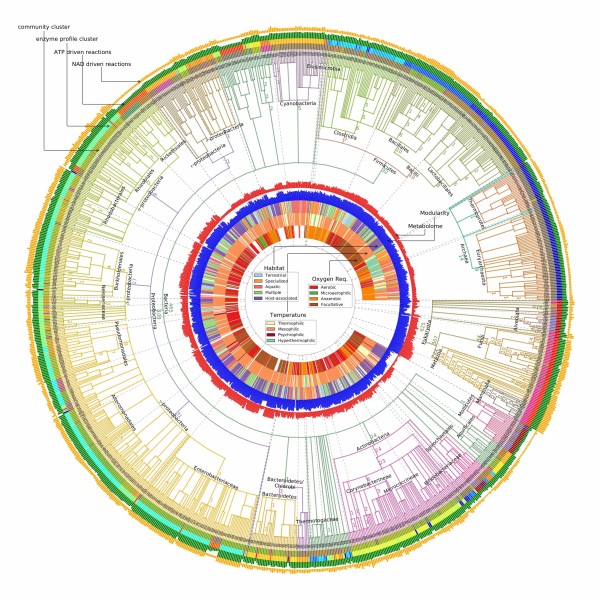
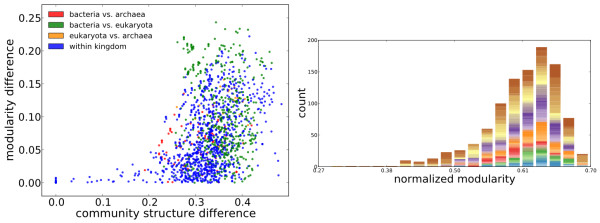
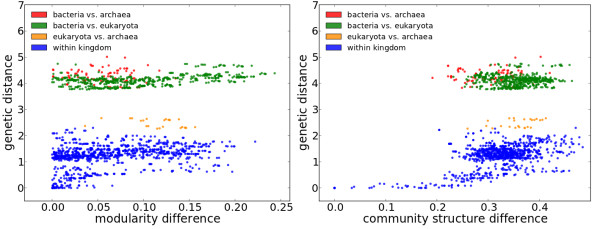
In this work, we studied the relationship between similarities in modularity scores and similarities in community structures of the metabolic networks of 1021 species. Both similarities are then compared against the genetic distances. We revisited the association between modularity and variability of the microbial living environments and extended the analysis to other aspects of their life style such as temperature and oxygen requirements. We also tested both topological and biological intuition of the community structures identified and investigated the extent of their conservation with respect to the taxonomy.
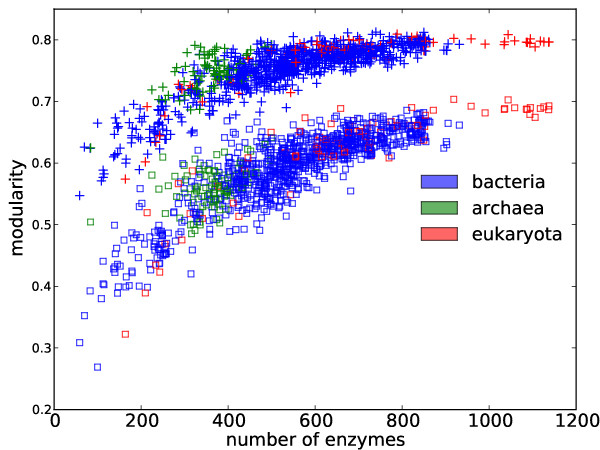
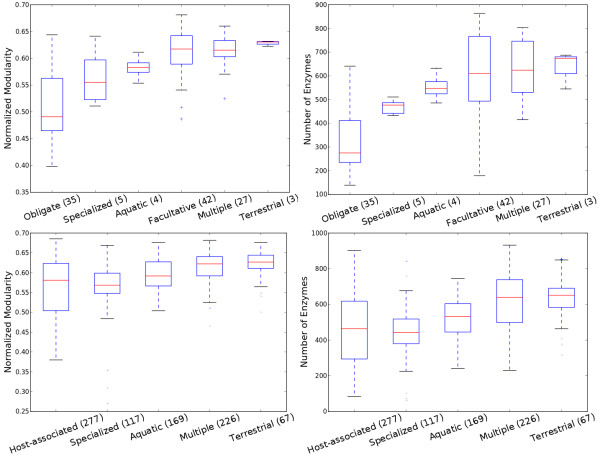
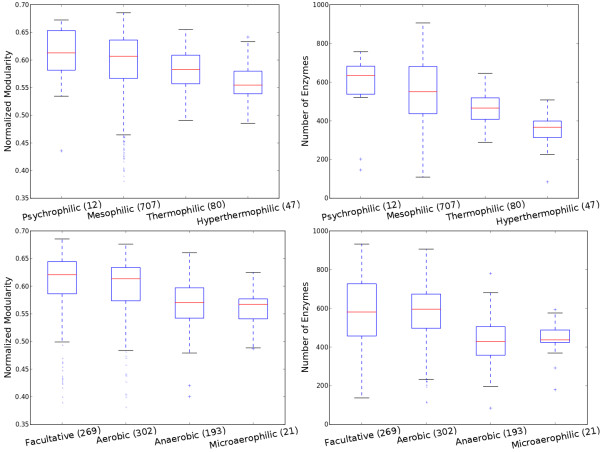
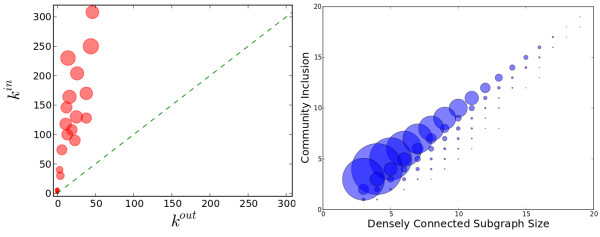
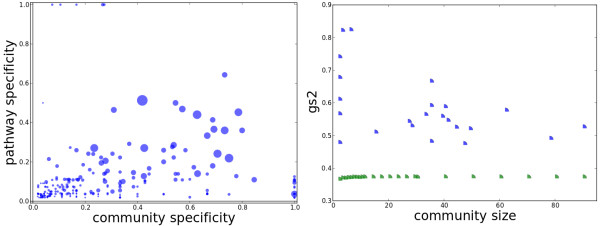
We find that similar modularities are realized by different community structures. We find that such convergent evolution of modularity is closely associated with the number of (distinct) enzymes in the organism's metabolome, a consequence of different life styles of the species. We find that the order of modularity is the same as the order of the number of the enzymes under the classification based on the temperature preference but not on the oxygen requirement. Besides, inspection of modularity-based communities reveals that these communities are graph-theoretically meaningful yet not reflective of specific biological functions. From an evolutionary perspective, we find that the community structures are conserved only at the level of kingdoms. Our results call for more investigation into the interplay between evolution and modularity: how evolution shapes modularity, and how modularity affects evolution (mainly in terms of fitness and evolvability). Further, our results call for exploring new measures of modularity and network communities that better correspond to functional categorizations.
据报道,细菌代谢网络的模块性与其生活环境的可变性密切相关。然而,鉴于模块性得分依赖于群落结构,目前尚不清楚生物体是否通过相似或不同的群落结构来实现特定的模块性。
在这项工作中,我们研究了 1021 个物种的代谢网络的模块性得分相似性和群落结构相似性之间的关系。然后将这两个相似性与遗传距离进行比较。我们重新研究了模块性与微生物生活环境变异性之间的关联,并将分析扩展到它们生活方式的其他方面,如温度和氧气需求。我们还测试了所识别的群落结构的拓扑和生物学直觉,并研究了它们相对于分类的保守程度。
我们发现相似的模块性是通过不同的群落结构来实现的。我们发现,这种模块性的趋同进化与生物体代谢组中(不同的)酶的数量密切相关,这是物种不同生活方式的结果。我们发现,根据基于温度偏好的分类,模块性的顺序与酶的数量顺序相同,但不是基于氧气需求的顺序。此外,对基于模块性的群落进行检查表明,这些群落从图论的角度来看是有意义的,但不能反映特定的生物学功能。从进化的角度来看,我们发现群落结构仅在王国级别上是保守的。我们的研究结果呼吁进一步研究进化和模块性之间的相互作用:进化如何塑造模块性,以及模块性如何影响进化(主要是在适应性和可进化性方面)。此外,我们的研究结果呼吁探索新的模块性和网络群落度量标准,使其更好地对应于功能分类。