Laboratory of Biochemistry and Cellular Engineering, Division of NanoBio Technology, Daegu Gyeongbuk Institute of Science and Technology, Daegu 711-873, South Korea.
BMC Biotechnol. 2012 Sep 14;12:61. doi: 10.1186/1472-6750-12-61.
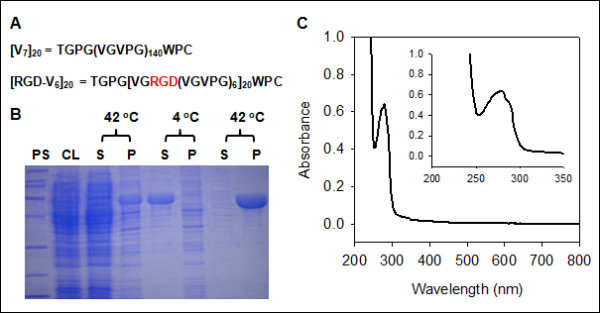
Integrin-mediated interaction of neuronal cells with extracellular matrix (ECM) is important for the control of cell adhesion, morphology, motility, and differentiation in both in vitro and in vivo systems. Arg-Gly-Asp (RGD) sequence is one of the most potent integrin-binding ligand found in many native ECM proteins. An elastin-mimetic recombinant protein, TGPG[VGRGD(VGVPG)6]20WPC, referred to as [RGD-V6]20, contains multiple RGD motifs to bind cell-surface integrins. This study aimed to investigate how surface-adsorbed recombinant protein can be used to modulate the behaviors and differentiation of neuronal cells in vitro. For this purpose, biomimetic ECM surfaces were prepared by isothermal adsorption of [RGD-V6]20 onto the tissue culture polystyrene (TCPS), and the effects of protein-coated surfaces on neuronal cell adhesion, spreading, migration, and differentiation were quantitatively measured using N2a neuroblastoma cells.
The [RGD-V6]20 was expressed in E. coli and purified by thermally-induced phase transition. N2a cell attachment to either [RGD-V6]20 or fibronectin followed hyperbolic binding kinetics saturating around 2 μM protein concentration. The apparent maximum cell binding to [RGD-V6]20 was approximately 96% of fibronectin, with half-maximal adhesion on [RGD-V6]20 and fibronectin occurring at a coating concentration of 2.4 × 10⁻⁷ and 1.4 × 10⁻⁷ M, respectively. The percentage of spreading cells was in the following order of proteins: fibronectin (84.3% ± 6.9%) > [RGD-V6]20 (42.9% ± 6.5%) > [V7]20 (15.5% ± 3.2%) > TCPS (less than 10%). The migration speed of N2a cells on [RGD-V6]20 was similar to that of cells on fibronectin. The expression of neuronal marker proteins Tuj1, MAP2, and GFAP was approximately 1.5-fold up-regulated by [RGD-V6]20 relative to TCPS. Moreover, by the presence of both [RGD-V6]20 and RA, the expression levels of NSE, TuJ1, NF68, MAP2, and GFAP were significantly elevated.
We have shown that an elastin-mimetic protein consisting of alternating tropoelastin structural domains and cell-binding RGD motifs is able to stimulate neuronal cell behaviors and differentiation. In particular, adhesion-induced neural differentiation is highly desirable for neural development and nerve repair. In this context, our data emphasize that the combination of biomimetically engineered recombinant protein and isothermal adsorption approach allows for the facile preparation of bioactive matrix or coating for neural tissue regeneration.
神经元细胞与细胞外基质(ECM)的整合素介导的相互作用对于控制体外和体内系统中的细胞黏附、形态、迁移和分化非常重要。精氨酸-甘氨酸-天冬氨酸(RGD)序列是许多天然 ECM 蛋白中发现的最有效的整合素结合配体之一。一种弹性蛋白模拟重组蛋白,TGPG[VGRGD(VGVPG)6]20WPC,称为 [RGD-V6]20,包含多个 RGD 基序以结合细胞表面整合素。本研究旨在探讨如何利用表面吸附的重组蛋白来调节体外神经元细胞的行为和分化。为此,通过将 [RGD-V6]20 等温吸附到组织培养聚苯乙烯(TCPS)上来制备仿生 ECM 表面,并使用 N2a 神经母细胞瘤细胞定量测量蛋白涂层表面对神经元细胞黏附、铺展、迁移和分化的影响。
[RGD-V6]20 在大肠杆菌中表达并通过热诱导相转变进行纯化。N2a 细胞对 [RGD-V6]20 或纤连蛋白的附着遵循双曲线结合动力学,在约 2 μM 蛋白浓度下达到饱和。[RGD-V6]20 对细胞的最大附着量约为纤连蛋白的 96%,在 [RGD-V6]20 和纤连蛋白上的半最大附着浓度分别为 2.4×10⁻⁷ 和 1.4×10⁻⁷ M。铺展细胞的百分比按以下顺序排列:纤连蛋白(84.3%±6.9%)> [RGD-V6]20(42.9%±6.5%)> [V7]20(15.5%±3.2%)> TCPS(<10%)。N2a 细胞在 [RGD-V6]20 上的迁移速度与在纤连蛋白上的迁移速度相似。与 TCPS 相比,[RGD-V6]20 使神经元标记蛋白 Tuj1、MAP2 和 GFAP 的表达上调约 1.5 倍。此外,[RGD-V6]20 和 RA 的存在使 NSE、TuJ1、NF68、MAP2 和 GFAP 的表达水平显著升高。
我们已经表明,由交替的原弹性蛋白结构域和细胞结合 RGD 基序组成的弹性蛋白模拟蛋白能够刺激神经元细胞的行为和分化。特别是,粘附诱导的神经分化对于神经发育和神经修复非常理想。在这种情况下,我们的数据强调了仿生工程重组蛋白与等温吸附方法的结合,允许简便地制备用于神经组织再生的生物活性基质或涂层。