Hazenbiller Olesja, Duncan Neil A, Krawetz Roman J
McCaig Institute for Bone and Joint Health, University of Calgary, Calgary, AB, Canada.
Department of Civil Engineering Schulich School of Engineering, University of Calgary, Calgary, Canada.
BMC Cell Biol. 2017 Nov 14;18(1):32. doi: 10.1186/s12860-017-0148-6.
Self-renewal and differentiation of embryonic stem cells (ESCs) is directed by biological and/or physical cues that regulate multiple signaling cascades. We have previously shown that mESCs seeded in a type I collagen matrix demonstrate a loss of pluripotent marker expression and differentiate towards an osteogenic lineage. In this study, we examined if this effect was mediated in part through Arginylglycylaspartic acid (RGD) dependent integrin activity and/or mechano-transduction.
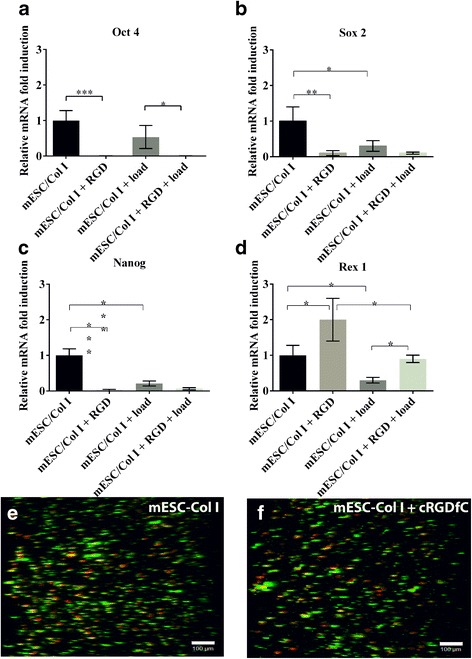
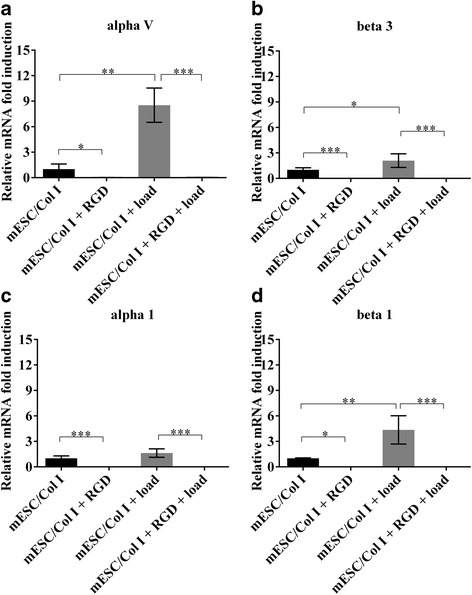
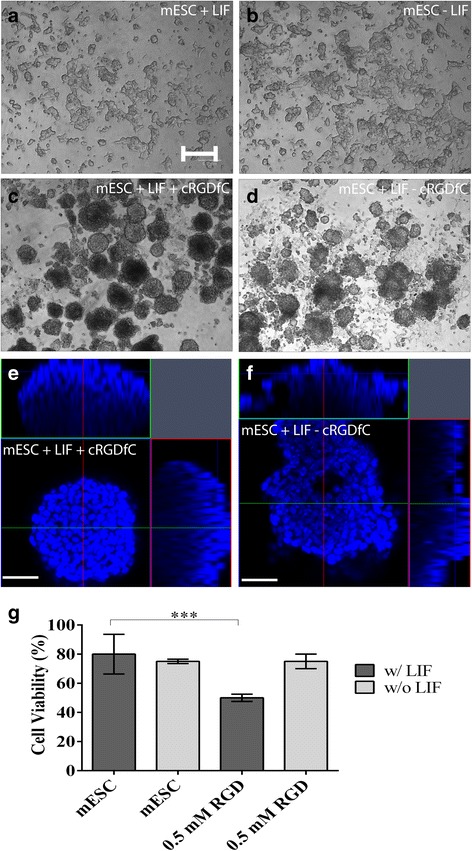
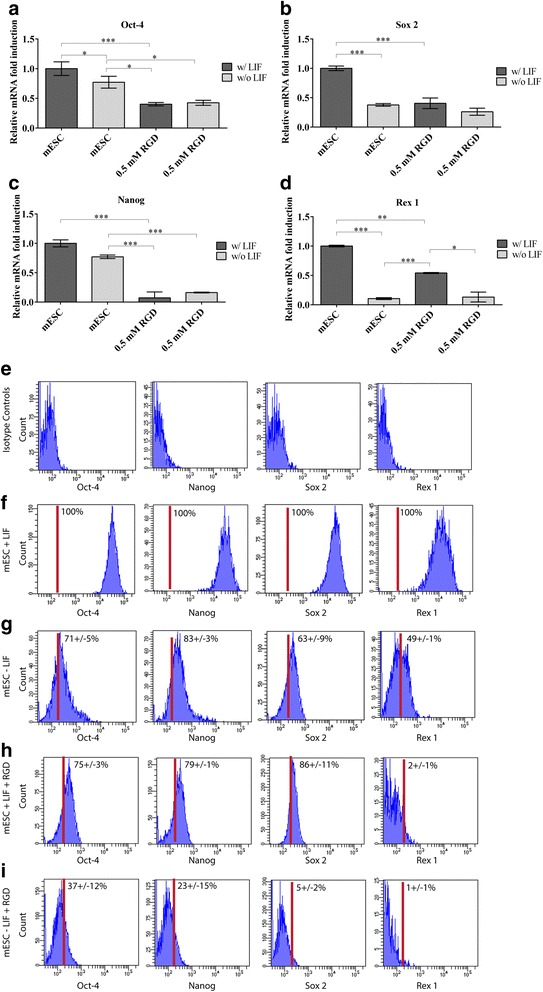
The results from this study suggest that mESC interaction with the local microenvironment through RGD dependent integrins play a role in the regulation of mESC core transcription factors (TF), Oct-4, Sox 2 and Nanog. Disruption of this interaction with a cyclic RGD peptide (cRGDfC) was sufficient to mimic the effect of a mechanical stimulus in terms of pluripotent gene expression, specifically, we observed that supplementation with cRGDfC, or mechanical stimulus, significantly influenced mESC pluripotency by down-regulating core transcription factors. Moreover, our results indicated that the presence of the cRGDfC peptide inhibited integrin expression and up-regulated early lineage markers (mesoderm and ectoderm) in a Leukemia inhibitory factor (LIF) dependent manner. When cRGDfC treated mESCs were injected in Severe combined immunodeficiency (SCID) mice, no tissue growth and/or teratoma formation was observed, suggesting that the process of mESC tumor formation in vivo is potentially dependent on integrin interaction.
Overall, the disruption of cell-integrin interaction via cRGDfC peptide can mimic the effect of mechanical stimulation on mESC pluripotency gene expression and also inhibit the tumorigenic potential of mESCs in vivo.
胚胎干细胞(ESC)的自我更新和分化受调控多个信号级联反应的生物和/或物理信号的引导。我们之前已经表明,接种于I型胶原基质中的小鼠胚胎干细胞(mESC)会出现多能性标志物表达缺失,并向成骨谱系分化。在本研究中,我们检测了这种效应是否部分通过精氨酰甘氨酰天冬氨酸(RGD)依赖性整合素活性和/或机械转导介导。
本研究结果表明,mESC通过RGD依赖性整合素与局部微环境的相互作用在调控mESC核心转录因子(TF)Oct-4、Sox 2和Nanog中发挥作用。用环状RGD肽(cRGDfC)破坏这种相互作用足以在多能基因表达方面模拟机械刺激的效果,具体而言,我们观察到补充cRGDfC或机械刺激通过下调核心转录因子显著影响mESC多能性。此外,我们的结果表明,cRGDfC肽的存在以白血病抑制因子(LIF)依赖性方式抑制整合素表达并上调早期谱系标志物(中胚层和外胚层)。当将经cRGDfC处理的mESC注射到严重联合免疫缺陷(SCID)小鼠中时,未观察到组织生长和/或畸胎瘤形成,这表明mESC在体内形成肿瘤的过程可能依赖于整合素相互作用。
总体而言,通过cRGDfC肽破坏细胞-整合素相互作用可模拟机械刺激对mESC多能性基因表达的影响,并且还可抑制mESC在体内的致瘤潜力。