Public Health and Environment Post-graduation, National School of Public Health at Oswaldo Cruz Foundation, Rio de Janeiro, Brazil.
Environ Health. 2012 Sep 14;11:64. doi: 10.1186/1476-069X-11-64.
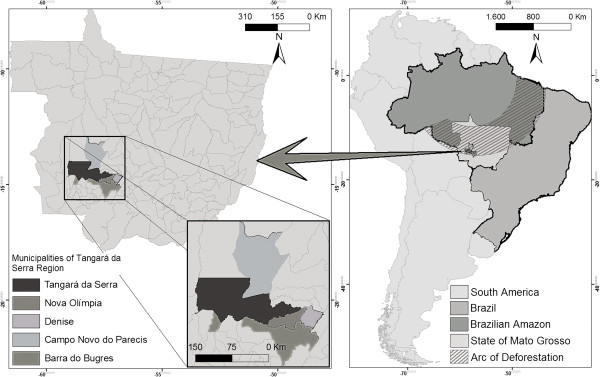
Exposure to fine fractions of particulate matter (PM(2.5)) is associated with increased hospital admissions and mortality for respiratory and cardiovascular disease in children and the elderly. This study aims to estimate the toxicological risk of PM(2.5) from biomass burning in children and adolescents between the age of 6 and 14 in Tangará da Serra, a municipality of Subequatorial Brazilian Amazon.
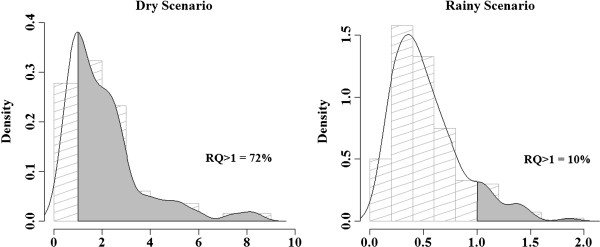
Risk assessment methodology was applied to estimate the risk quotient in two scenarios of exposure according to local seasonality. The potential dose of PM(2.5) was estimated using the Monte Carlo simulation, stratifying the population by age, gender, asthma and Body Mass Index (BMI).
Male asthmatic children under the age of 8 at normal body rate had the highest risk quotient among the subgroups. The general potential average dose of PM(2.5) was 1.95 μg/kg.day (95% CI: 1.62 - 2.27) during the dry scenario and 0.32 μg/kg.day (95% CI: 0.29 - 0.34) in the rainy scenario. During the dry season, children and adolescents showed a toxicological risk to PM(2.5) of 2.07 μg/kg.day (95% CI: 1.85 - 2 .30).
Children and adolescents living in the Subequatorial Brazilian Amazon region were exposed to high levels of PM(2.5) resulting in toxicological risk for this multi-pollutant. The toxicological risk quotients of children in this region were comparable or higher to children living in metropolitan regions with PM(2.5) air pollution above the recommended limits to human health.
细颗粒物(PM(2.5))暴露与儿童和老年人的呼吸道和心血管疾病住院率和死亡率增加有关。本研究旨在评估巴西亚马逊亚热带地区坦加拉达塞拉市 6 至 14 岁儿童和青少年生物质燃烧 PM(2.5)的毒理学风险。
应用风险评估方法,根据当地季节性,在两种暴露情景下估计风险商数。使用蒙特卡罗模拟估计 PM(2.5)的潜在剂量,按年龄、性别、哮喘和体重指数(BMI)对人群进行分层。
在正常体重率下,年龄在 8 岁以下的男性哮喘儿童在亚组中具有最高的风险商数。在干燥情景下,PM(2.5)的总潜在平均剂量为 1.95μg/kg.day(95%CI:1.62-2.27),在雨季为 0.32μg/kg.day(95%CI:0.29-0.34)。在干燥季节,儿童和青少年对 PM(2.5)的毒理学风险为 2.07μg/kg.day(95%CI:1.85-2.30)。
生活在巴西亚马逊亚热带地区的儿童和青少年暴露于高水平的 PM(2.5),导致这种多污染物存在毒理学风险。该地区儿童的毒理学风险商数与生活在 PM(2.5)空气污染超过人类健康推荐限值的大都市地区的儿童相当或更高。