School of Public Health, Curtin University, Kent Street, Bentley, 6102, Western Australia.
Lipids Health Dis. 2012 Sep 17;11:117. doi: 10.1186/1476-511X-11-117.
Several studies have identified use of non-steroidal-anti-inflammatory drugs and statins for prevention of dementia, but their efficacy in slowing progression is not well understood. Cerebrovascular disturbances are common pathological feature of Alzheimer's disease. We previously reported chronic ingestion of saturated fatty acids (SFA) compromises blood-brain barrier (BBB) integrity resulting in cerebral extravasation of plasma proteins and inflammation. However, the SFA-induced parenchymal accumulation of plasma proteins could be prevented by co-administration of some cholesterol lowering agents. Restoration of BBB dysfunction is clinically relevant, so the purpose of this study was to explore lipid-lowering agents could reverse BBB disturbances induced by chronic ingestion of SFA's.
Wild-type mice were fed an SFA diet for 12 weeks to induce BBB dysfunction, and then randomised to receive atorvastatin, pravastatin or ibuprofen in combination with the SFA-rich diet for 2 or 8 weeks. Abundance of plasma-derived immunoglobulin-G (IgG) and amyloid-β enriched apolipoprotein (apo)-B lipoproteins within brain parenchyme were quantified utilising immunofluorescence microscopy.
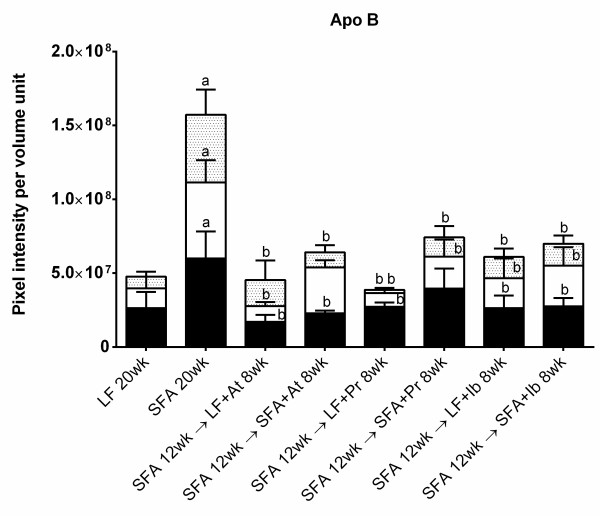
Atorvastatin treatment for 2 and 8 weeks restored BBB integrity, indicated by a substantial reduction of IgG and apo B, particularly within the hippocampus. Pravastatin, a water-soluble statin was less effective than atorvastatin (lipid-soluble). Statin effects were independent of changes in plasma lipid homeostasis. Ibuprofen, a lipid-soluble cyclooxygenase inhibitor attenuated cerebral accumulation of IgG and apo B as effectively as atorvastatin. Our findings are consistent with the drug effects being independent of plasma lipid homeostasis.
Our findings suggest that BBB dysfunction induced by chronic ingestion of SFA is reversible with timely introduction and sustained treatment with agents that suppress inflammation.
多项研究已经确定了非甾体抗炎药和他汀类药物在预防痴呆方面的作用,但它们减缓疾病进展的效果尚不清楚。脑血管紊乱是阿尔茨海默病的常见病理特征。我们之前曾报道过,慢性摄入饱和脂肪酸(SFA)会损害血脑屏障(BBB)的完整性,导致血浆蛋白脑外渗和炎症。然而,一些降胆固醇药物的联合应用可以预防 SFA 诱导的实质中血浆蛋白的蓄积。恢复 BBB 功能障碍具有临床相关性,因此本研究的目的是探讨降脂药物是否可以逆转慢性摄入 SFA 引起的 BBB 紊乱。
野生型小鼠喂食 SFA 饮食 12 周以诱导 BBB 功能障碍,然后随机分为阿托伐他汀、普伐他汀或布洛芬联合 SFA 丰富饮食治疗 2 或 8 周。利用免疫荧光显微镜定量脑实质中血浆衍生免疫球蛋白 G(IgG)和富含淀粉样蛋白-β的载脂蛋白(apo)-B 脂蛋白的含量。
阿托伐他汀治疗 2 周和 8 周恢复了 BBB 的完整性,这表现在 IgG 和 apoB 的含量显著减少,特别是在海马体中。普伐他汀,一种水溶性他汀类药物,不如阿托伐他汀(脂溶性)有效。他汀类药物的作用独立于血浆脂质稳态的变化。脂溶性环氧化酶抑制剂布洛芬与阿托伐他汀一样有效地减轻了 IgG 和 apoB 在大脑中的蓄积。我们的发现与药物作用独立于血浆脂质稳态的观点一致。
我们的发现表明,慢性摄入 SFA 引起的 BBB 功能障碍可以通过及时引入和持续使用抑制炎症的药物来逆转。