Tsai Pui-Jen
Center for General Education, Aletheria University, New Taipei, Republic of China (Taiwan).
Glob J Health Sci. 2012 Jul 24;4(5):63-77. doi: 10.5539/gjhs.v4n5p63.
This study focused on using Moran's tests and logistic regression to detect changes in spatial clustering for females and males.
For spatial distribution analysis, an average morbidity rate for a 7-year period was calculated. Medical cases from Taiwan National Health Insurance (NHI) were used as the numerator, and the denominator was the average mid-year population. Spatial analysis techniques, with a morbidity-smoothing coefficient estimate based on the empirical Bayesian method, were incorporated and applied to global and local Moran tests. In addition, we used a logistic regression model to test the characteristics of similarity and dissimilarity between males and females and to formulate the common spatial risk.
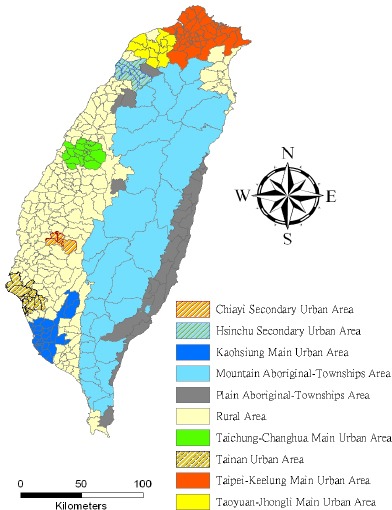
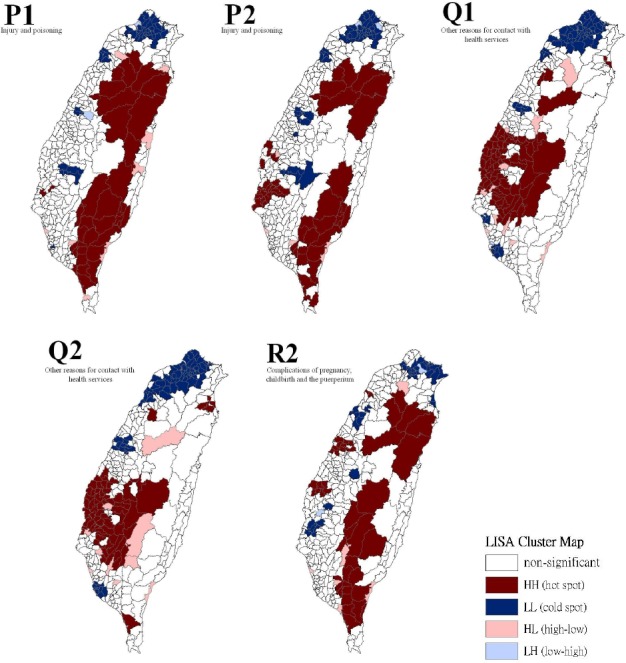
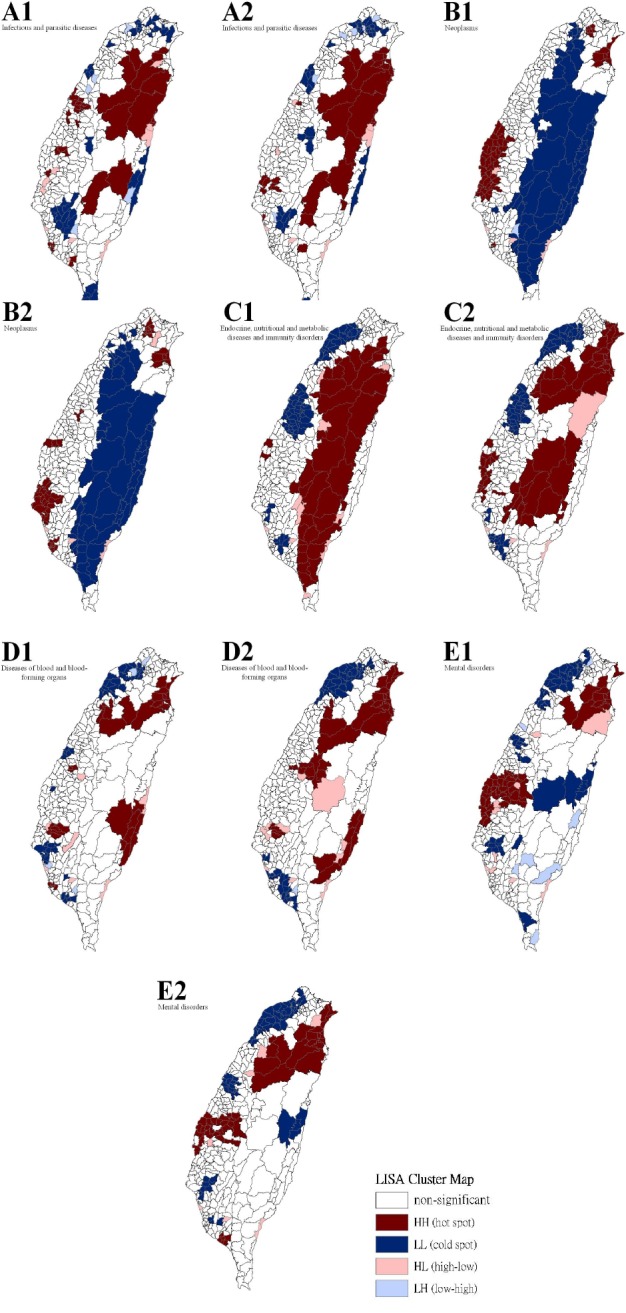
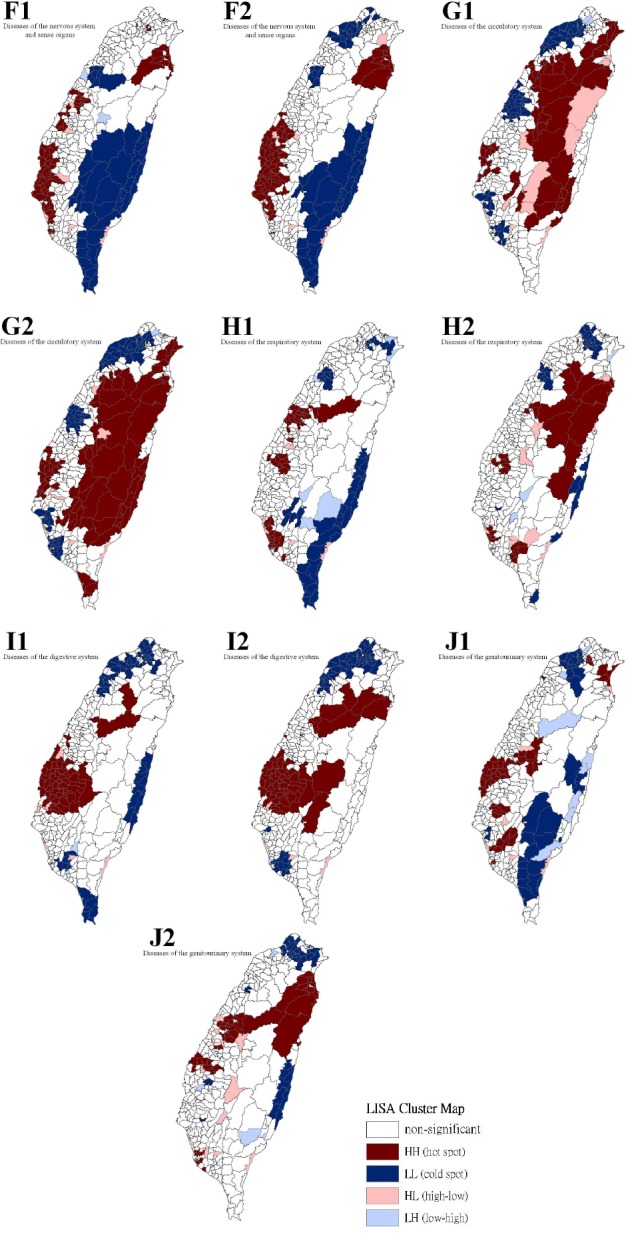
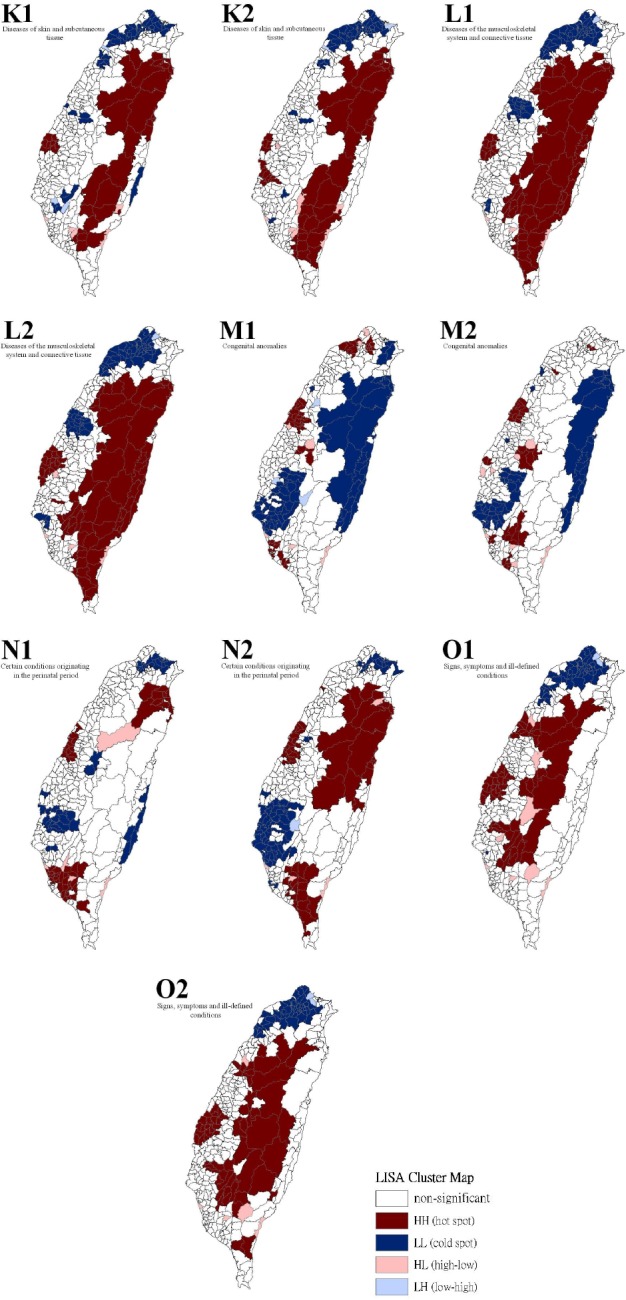
The mean found by local spatial autocorrelation analysis was used to identify spatial cluster patterns. There is great interest in discovering the relationship between leading health care problems and spatial risk factors. For example, in Taiwan, the geographic distribution of clusters where neoplasms were prevalent was found to closely correspond to the locations in the arseniasis-endemic areas of Southwestern and Northeastern Taiwan, as well as to locations in the Tainan urban area (for females) and clusters in Changhua County and Yunlin County (for males). The high-density populations in urban areas showed carcinogen clusters in Taiwan's 3 main urban centers (i.e., Taipei, Taichung, and Kaohsiung) for female neoplasms.
Cluster mapping helped clarify issues such as the spatial aspects of both the internal and external correlations for leading health care events. This information greatly assists in assessing spatial risk factors, which facilitates the planning of the most advantageous types of health care policies, as well as the implementation of effective health care services.
本研究着重运用莫兰检验和逻辑回归来检测男性和女性空间聚集性的变化。
对于空间分布分析,计算了7年期间的平均发病率。以台湾全民健康保险(NHI)的医疗病例作为分子,分母为年中平均人口数。纳入基于经验贝叶斯方法的发病率平滑系数估计的空间分析技术,并应用于全局和局部莫兰检验。此外,我们使用逻辑回归模型来检验男性和女性之间相似性和差异性的特征,并制定共同的空间风险。
通过局部空间自相关分析得出的均值用于识别空间聚集模式。人们对发现主要医疗保健问题与空间风险因素之间的关系非常感兴趣。例如,在台湾,发现肿瘤高发聚集区的地理分布与台湾西南部和东北部砷中毒流行地区的位置密切对应,以及台南市区(女性)的位置和彰化县及云林县(男性)的聚集区。台湾3个主要城市中心(即台北、台中、高雄)的城市高密度人群中出现了女性肿瘤的致癌物聚集区。
聚集图谱有助于阐明主要医疗保健事件的内部和外部相关性等空间方面的问题。这些信息极大地有助于评估空间风险因素,从而便于规划最有利的医疗保健政策类型以及实施有效的医疗保健服务。