Department of Biostatistics and Epidemiology, Health School, Isfahan University of Medical Science, Isfahan, Iran.
BMC Pediatr. 2012 Sep 17;12:149. doi: 10.1186/1471-2431-12-149.
The World Health Organization (WHO) is in the process of establishing a new global database on the growth of school children and adolescents. Limited national data exist from Asian children, notably those living in the Middle East and North Africa (MENA). This study aimed to generate the growth chart of a nationally representative sample of Iranian children aged 10-19 years, and to explore how well these anthropometric data match with international growth references.
In this nationwide study, the anthropometric data were recorded from Iranian students, aged 10-19 years, who were selected by multistage random cluster sampling from urban and rural areas. Prior to the analysis, outliers were excluded from the features height-for-age and body mass index (BMI)-for-age using the NCHS/WHO cut-offs. The Box-Cox power exponential (BCPE) method was used to calculate height-for-age and BMI-for-age Z-scores for our study participants. Then, children with overweight, obesity, thinness, and severe thinness were identified using the BMI-for-age z-scores. Moreover, stunted children were detected using the height-for-age z-scores. The growth curve of the Iranian children was then generated from the z-scores, smoothed by cubic S-plines.
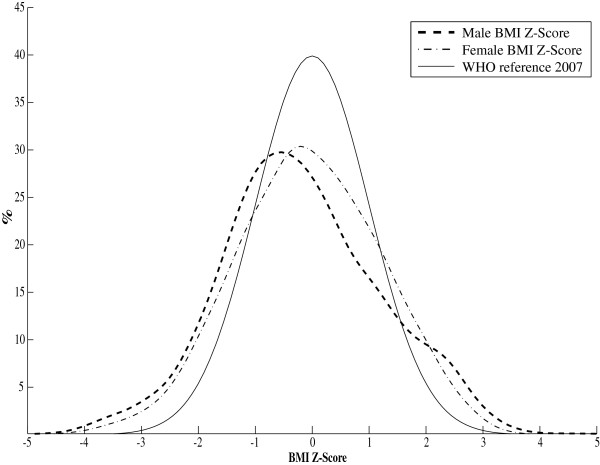
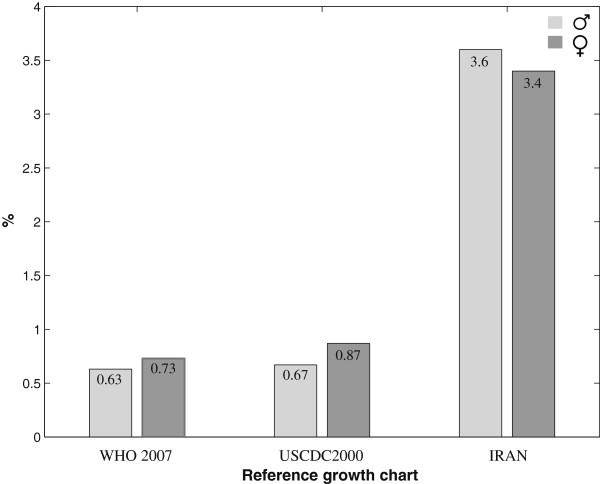
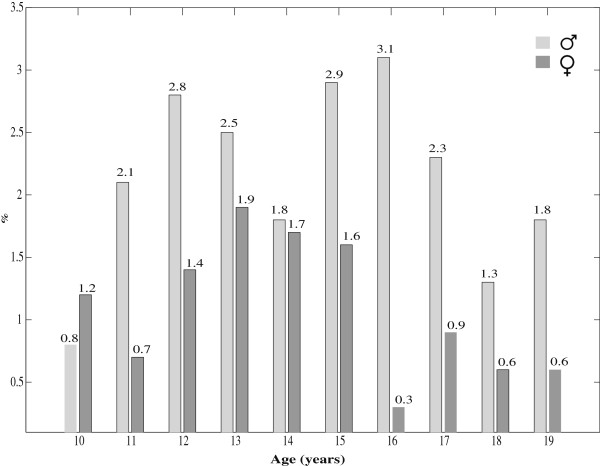
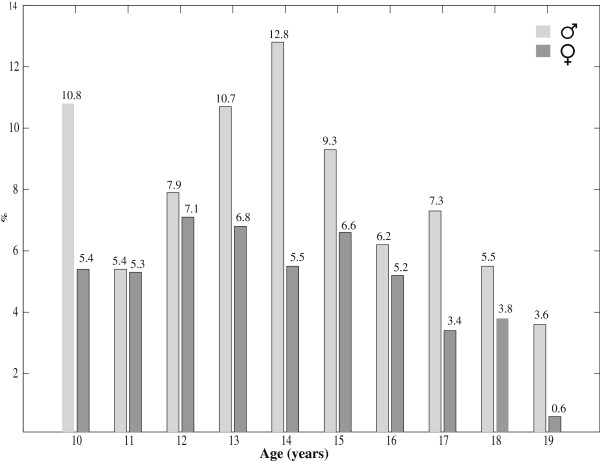
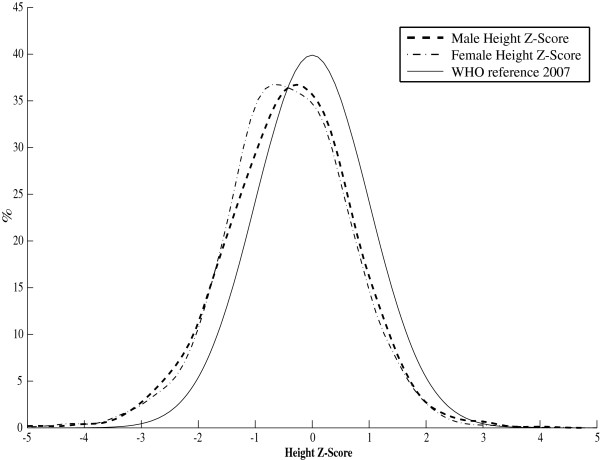
The study population comprised 5430 school students consisting of 2312 (44%) participants aged 10-14 years , and 3118 (58%) with 15-19 years of age. Eight percent of the participants had low BMI (thinness: 6% and severe thinness: 2%), 20% had high BMI (overweight: 14% and obesity: 6%), and 7% were stunted. The prevalence rates of low and high BMI were greater in boys than in girls (P < 0.001). The mean BMI-for-age, and the average height-for-age of Iranian children aged 10-19 years were lower than the WHO 2007 and United states Centers for Disease Control and Prevention 2000 (USCDC2000) references.
The current growth curves generated from a national dataset may be included for establishing WHO global database on children's growth. Similar to most low-and middle income populations, Iranian children aged 10-19 years are facing a double burden of weight disorders, notably under- and over- nutrition, which should be considered in public health policy-making.
世界卫生组织(WHO)正在建立一个新的全球儿童和青少年生长数据库。亚洲儿童,尤其是生活在中东和北非(MENA)的儿童,仅有有限的国家数据。本研究旨在生成具有全国代表性的 10-19 岁伊朗儿童样本的生长图表,并探讨这些人体测量数据与国际生长参考标准的吻合程度。
在这项全国性研究中,从城市和农村地区通过多阶段随机聚类抽样选择的 10-19 岁伊朗学生记录了人体测量数据。在分析之前,使用 NCHS/WHO 截断值从特征身高-年龄和体重指数(BMI)-年龄中排除离群值。使用 Box-Cox 幂指数(BCPE)方法为我们的研究参与者计算身高-年龄和 BMI-年龄 Z 分数。然后,使用 BMI-年龄 z 分数确定超重、肥胖、消瘦和严重消瘦的儿童。此外,使用身高-年龄 z 分数检测发育迟缓的儿童。然后,从 z 分数生成伊朗儿童的生长曲线,并通过三次样条平滑。
研究人群包括 5430 名学生,其中 2312 名(44%)参与者年龄为 10-14 岁,3118 名(58%)参与者年龄为 15-19 岁。8%的参与者 BMI 较低(消瘦:6%和严重消瘦:2%),20%的参与者 BMI 较高(超重:14%和肥胖:6%),7%的参与者发育迟缓。男孩的低和高 BMI 患病率均高于女孩(P < 0.001)。10-19 岁伊朗儿童的平均 BMI-年龄和平均身高-年龄均低于 WHO 2007 年和美国疾病控制与预防中心 2000 年(USCDC2000)参考值。
从国家数据集生成的当前生长曲线可纳入 WHO 儿童生长全球数据库。与大多数低收入和中等收入人群一样,10-19 岁的伊朗儿童面临体重障碍的双重负担,特别是营养不足和营养过剩,这在制定公共卫生政策时应予以考虑。