Bacteriology Unit, National Institute for Health and Welfare, Helsinki, Finland.
BMC Microbiol. 2012 Sep 17;12:208. doi: 10.1186/1471-2180-12-208.
Y. enterocolitica biotype (BT) 1A strains are often isolated from human clinical samples but their contribution to disease has remained a controversial topic. Variation and the population structure among the clinical Y. enterocolitica BT 1A isolates have been poorly characterized. We used multi-locus sequence typing (MLST), 16S rRNA gene sequencing, PCR for ystA and ystB, lipopolysaccharide analysis, phage typing, human serum complement killing assay and analysis of the symptoms of the patients to characterize 298 clinical Y. enterocolitica BT 1A isolates in order to evaluate their relatedness and pathogenic potential.
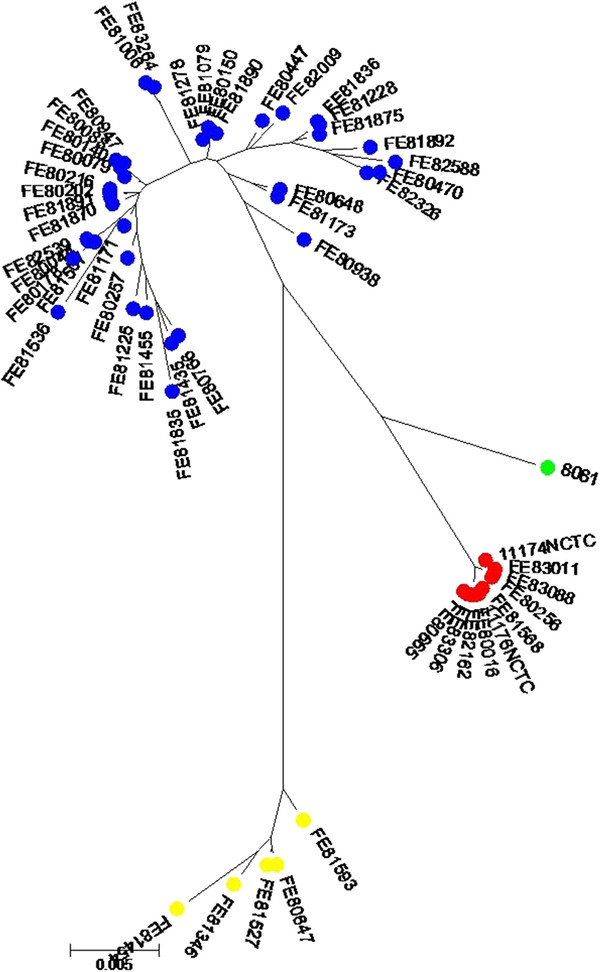
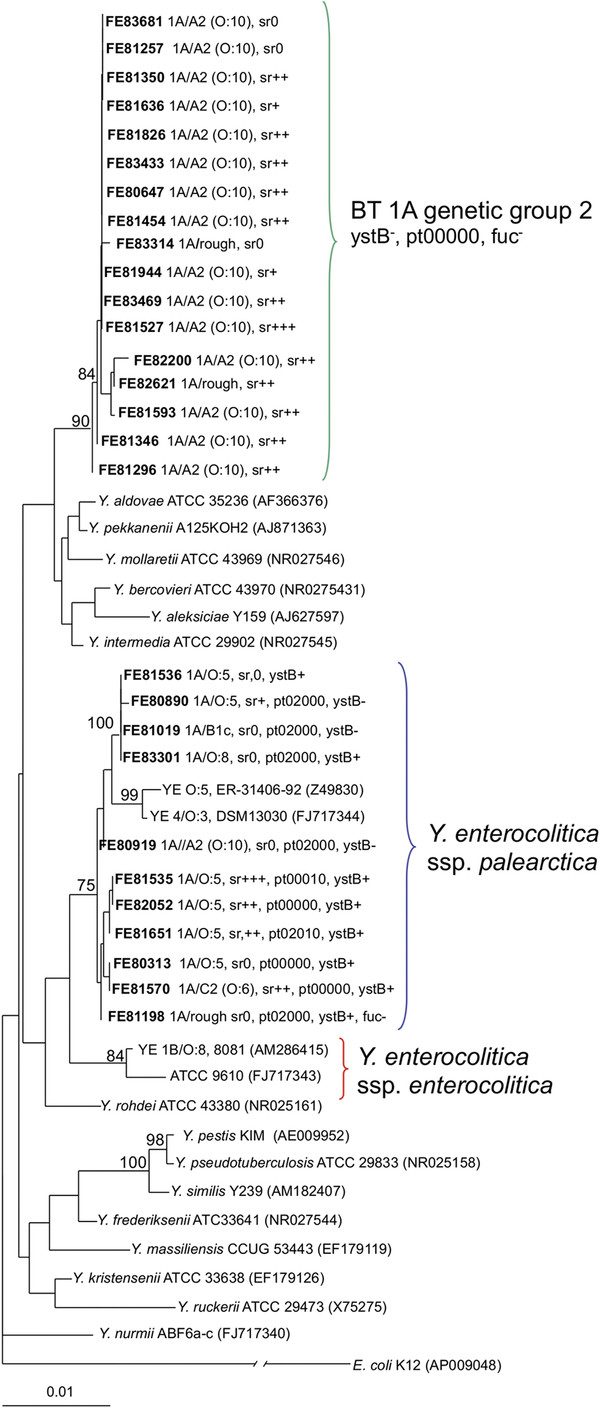
A subset of 71 BT 1A strains, selected based on their varying LPS patterns, were subjected to detailed genetic analyses. The MLST on seven house-keeping genes (adk, argA, aroA, glnA, gyrB, thrA, trpE) conducted on 43 of the strains discriminated them into 39 MLST-types. By Bayesian analysis of the population structure (BAPS) the strains clustered conclusively into two distinct lineages, i.e. Genetic groups 1 and 2. The strains of Genetic group 1 were more closely related (97% similarity) to the pathogenic bio/serotype 4/O:3 strains than Genetic group 2 strains (95% similarity). Further comparison of the 16S rRNA genes of the BT 1A strains indicated that altogether 17 of the 71 strains belong to Genetic group 2. On the 16S rRNA analysis, these 17 strains were only 98% similar to the previously identified subspecies of Y. enterocolitica. The strains of Genetic group 2 were uniform in their pathogenecity-related properties: they lacked the ystB gene, belonged to the same LPS subtype or were of rough type, were all resistant to the five tested yersiniophages, were largely resistant to serum complement and did not ferment fucose. The 54 strains in Genetic group 1 showed much more variation in these properties. The most commonly detected LPS types were similar to the LPS types of reference strains with serotypes O:6,30 and O:6,31 (37%), O:7,8 (19%) and O:5 (15%).
The results of the present study strengthen the assertion that strains classified as Y. enterocolitica BT 1A represent more than one subspecies. Especially the BT 1A strains in our Genetic group 2 commonly showed resistance to human serum complement killing, which may indicate pathogenic potential for these strains. However, their virulence mechanisms remain unknown.
Y. enterocolitica 生物型(BT)1A 菌株通常从人类临床样本中分离出来,但它们对疾病的贡献一直是一个有争议的话题。临床 Y. enterocolitica BT 1A 分离株的变异和种群结构尚未得到很好的描述。我们使用多位点序列分型(MLST)、16S rRNA 基因测序、ystA 和 ystB 的 PCR、脂多糖分析、噬菌体分型、人类血清补体杀伤试验和患者症状分析来描述 298 株临床 Y. enterocolitica BT 1A 分离株,以评估它们的相关性和致病潜力。
选择了一组基于不同 LPS 模式的 71 株 BT 1A 菌株进行详细的遗传分析。对 43 株菌株的 7 个管家基因(adk、argA、aroA、glnA、gyrB、thrA、trpE)进行的 MLST 将它们分为 39 种 MLST 型。通过种群结构的贝叶斯分析(BAPS),菌株明确聚类为两个不同的谱系,即遗传组 1 和 2。遗传组 1 的菌株与致病性生物/血清型 4/O:3 菌株的亲缘关系更近(97%相似性),而遗传组 2 菌株的亲缘关系则不如前者(95%相似性)。进一步比较 BT 1A 菌株的 16S rRNA 基因发现,71 株中有 17 株属于遗传组 2。在 16S rRNA 分析中,这 17 株与先前鉴定的 Y. enterocolitica 亚种仅 98%相似。遗传组 2 的菌株在与其致病性相关的特性方面是一致的:它们缺乏 ystB 基因,属于相同的 LPS 亚型或为粗糙型,对五种测试的耶尔森噬菌体均有抗性,对血清补体的抗性较大,不能发酵岩藻糖。遗传组 1 的 54 株菌株在这些特性上表现出更多的变异。最常见的检测到的 LPS 类型与参考菌株的血清型 O:6、30 和 O:6、31(37%)、O:7、8(19%)和 O:5(15%)相似。
本研究结果进一步证实了分类为 Y. enterocolitica BT 1A 的菌株代表了不止一个亚种。特别是我们遗传组 2 中的 BT 1A 菌株通常对人血清补体杀伤有抗性,这可能表明这些菌株具有致病性。然而,它们的毒力机制尚不清楚。