Department of Applied Physiology and Kinesiology, University of Florida, 122 Florida Gym, P.O. Box 118205, Gainesville, FL 32611-8205, USA.
J Biomech. 2012 Nov 15;45(16):2817-21. doi: 10.1016/j.jbiomech.2012.08.036. Epub 2012 Sep 14.
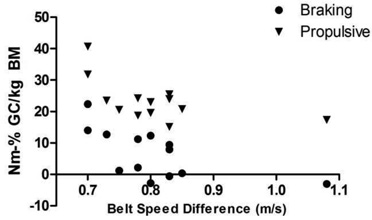
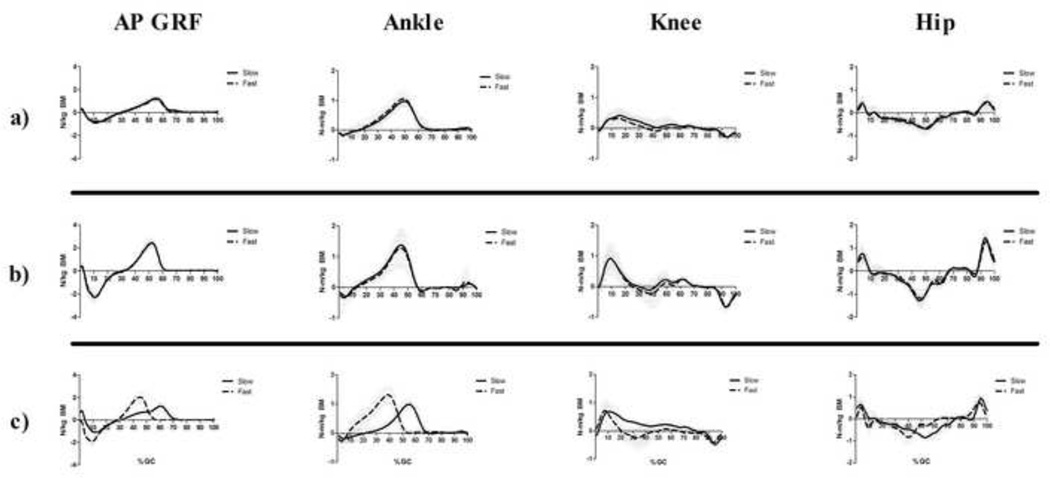
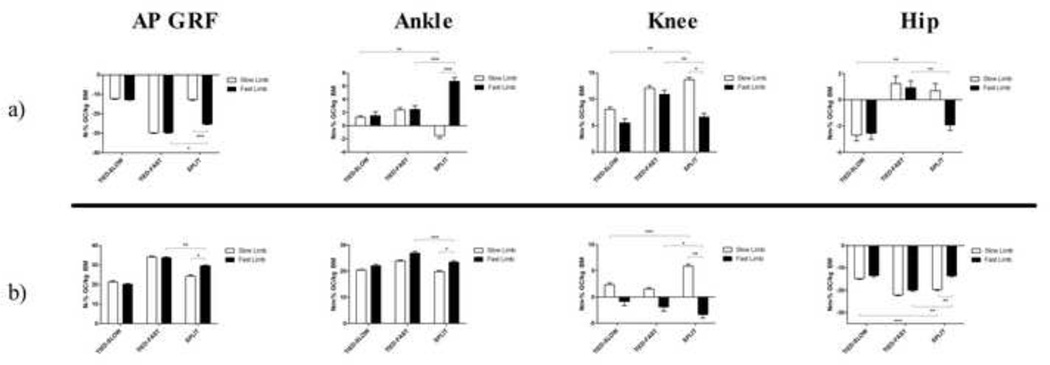
The split-belt treadmill (SBT) has recently been used to rehabilitate locomotor asymmetries in clinical populations. However, the joint mechanics produced while walking on a SBT are not well-understood. The purpose of this study was to investigate the lower extremity sagittal joint moment patterns produced by each limb during SBT walking and provide insight as to how these joint moment patterns may be useful in rehabilitating unilateral gait deficits. Thirteen healthy young volunteers walked on the SBT with the belts tied and in a "SPLIT" session in which one belt moved twice as fast as the other. Sagittal lower extremity joint moment and ground reaction force impulses were then calculated over the braking and propulsive phases of the gait cycle. Paired t-tests were performed to analyze magnitude differences between conditions (i.e. the fast and slow limbs during SPLIT vs. the same limb during tied-belt walking) and between the fast and slow limbs during SPLIT. During the SPLIT session, the fast limb produced higher ground reaction force and ankle moment impulses during the propulsive and braking phases, and lower knee moment impulses during the propulsive phase when compared to the slow limb. The knee moment impulse was also significantly higher during braking in the slow limb than in the fast limb. The mechanics of each limb during the SPLIT session also differed from the mechanics observed when the belt speeds were tied. Based on these findings, we suggest that each belt may have intrinsic value in rehabilitating specific unilateral locomotor deficits.
分割带跑步机(SBT)最近已被用于康复临床人群的运动不对称性。然而,在 SBT 上行走时产生的关节力学尚不清楚。本研究的目的是研究 SBT 行走时每条肢体产生的下肢矢状面关节力矩模式,并深入了解这些关节力矩模式如何在矫正单侧步态缺陷中发挥作用。13 名健康年轻志愿者在 SBT 上行走,系紧安全带,并在“SPLIT”会议上,一条安全带的速度是另一条安全带的两倍。然后计算步态周期的制动和推进阶段的矢状下肢关节力矩和地面反作用力冲量。进行配对 t 检验以分析条件之间的幅度差异(即 SPLIT 期间的快腿和慢腿与系紧安全带行走期间的相同腿之间)以及 SPLIT 期间的快腿和慢腿之间的差异。在 SPLIT 期间,与慢腿相比,快腿在推进和制动阶段产生更高的地面反作用力和踝关节力矩冲量,在推进阶段产生更低的膝关节力矩冲量。在慢腿的制动阶段,膝关节力矩冲量也明显高于快腿。SPLIT 期间每条腿的力学也与系紧安全带时观察到的力学不同。基于这些发现,我们建议每个安全带在矫正特定的单侧运动缺陷方面可能具有内在价值。