Department of Pharmaceutical Analysis and Drug Metabolism, College of Pharmaceutical Sciences, Zhejiang University, 866 Yuhangtang Road, Hangzhou 310058, China.
Fitoterapia. 2012 Dec;83(8):1616-22. doi: 10.1016/j.fitote.2012.09.011. Epub 2012 Sep 20.
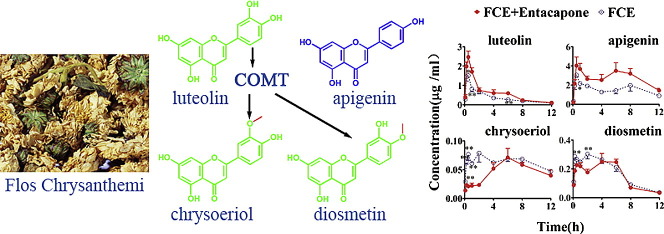
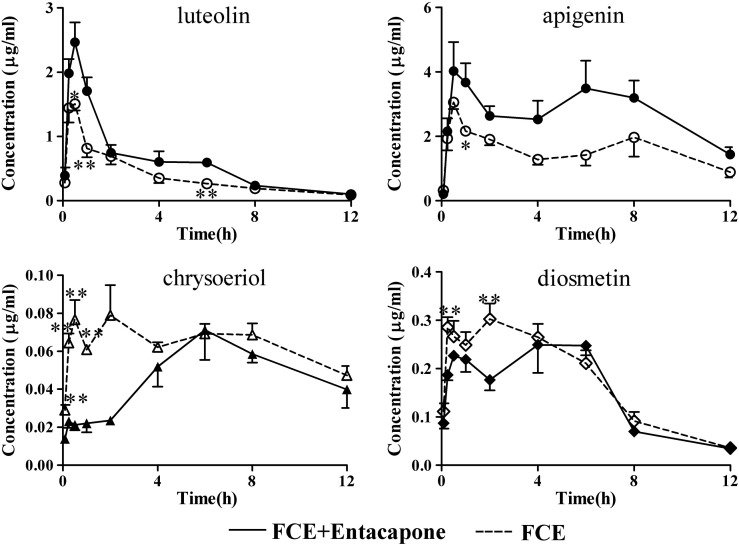
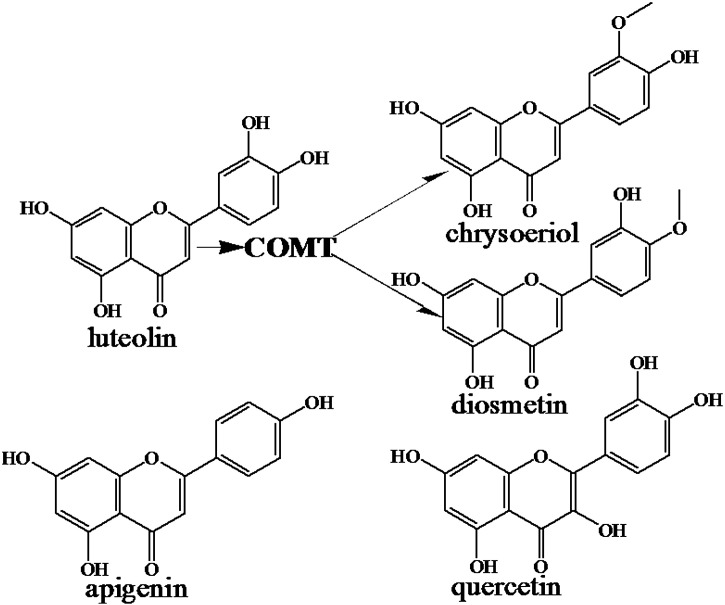
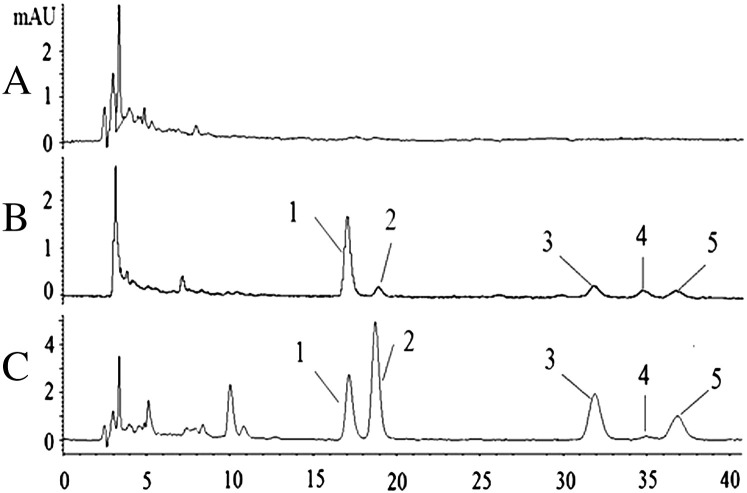
Flos Chrysanthemi (the flower of Chrysanthemum morifolium Ramat.) is widely used in China as a food and traditional Chinese medicine for many diseases. Luteolin and apigenin are two main bioactive components in Flos Chrysanthemi, and chrysoeriol and diosmetin are two methylated metabolites of luteolin in vivo by cathechol-O-methyltransferase (COMT). However, there was lack of pharmacokinetic information of chrysoeriol and diosmetin after oral administration of Flos Chrysanthemi extract (FCE). The present study aimed to develop an HPLC-UV method for simultaneous determination of rat plasma concentration of luteolin, apigenin, chrysoeriol and diosmetin and utilize it in pharmacokinetic study of the four compounds after orally giving FCE to rats. The method was successfully validated and applied to the pharmacokinetic study when oral administration of FCE to rats with or without co-giving a COMT inhibitor, entacapone. Chrysoeriol and diosmetin were detected in rat plasma after oral administration of FCE and their concentrations were significantly decreased after co-giving entacapone. Furthermore, AUC of luteolin was significantly increased by entacapone, while that of chrysoeriol was decreased by entacapone, which revealed COMT might play an important role in the disposition of luteolin in rats after dosing of FCE. In conclusion, a sensitive, accurate and reproducible HPLC-UV method for simultaneous determination of luteolin, apigenin, chrysoeriol and diosmetin in rat plasma were developed, pharmacokinetics of chrysoeriol and diosmetin combined with luteolin and apigenin were characterized after oral administration of FCE to rats, which gave us more information on pharmacokinetics and potential pharmacological effects of FCE in vivo.
菊花(Chrysanthemum morifolium Ramat.)的花在我国被广泛用作食品和传统中药,用于治疗多种疾病。木犀草素和芹菜素是菊花中的两种主要生物活性成分,香叶木素和芫荽乙素是体内儿茶酚-O-甲基转移酶(COMT)催化木犀草素甲基化的两种代谢产物。然而,菊花提取物(FCE)口服给药后香叶木素和芫荽乙素的药代动力学信息尚缺乏。本研究旨在建立一种同时测定大鼠血浆中木樨草素、芹菜素、香叶木素和芫荽乙素浓度的 HPLC-UV 方法,并将其应用于 FCE 灌胃给药后这四种化合物的药代动力学研究。该方法经过验证后成功应用于 FCE 灌胃给药大鼠和同时给予 COMT 抑制剂恩他卡朋时大鼠的药代动力学研究。在 FCE 灌胃给药后,大鼠血浆中检测到香叶木素和芫荽乙素,且同时给予恩他卡朋后其浓度明显降低。此外,恩他卡朋使木樨草素的 AUC 显著增加,而香叶木素的 AUC 降低,这表明 COMT 可能在 FCE 给药后大鼠体内木樨草素的处置中发挥重要作用。总之,建立了一种灵敏、准确、重现性好的同时测定大鼠血浆中木樨草素、芹菜素、香叶木素和芫荽乙素的 HPLC-UV 方法,研究了 FCE 灌胃给药后这四种化合物的药代动力学特征,为 FCE 体内药代动力学和潜在药理作用提供了更多信息。