Empa, Swiss Federal Laboratories for Materials Science and Technology, Laboratory for Biomaterials, CH-9014, St, Gallen, Switzerland.
BMC Biotechnol. 2012 Sep 24;12:67. doi: 10.1186/1472-6750-12-67.
Protein glycosylation is of fundamental importance in many biological systems. The discovery of N-glycosylation in bacteria and the functional expression of the N-oligosaccharyltransferase PglB of Campylobacter jejuni in Escherichia coli enabled the production of engineered glycoproteins and the study of the underlying molecular mechanisms. A particularly promising application for protein glycosylation in recombinant bacteria is the production of potent conjugate vaccines where polysaccharide antigens of pathogenic bacteria are covalently bound to immunogenic carrier proteins.
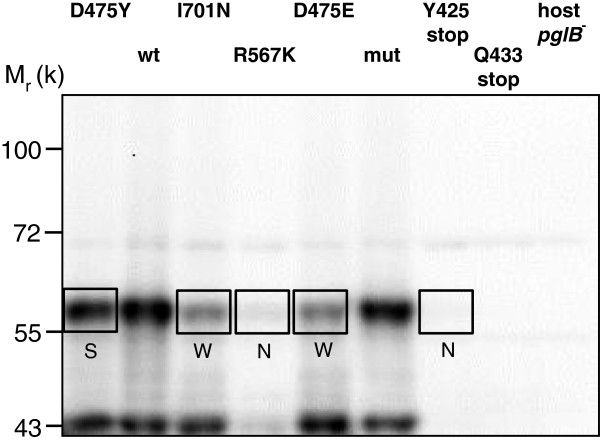
In this study capsular polysaccharides of the clinically relevant pathogen Staphylococcus aureus serotype 5 (CP5) were expressed in Escherichia coli and linked in vivo to a detoxified version of Pseudomonas aeruginosa exotoxin (EPA). We investigated which amino acids of the periplasmic domain of PglB are crucial for the glycosylation reaction using a newly established 96-well screening system enabling the relative quantification of glycoproteins by enzyme-linked immunosorbent assay. A random mutant library was generated by error-prone PCR and screened for inactivating amino acid substitutions. In addition to 15 inactive variants with amino acid changes within the previously known, strictly conserved WWDYG motif of N-oligosaccharyltransferases, 8 inactivating mutations mapped to a flexible loop in close vicinity of the amide nitrogen atom of the acceptor asparagine as revealed in the crystal structure of the homologous enzyme C. lari PglB. The importance of the conserved loop residue H479 for glycosylation was confirmed by site directed mutagenesis, while a change to alanine of the adjacent, non-conserved L480 had no effect. In addition, we investigated functional requirements in the so-called MIV motif of bacterial N-oligosaccharyltransferases. Amino acid residues I571 and V575, which had been postulated to interact with the acceptor peptide, were subjected to cassette saturation mutagenesis. With the exception of I571C only hydrophobic residues were found in active variants. Variant I571V performed equally well as the wild type, cysteine at the same position reduced glycoprotein yield slightly, while a change to phenylalanine reduced activity by a factor of three.
This study provides novel structure-function relationships for the periplasmic domain of the Campylobacter jejuni N-oligosaccharyltransferase PglB and describes procedures for generating and screening oligosaccharyltransferase mutant libraries in an engineered E. coli system.
蛋白质糖基化在许多生物系统中具有重要意义。在细菌中发现 N-糖基化,并在大肠杆菌中功能性表达空肠弯曲菌的 N-寡糖基转移酶 PglB,这使得工程糖蛋白的生产和潜在分子机制的研究成为可能。在重组细菌中,蛋白质糖基化的一个特别有前景的应用是生产有效的结合疫苗,其中致病菌的多糖抗原与免疫原性载体蛋白共价结合。
在这项研究中,临床相关病原体金黄色葡萄球菌血清型 5 的荚膜多糖(CP5)在大肠杆菌中表达,并与铜绿假单胞菌外毒素(EPA)的解毒版本在体内连接。我们使用新建立的 96 孔筛选系统,通过酶联免疫吸附试验相对定量糖蛋白,研究了 PglB 周质域中的哪些氨基酸对糖基化反应至关重要。通过易错 PCR 生成随机突变文库,并筛选失活的氨基酸取代。除了在 N-寡糖基转移酶严格保守的 WWDYG 基序内发生氨基酸变化的 15 个无活性变体外,8 个失活突变映射到与受体质子化天冬酰胺酰胺氮原子紧密相邻的柔性环中,这在同源酶 C.lari PglB 的晶体结构中得到揭示。晶体结构。保守环残基 H479 对糖基化的重要性通过定点诱变得到证实,而相邻非保守残基 L480 突变为丙氨酸则没有影响。此外,我们研究了细菌 N-寡糖基转移酶中所谓的 MIV 基序的功能要求。假定与受体肽相互作用的氨基酸残基 I571 和 V575 进行了盒式饱和诱变。除了 I571C 之外,在活性变体中仅发现了疏水性残基。变体 I571V 的性能与野生型相当,同一位置的半胱氨酸略微降低糖蛋白产量,而突变为苯丙氨酸则使活性降低三倍。
本研究为空肠弯曲菌 N-寡糖基转移酶 PglB 的周质域提供了新的结构-功能关系,并描述了在工程大肠杆菌系统中生成和筛选寡糖基转移酶突变文库的程序。