Department of Maxillofacial Diagnostic Science, Division of Pathology, Kanagawa Dental College, 82 Inaoka-cho, Yokosuka, Kanagawa 238-8580, Japan ; Research Institute of Salivary Gland and Health Medicine, Kanagawa Dental College, 82 Inaoka-cho, Yokosuka, Kanagawa 238-8580, Japan.
Acta Histochem Cytochem. 2012 Aug 30;45(4):211-8. doi: 10.1267/ahc.12005. Epub 2012 Jun 30.
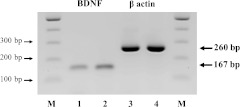
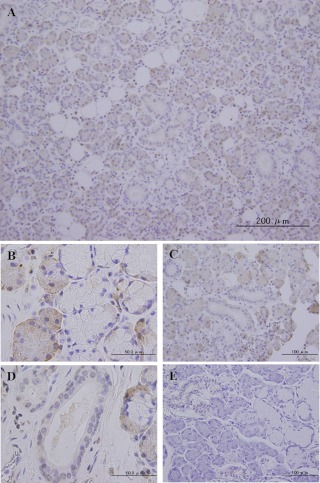
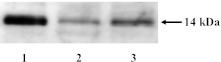
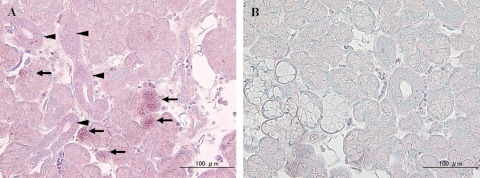
Brain-derived neurotrophic factor (BDNF) promotes cell survival and differentiation in the central and peripheral nervous systems. Previously, we reported that BDNF is produced by salivary glands under acute immobilization stress in rats. However, expression of BDNF is poorly understood in humans, although salivary gland localization of BDNF in rodents has been demonstrated. In the present study, we investigated the expression and localization of BDNF in the human submandibular gland (HSG) using reverse transcription-polymerase chain reaction, western blot analysis, in situ hybridization (ISH), immunohistochemistry (IHC), and ELISA. BDNF was consistently localized in HSG serous and ductal cells, as detected by ISH and IHC, with reactivity being stronger in serous cells. In addition, immunoreactivity for BDNF was observed in the saliva matrix of ductal cavities. Western blotting detected one significant immunoreactive 14 kDa band in the HSG and saliva. Immunoreactivities for salivary BDNF measured by ELISA in humans were 40.76±4.83 pg/mL and 52.64±8.42 pg/mL, in men and women, respectively. Although salivary BDNF concentrations in females tended to be higher than in males, the concentrations were not significantly different. In conclusion, human salivary BDNF may originate from salivary glands, as the HSG appears to produce BDNF.
脑源性神经营养因子(BDNF)促进中枢和周围神经系统中的细胞存活和分化。此前,我们报道了 BDNF 是在大鼠急性束缚应激下由唾液腺产生的。然而,尽管已经在啮齿动物中证明了 BDNF 存在于唾液腺中,但人类 BDNF 的表达仍知之甚少。在本研究中,我们使用逆转录-聚合酶链反应(RT-PCR)、western blot 分析、原位杂交(ISH)、免疫组织化学(IHC)和 ELISA 来研究 BDNF 在人下颌下腺(HSG)中的表达和定位。ISH 和 IHC 检测到 BDNF 始终定位于 HSG 的浆液细胞和导管细胞中,浆液细胞中的反应性更强。此外,在导管腔的唾液基质中观察到 BDNF 的免疫反应性。western blot 在 HSG 和唾液中检测到一个明显的 14 kDa 免疫反应性条带。ELISA 测定的人类唾液 BDNF 免疫反应性分别为 40.76±4.83 pg/mL 和 52.64±8.42 pg/mL,分别为男性和女性。尽管女性的唾液 BDNF 浓度似乎高于男性,但浓度无显著差异。总之,人唾液 BDNF 可能来源于唾液腺,因为 HSG 似乎产生 BDNF。