Enteric Neuroscience Program, Division of Gastroenterology and Hepatology, Department of Physiology and Biomedical Engineering, Mayo Clinic, Rochester, MN, USA.
Channels (Austin). 2012 Nov-Dec;6(6):457-62. doi: 10.4161/chan.22017. Epub 2012 Sep 27.
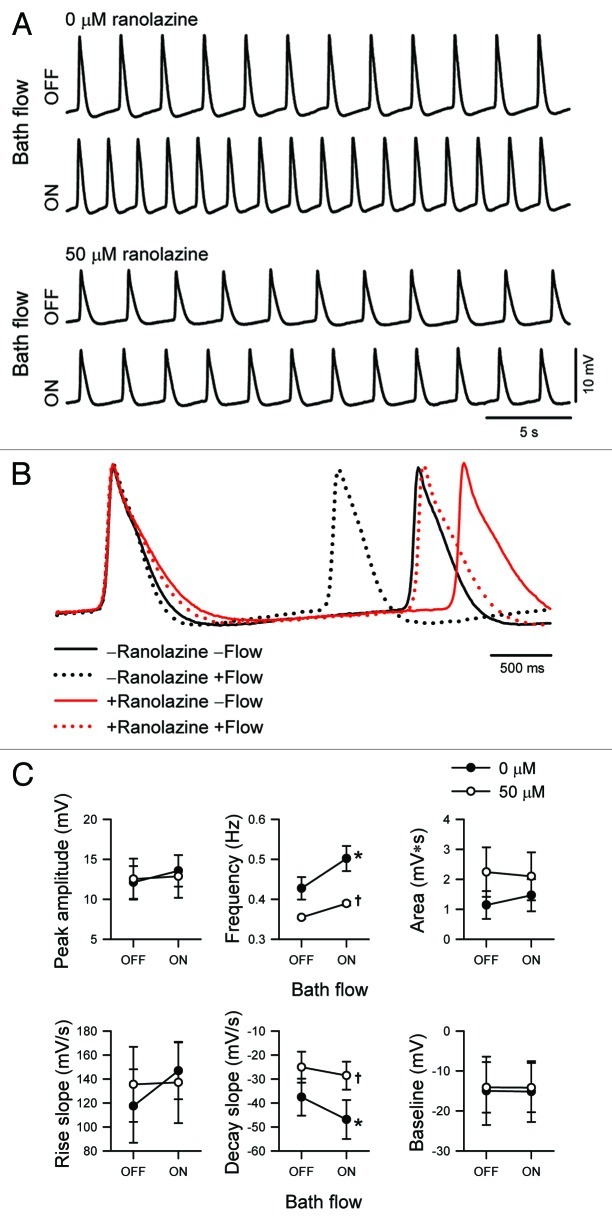
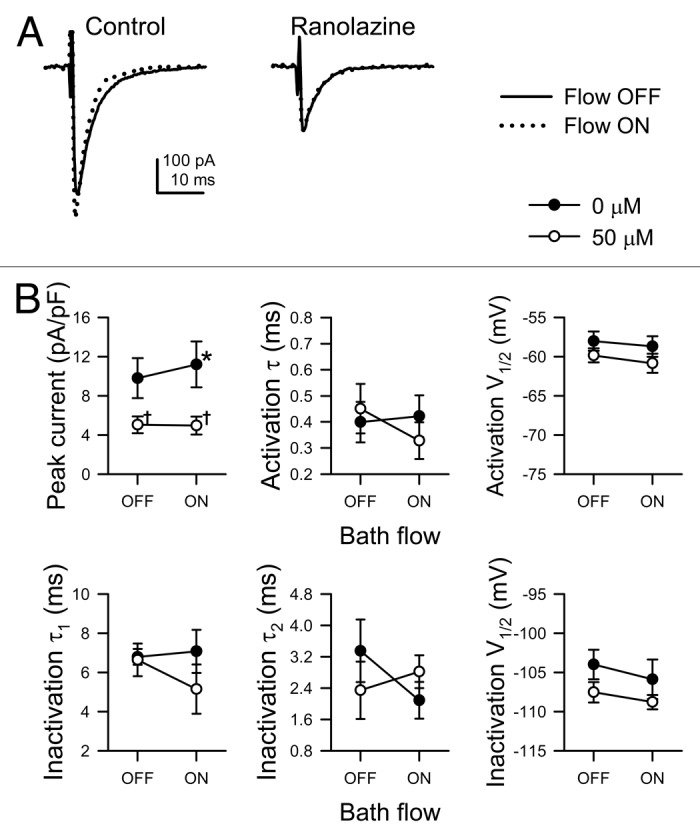
Na(V)1.5 is a mechanosensitive voltage-gated Na(+) channel encoded by the gene SCN5A, expressed in cardiac myocytes and required for phase 0 of the cardiac action potential (AP). In the cardiomyocyte, ranolazine inhibits depolarizing Na(+) current and delayed rectifier (I(Kr)) currents. Recently, ranolazine was also shown to be an inhibitor of Na(V)1.5 mechanosensitivity. Stretch also accelerates the firing frequency of the SA node, and fluid shear stress increases the beating rate of cultured cardiomyocytes in vitro. However, no cultured cell platform exists currently for examination of spontaneous electrical activity in response to mechanical stimulation. In the present study, flow of solution over atrial myocyte-derived HL-1 cultured cells was used to study shear stress mechanosensitivity of Na(+) current and spontaneous, endogenous rhythmic action potentials. In voltage-clamped HL-1 cells, bath flow increased peak Na(+) current by 14 ± 5%. In current-clamped cells, bath flow increased the frequency and decay rate of AP by 27 ± 12% and 18 ± 4%, respectively. Ranolazine blocked both responses to shear stress. This study suggests that cultured HL-1 cells are a viable in vitro model for detailed study of the effects of mechanical stimulation on spontaneous cardiac action potentials. Inhibition of the frequency and decay rate of action potentials in HL-1 cells are potential mechanisms behind the antiarrhythmic effect of ranolazine.
钠通道 1.5(Na(V)1.5)是一种由 SCN5A 基因编码的机械敏感性电压门控钠离子通道,在心肌细胞中表达,是心脏动作电位(AP)0 相所必需的。在心肌细胞中,雷诺嗪抑制去极化钠离子电流和延迟整流钾电流(I(Kr))。最近,雷诺嗪也被证明是 Na(V)1.5 机械敏感性的抑制剂。伸展还会加速窦房结的点火频率,流体切应力增加体外培养心肌细胞的搏动率。然而,目前没有培养细胞平台可用于检查对机械刺激的自发电活动。在本研究中,使用溶液流过心房肌源性 HL-1 培养细胞来研究钠离子电流和自发的、内源性节律性动作电位的切应力机械敏感性。在电压钳制的 HL-1 细胞中,浴流增加了峰值钠离子电流 14±5%。在电流钳制细胞中,浴流分别增加了 AP 的频率和衰减率 27±12%和 18±4%。雷诺嗪阻断了这两种对切应力的反应。这项研究表明,培养的 HL-1 细胞是研究机械刺激对自发性心脏动作电位影响的可行体外模型。HL-1 细胞中动作电位的频率和衰减率的抑制是雷诺嗪抗心律失常作用的潜在机制。