Centre for Psycho-oncology Research and Teaching, School of Public Health, The University of Hong Kong, Hong Kong, People's Republic of China.
PLoS One. 2012;7(9):e44022. doi: 10.1371/journal.pone.0044022. Epub 2012 Sep 18.
This secondary longitudinal analysis describes distinct quality of life trajectories during eight months of radiation therapy (RT) among patients with nasopharyngeal cancer (NPC) and examines factors differentiating these trajectories.
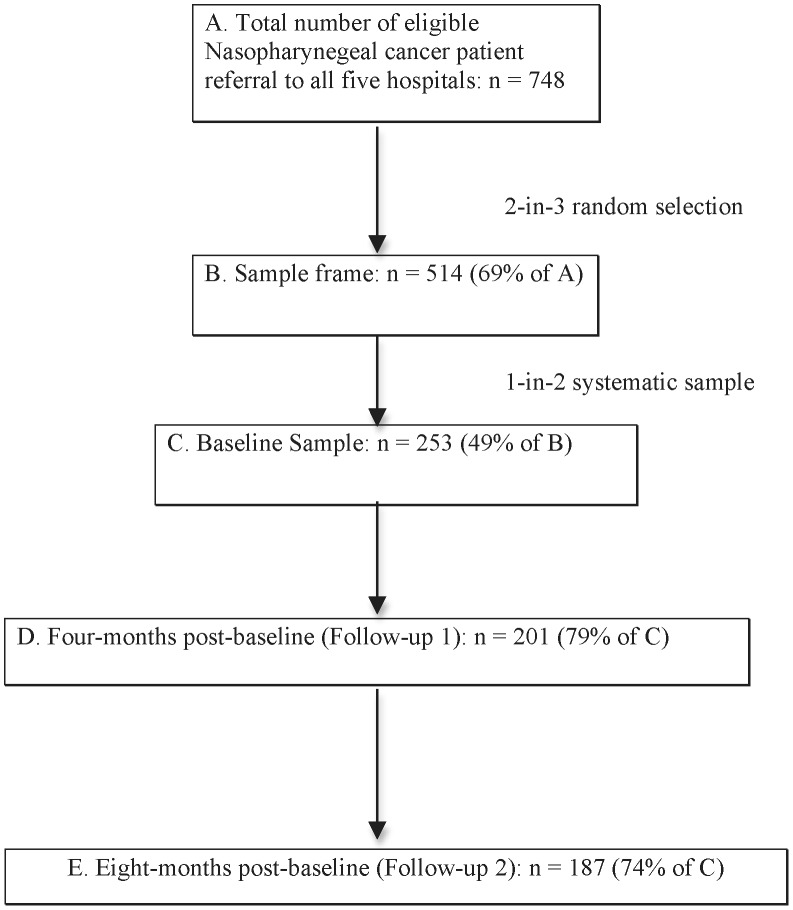
253 Chinese patients with NPC scheduled for RT were assessed at pre-treatment, and 4 months and 8 months later on QoL (Chinese version of the FACT-G), optimism, pain, eating function, and patient satisfaction. Latent growth mixture modelling identified different trajectories within each of four QoL domains: Physical, Emotional, Social/family, and Functional well-being. Multinomial logistic regression compared optimism, pain, eating function, and patient satisfaction by trajectories adjusted for demographic and medical characteristics.
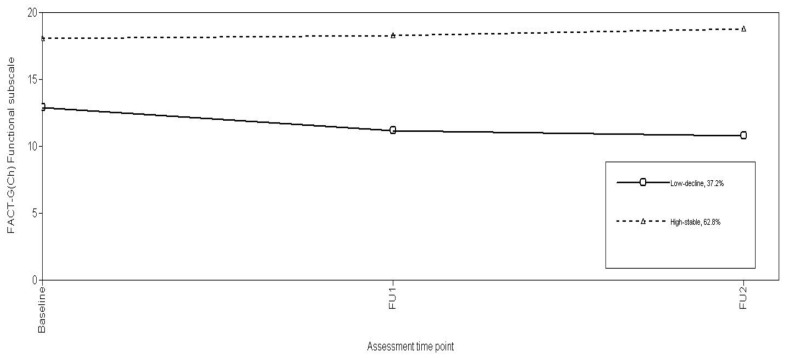
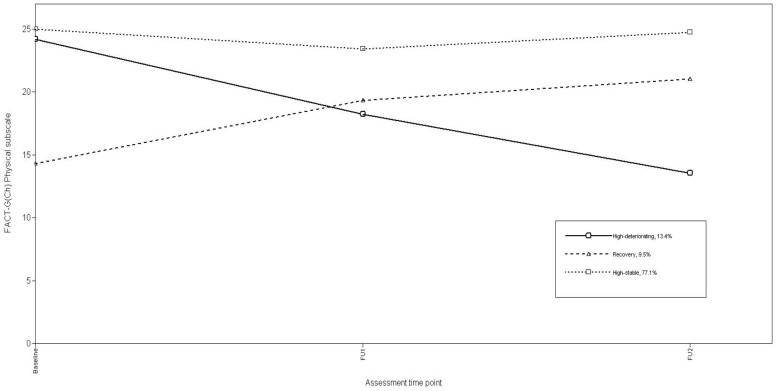
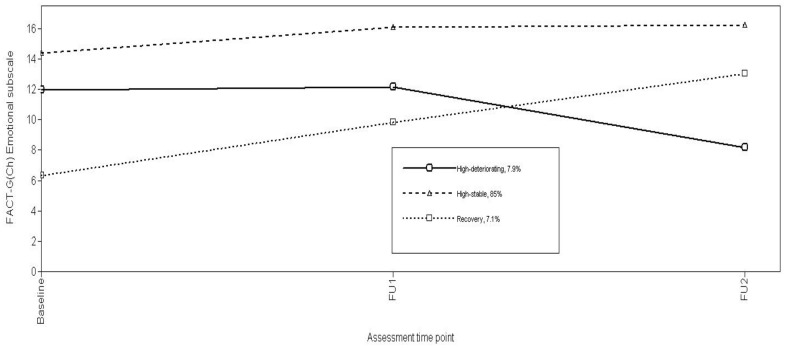
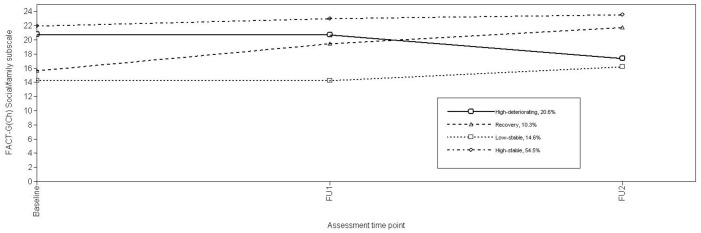
We identified three distinct trajectories for physical and emotional QoL domains, four trajectories for social/family, and two trajectories for functional domains. Within each domain most patients (physical (77%), emotional (85%), social/family (55%) and functional (63%)) experienced relatively stable high levels of well-being over the 8-month period. Different Physical trajectory patterns were predicted by pain and optimism, whereas for Emotion-domain trajectories pain, optimism, eating enjoyment, patient satisfaction with information, and gender were predictive. Age, appetite, optimism, martial status, and household income predicted Social/family trajectories; household income, eating enjoyment, optimism, and patient satisfaction with information predicted Functional trajectories.
Most patients with NPC showed high stable QoL during radiotherapy. Optimism predicted good QoL. Symptom impacts varied by QoL domain. Information satisfaction was protective in emotional and functional well-being, reflecting the importance in helping patients to establish a realistic expectation of treatment impacts.
本二次纵向分析描述了鼻咽癌(NPC)患者在接受放射治疗(RT)的八个月期间生活质量的不同轨迹,并探讨了区分这些轨迹的因素。
253 名计划接受 RT 的中国 NPC 患者在治疗前、治疗 4 个月和 8 个月时分别进行生活质量(FACT-G 中文版)、乐观主义、疼痛、进食功能和患者满意度评估。潜在增长混合模型在四个生活质量领域(身体、情感、社会/家庭和功能幸福感)内确定了不同的轨迹。通过调整人口统计学和医疗特征的轨迹,对乐观主义、疼痛、进食功能和患者满意度进行多项逻辑回归比较。
我们确定了身体和情感生活质量领域的三个不同轨迹、社会/家庭领域的四个轨迹和功能领域的两个轨迹。在每个领域,大多数患者(身体(77%)、情感(85%)、社会/家庭(55%)和功能(63%))在 8 个月的治疗期间经历了相对稳定的高水平幸福感。身体轨迹模式由疼痛和乐观主义预测,而情绪域轨迹由疼痛、乐观主义、进食享受、对信息的满意度和性别预测。年龄、食欲、乐观主义、婚姻状况和家庭收入预测社会/家庭轨迹;家庭收入、进食享受、乐观主义和对信息的满意度预测功能轨迹。
大多数 NPC 患者在放射治疗期间表现出较高的稳定生活质量。乐观主义预测良好的生活质量。症状影响因生活质量领域而异。信息满意度在情感和功能幸福感方面具有保护作用,反映了帮助患者建立对治疗影响的现实期望的重要性。