Quantiative Study Group, Faculty of Business Administration, University of New Brunswick, Fredericton, New Brunswick, Canada.
PLoS One. 2012;7(9):e44872. doi: 10.1371/journal.pone.0044872. Epub 2012 Sep 19.
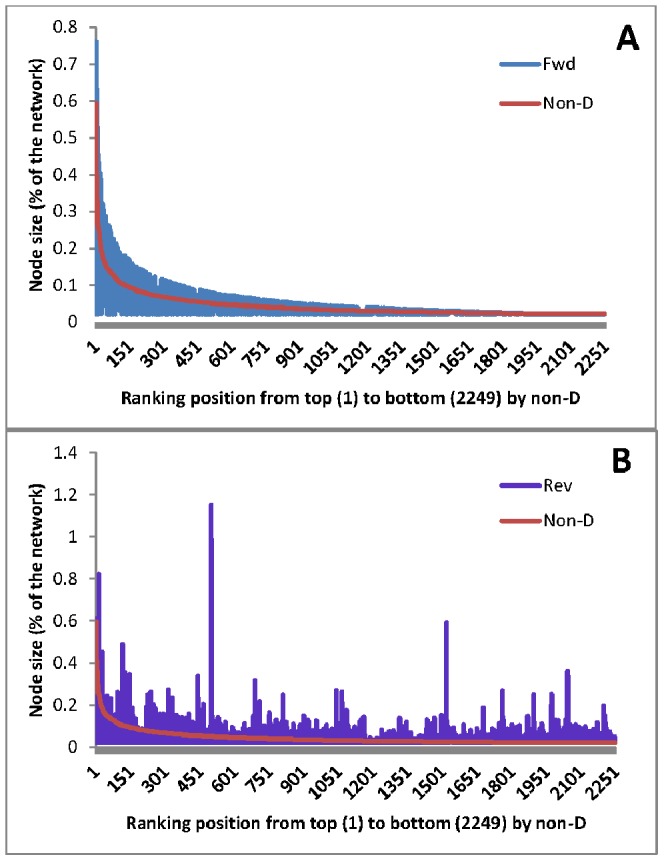
Most protein PageRank studies do not use signal flow direction information in protein interactions because this information was not readily available in large protein databases until recently. Therefore, four questions have yet to be answered: A) What is the general difference between signal emitting and receiving in a protein interactome? B) Which proteins are among the top ranked in directional ranking? C) Are high ranked proteins more evolutionarily conserved than low ranked ones? D) Do proteins with similar ranking tend to have similar subcellular locations? In this study, we address these questions using the forward, reverse, and non-directional PageRank approaches to rank an information-directional network of human proteins and study their evolutionary conservation. The forward ranking gives credit to information receivers, reverse ranking to information emitters, and non-directional ranking mainly to the number of interactions. The protein lists generated by the forward and non-directional rankings are highly correlated, but those by the reverse and non-directional rankings are not. The results suggest that the signal emitting/receiving system is characterized by key-emittings and relatively even receivings in the human protein interactome. Signaling pathway proteins are frequent in top ranked ones. Eight proteins are both informational top emitters and top receivers. Top ranked proteins, except a few species-related novel-function ones, are evolutionarily well conserved. Protein-subunit ranking position reflects subunit function. These results demonstrate the usefulness of different PageRank approaches in characterizing protein networks and provide insights to protein interaction in the cell.
大多数蛋白质 PageRank 研究都没有使用蛋白质相互作用中的信号流方向信息,因为直到最近,这种信息在大型蛋白质数据库中还不容易获得。因此,仍有四个问题有待回答:A)蛋白质相互作用组中信号发射和接收的一般区别是什么?B)在定向排名中哪些蛋白质排名靠前?C)排名较高的蛋白质比排名较低的蛋白质更具进化保守性吗?D)具有相似排名的蛋白质是否倾向于具有相似的亚细胞位置?在这项研究中,我们使用正向、反向和非定向 PageRank 方法对人类蛋白质的信息定向网络进行排名,并研究它们的进化保守性,从而回答了这些问题。正向排名赋予信息接收者以信誉,反向排名赋予信息发送者以信誉,而非定向排名主要赋予交互的数量。正向和非定向排名生成的蛋白质列表高度相关,但反向和非定向排名生成的蛋白质列表则不相关。结果表明,在人类蛋白质相互作用组中,信号发射/接收系统的特点是关键发射者和相对均匀的接收者。信号通路蛋白在排名靠前的蛋白中很常见。有 8 种蛋白质既是信息的主要发射者,也是信息的主要接收者。排名靠前的蛋白质除了少数与物种相关的新功能蛋白质外,在进化上都很好地保存下来。蛋白质亚基排名位置反映了亚基功能。这些结果表明,不同的 PageRank 方法在表征蛋白质网络方面非常有用,并为细胞内的蛋白质相互作用提供了新的见解。