Université Pierre et Marie Curie and CNRS, Developmental Biology Unit, Villefranche-sur-Mer, France.
PLoS One. 2012;7(9):e45431. doi: 10.1371/journal.pone.0045431. Epub 2012 Sep 20.
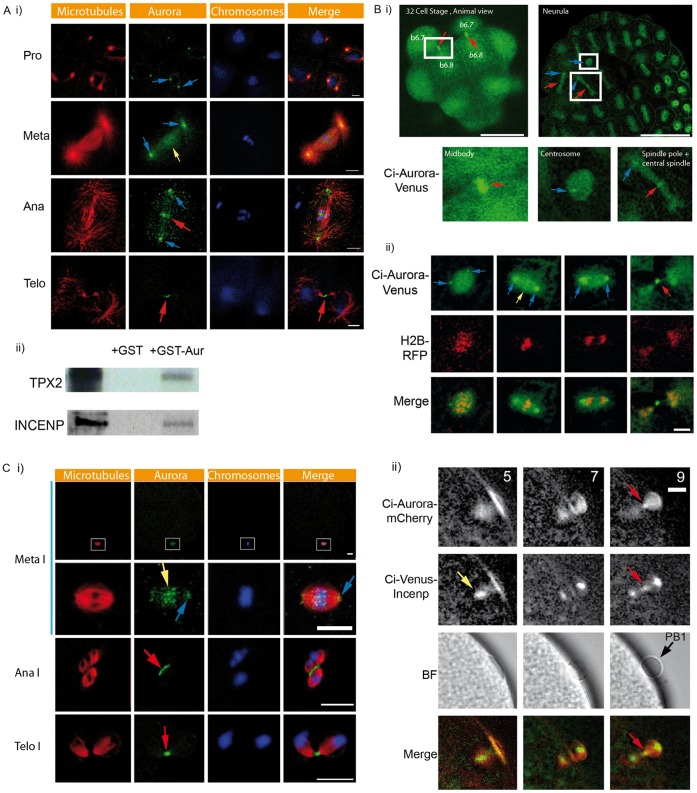
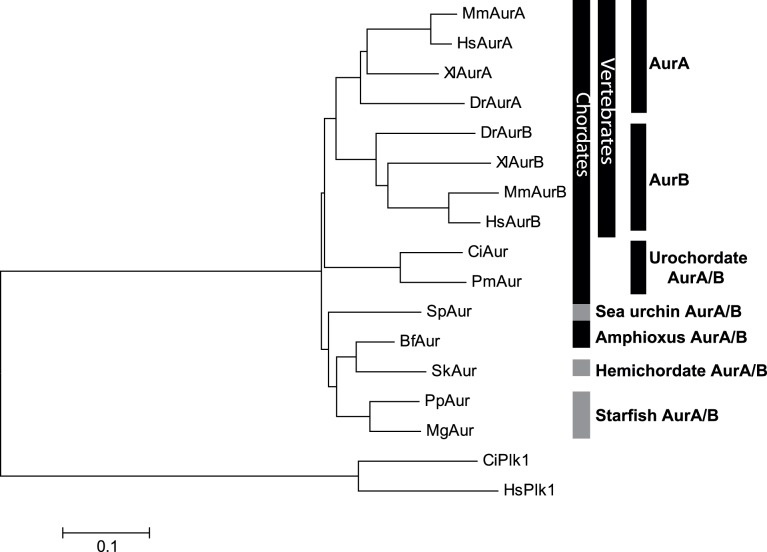
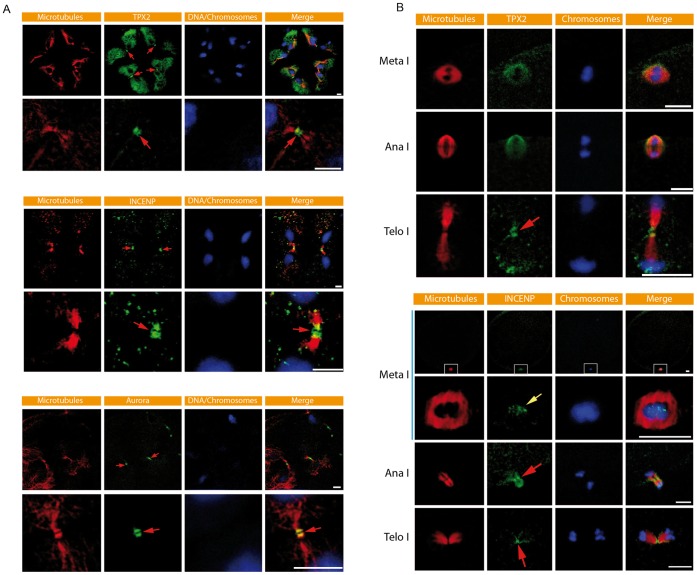
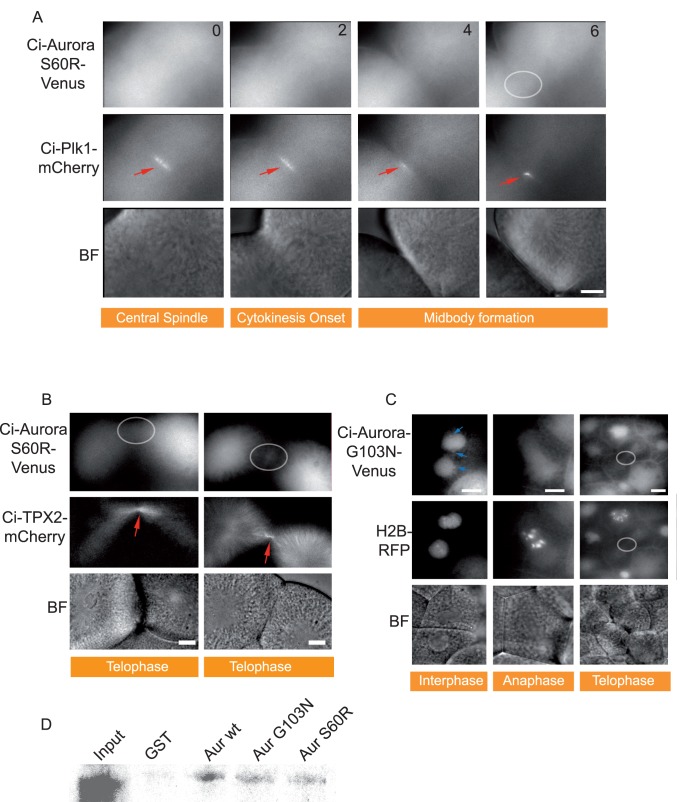
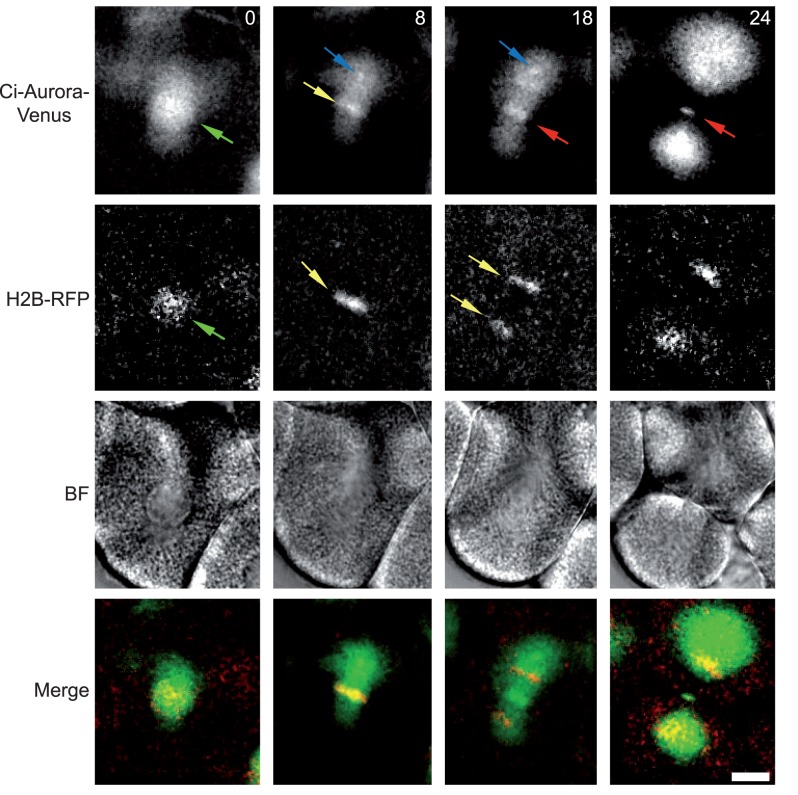
Aurora kinases are key proteins found throughout the eukaryotes that control mitotic progression. Vertebrate Aurora-A and B kinases are thought to have evolved from a single Aurora-kinase isoform closest to that found in present day urochordates. In urochordate ascidians Aurora binds both TPX2 (a vertebrate AURKA partner) and INCENP (a vertebrate AURKB partner) and localizes to centrosomes and spindle microtubules as well as chromosomes and midbody during both meiosis and mitosis. Ascidian Aurora also displays this localization pattern during mitosis in echinoderms, strengthening the idea that non-vertebrate deuterostomes such as the urochordates and echinoderms possess a single form of Aurora kinase that has properties of vertebrate Aurora-kinase A and B. In the ascidian, TPX2 localizes to the centrosome and the spindle poles also as in vertebrates. However, we were surprised to find that TPX2 also localized strongly to the midbody in ascidian eggs and embryos. We thus examined more closely Aurora localization to the midbody by creating two separate point mutations of ascidian Aurora predicted to perturb binding to TPX2. Both forms of mutated Aurora behaved as predicted: neither localized to spindle poles where TPX2 is enriched. Interestingly, neither form of mutated Aurora localized to the midbody where TPX2 is also enriched, suggesting that ascidian Aurora midbody localization required TPX2 binding in ascidians. Functional analysis revealed that inhibition of Aurora kinase with a pharmacological inhibitor or with a dominant negative kinase dead form of Aurora caused cytokinesis failure and perturbed midbody formation during polar body extrusion. Our data support the view that vertebrate Aurora-A and B kinases evolved from a single non-vertebrate deuterostome ancestor. Moreover, since TPX2 localizes to the midbody in ascidian eggs and cleavage stage embryos it may be worthwhile re-assessing whether Aurora A kinase or TPX2 localize to the midbody in eggs and cleavage stage embryos.
极光激酶是真核生物中控制有丝分裂进程的关键蛋白。脊椎动物 Aurora-A 和 B 激酶被认为是从与现存尾索动物最接近的单个 Aurora-激酶同工型进化而来的。在尾索动物海鞘中,Aurora 与 TPX2(脊椎动物 AURKA 伴侣)和 INCENP(脊椎动物 AURKB 伴侣)结合,并在减数分裂和有丝分裂过程中定位于中心体和纺锤体微管以及染色体和中体。海鞘 Aurora 在棘皮动物的有丝分裂中也显示出这种定位模式,这加强了这样一种观点,即无脊椎后口动物(如尾索动物和棘皮动物)拥有一种具有脊椎动物 Aurora 激酶 A 和 B 特性的单一形式 Aurora 激酶。在海鞘中,TPX2 与脊椎动物一样定位于中心体和纺锤体极。然而,我们惊讶地发现,TPX2 也强烈定位于海鞘卵和胚胎的中体。因此,我们通过创建两个单独的海鞘 Aurora 点突变来更仔细地检查 Aurora 向中体的定位,这些突变预测会干扰与 TPX2 的结合。两种形式的突变 Aurora 都表现出预期的行为:都没有定位于富含 TPX2 的纺锤体极。有趣的是,两种形式的突变 Aurora 都没有定位于中体,而中体也富含 TPX2,这表明海鞘 Aurora 中体定位需要 TPX2 在海鞘中的结合。功能分析表明,用药理学抑制剂或显性负性激酶失活形式的 Aurora 抑制 Aurora 激酶会导致胞质分裂失败,并在极体挤出过程中扰乱中体形成。我们的数据支持这样一种观点,即脊椎动物 Aurora-A 和 B 激酶是从一个单一的非脊椎后口动物祖先进化而来的。此外,由于 TPX2 定位于海鞘卵和卵裂期胚胎的中体,因此值得重新评估 Aurora A 激酶或 TPX2 是否定位于卵和卵裂期胚胎的中体。