Sividon Diagnostics GmbH, Nattermannallee 1, 50829, Cologne, Germany.
BMC Cancer. 2012 Oct 5;12:456. doi: 10.1186/1471-2407-12-456.
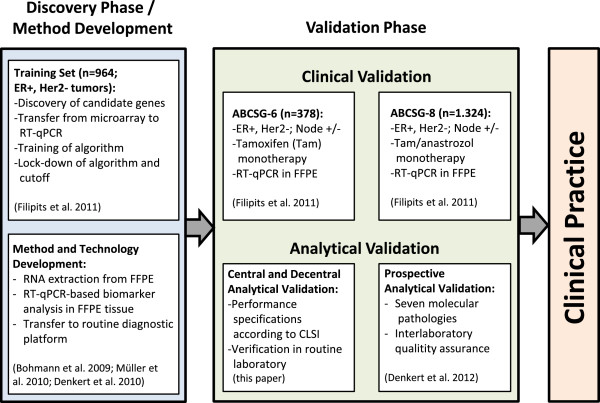
EndoPredict (EP) is a clinically validated multianalyte gene expression test to predict distant metastasis in ER-positive, HER2-negative breast cancer treated with endocrine therapy alone. The test is based on the combined analysis of 12 genes in formalin-fixed, paraffin-embedded (FFPE) tissue by reverse transcription-quantitative real-time PCR (RT-qPCR). Recently, it was shown that EP is feasible for reliable decentralized assessment of gene expression. The aim of this study was the analytical validation of the performance characteristics of the assay and its verification in a molecular-pathological routine laboratory.
Gene expression values to calculate the EP score were assayed by one-step RT-qPCR using RNA from FFPE tumor tissue. Limit of blank, limit of detection, linear range, and PCR efficiency were assessed for each of the 12 PCR assays using serial samples dilutions. Different breast cancer samples were used to evaluate RNA input range, precision and inter-laboratory variability.
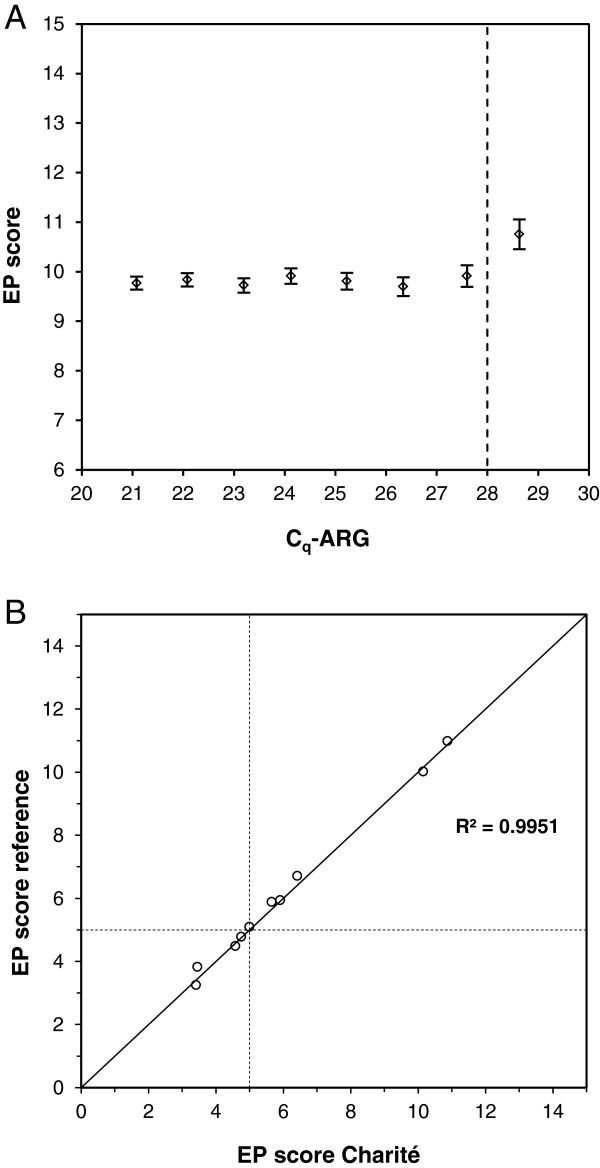
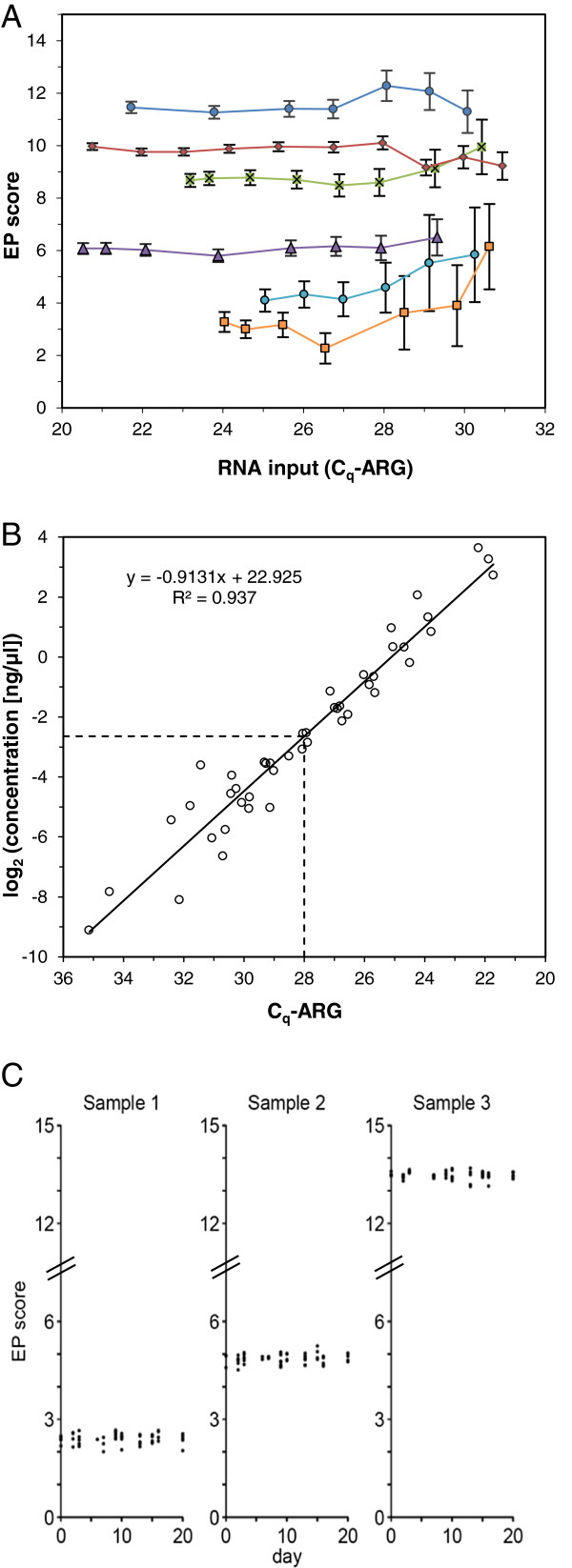
PCR assays were linear up to Cq values between 35.1 and 37.2. Amplification efficiencies ranged from 75% to 101%. The RNA input range without considerable change of the EP score was between 0.16 and 18.5 ng/μl. Analysis of precision (variation of day, day time, instrument, operator, reagent lots) resulted in a total noise (standard deviation) of 0.16 EP score units on a scale from 0 to 15. The major part of the total noise (SD 0.14) was caused by the replicate-to-replicate noise of the PCR assays (repeatability) and was not associated with different operating conditions (reproducibility). Performance characteristics established in the manufacturer's laboratory were verified in a routine molecular pathology laboratory. Comparison of 10 tumor samples analyzed in two different laboratories showed a Pearson coefficient of 0.995 and a mean deviation of 0.15 score units.
The EP test showed reproducible performance characteristics with good precision and negligible laboratory-to-laboratory variation. This study provides further evidence that the EP test is suitable for decentralized testing in specialized molecular pathological laboratories instead of a reference laboratory. This is a unique feature and a technical advance in comparison with existing RNA-based prognostic multigene expression tests.
EndoPredict(EP)是一种经过临床验证的多分析物基因表达测试,用于预测单独接受内分泌治疗的 ER 阳性、HER2 阴性乳腺癌的远处转移。该测试基于对福尔马林固定、石蜡包埋(FFPE)组织中 12 个基因的逆转录定量实时 PCR(RT-qPCR)的联合分析。最近,已经证明 EP 可以可靠地进行分散评估基因表达。本研究的目的是对该测定的性能特征进行分析验证,并在分子病理常规实验室中进行验证。
使用来自 FFPE 肿瘤组织的 RNA,通过一步 RT-qPCR 测定计算 EP 评分的基因表达值。使用系列样本稀释液评估每个 12 个 PCR 检测的空白极限、检测极限、线性范围和 PCR 效率。使用不同的乳腺癌样本评估 RNA 输入范围、精密度和实验室间变异性。
PCR 检测的线性范围在 Cq 值为 35.1 至 37.2 之间。扩增效率范围为 75%至 101%。没有明显改变 EP 评分的 RNA 输入范围在 0.16 至 18.5ng/μl 之间。分析精密度(天、天时间、仪器、操作员、试剂批次的变化)导致在 0 至 15 的范围内产生 0.16 个 EP 评分单位的总噪声(标准偏差)。总噪声(SD 0.14)的主要部分是由 PCR 检测的重复间噪声(重复性)引起的,与不同的操作条件无关(再现性)。在制造商的实验室中建立的性能特征在常规分子病理实验室中得到了验证。比较在两个不同实验室分析的 10 个肿瘤样本,Pearson 系数为 0.995,平均偏差为 0.15 个评分单位。
EP 测试表现出可重复的性能特征,具有良好的精密度和可忽略的实验室间变异性。这项研究进一步证明,EP 测试适合在专门的分子病理实验室进行分散测试,而不是在参考实验室进行。与现有的基于 RNA 的预后多基因表达测试相比,这是一个独特的特征和技术进步。