Type 1 Diabetes Center, The La Jolla Institute for Allergy and Immunology, La Jolla, CA 92037, USA.
APMIS. 2012 Dec;120(12):941-9. doi: 10.1111/apm.12011. Epub 2012 Oct 11.
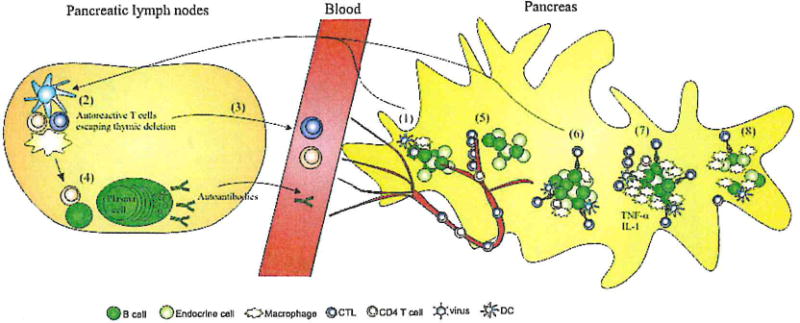
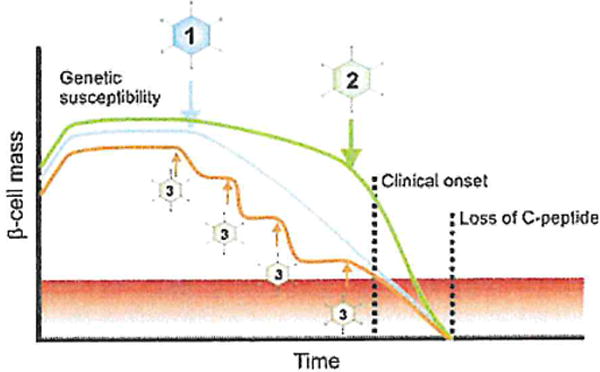
Type 1 diabetes (T1D) is a disease characterized by inflammation of pancreatic islets associated with autoimmunity against insulin-producing beta cells, leading to their progressive destruction. The condition constitutes a significant and worldwide problem to human health, particularly because of its rapid, but thus far unexplained, increase in incidence. Environmental factors such as viral infections are thought to account for this trend. While there is no lack of reports associating viral infections toT1D, it has proven difficult to establish which immunological processes link viral infections to disease onset or progression. One of the commonly discussed pathways is molecular mimicry, a mechanism that encompasses cross-reactive immunity against epitopes shared between viruses and beta cells. In this review, we will take a closer look at mechanistic evidence for a potential role of viruses in T1D, with a special focus on molecular mimicry.
1 型糖尿病(T1D)是一种以胰岛炎症为特征的疾病,其与针对产生胰岛素的β细胞的自身免疫有关,导致β细胞的进行性破坏。这种疾病对人类健康构成了重大的全球性问题,尤其是因为其发病率迅速上升,但目前仍不清楚其原因。人们认为环境因素,如病毒感染,是造成这种趋势的原因。虽然有很多报告将病毒感染与 T1D 联系起来,但要确定哪些免疫过程将病毒感染与疾病的发生或进展联系起来,这一直是个难题。其中一个被广泛讨论的途径是分子模拟,这是一种机制,包括病毒和β细胞之间共享表位的交叉反应性免疫。在这篇综述中,我们将更仔细地研究病毒在 T1D 中可能发挥作用的机制证据,特别关注分子模拟。